

Mapping Ancient Africa: Participants
Since its inception in 2021 the Mapping Ancient Africa (MAA) project has sought to bring together scientists working broadly on past environmental change in Africa. Connections have been forged through online seminars, face-to-face workshops and online platforms. The online aspect of MAA includes a Slack channel for collaborative interactions, pages and posts within the Ecology of the Past scientific blog (which you are currently reading), a YouTube playlist of seminars and interviews, and an email list (containing 147 names at the time of writing, March 2026).
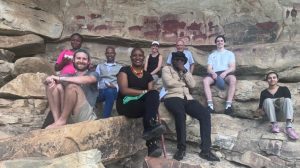
Mapping Ancient Africa: Workshop South Africa (2026)
The Mapping Ancient Afria project organised a research and writing workshop in South Africa (3-6 March 2026). Details of the workshop and the participants can be found by following the below links:
- Research and writing workshop overview and list of participants
- Research student perspective on participationn “From writing to rock art”
- Meet the participants
Mapping Ancient Africa: Workshop Kenya (2024)
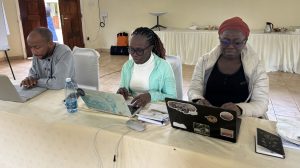
The Mapping Ancient Afria project organised a scientific writing workshop in Kenya (3-6 June 2024). Details of the workshop and the participants can be found by following the below links:
- Writing workshop overview and list of participants
- Videos of sessions from the writing workshop
- Meet the participants (part 1)
- Meet the participants (part 2)
- Meet the instructors
INQUA Rome Mapping Ancient Africa session (2023)
The Mapping Ancient Africa project organised two sessions at the INQUA Rome congress (13-20 July 2023). Details of the speakers and paper presented can be found here.
Read the reports from the session by clicking on the links below:

Rome workshop (2023)
The Rome workshop was attended by 16 participants in-person, a further nine participants were registered but were not able to attend due to a variety of reasons including: non-issue of visas, logistical difficulties, and ill health; people who were not able to attend in-person attendees are indicated in italics. To find out more about the workshop activity click here and follow the links.
| Name | Institute |
| Bahru Zinaye Asegahegn | University of Cologne |
| George Biddulph | University of St Andrews |
| Olugbenga Boboye | University of Ibadan |
| Soléne Boisard | University of Montréal |
| Brain Chase | CNRS: Montpellier |
| Manu Chevalier | University of Bonn |
| Angela Effion | University of the Witwatersrand |
| Jemma Finch | University of KwaZulu-Natal |
| Markus Fischer | University of Potsdam |
| William Gosling | University of Amsterdam |
| Trevor Hill | University of KwaZulu-Natal |
| Busisiwe Hlophe | University of the Witwatersrand |
| Alfred Houngnon | AGIR |
| Aliyu Adamu Isa | Ahmadu Bello University |
| Tom Johnson | University of Massachusetts Amherst |
| Stefanie Kaboth-Bahr | Free University Berlin |
| Rahab Kinyanjui | National Museums of Kenya / Max Planck Institute of Geoanthropology |
| Michela Leonardi | University of Cambridge |
| Husna Mashaka | University of Nairobi |
| Emma Mbua | National Museums of Kenya |
| Aissatou Thiam Ndong | University of Cheikh Diop, Dakar |
| Adisa Ogunfolakan | Leventis Museum of Natural History |
| Alice Paine | University of Oxford |
| Lynne Quick | Nelson Mandela University |
| Mathias Vinnepand | Johannes Gutenberg-University of Mainz |
Kick off meeting (2021)
The kick-off meeting of the Mapping Ancient Africa project was attended by 44 scientists around the world online and at regional hubs.


Original team (2021)
The application to INQUA for the funding to conduct the Mapping Ancient Africa project was supported by 23 scientists from around the world who provid expertise in a wide range of areas (listed below). However, this is not an exclusive list and we hope that during the project we will be joined by many additional researchers who are interested to contribute. So if you are interested to contribute to the project please get in touch.
| Name | Institute | Country | Role |
| Adamu, Aliyu | Ahmadu Bello University | Zaria-Nigeria | Expert in archaeology |
| Asrat, Asfawossen | Addis Ababa University | Ethiopia | Expert in geology and palaeoclimates |
| Bushozi, Pastory | University of Dar es Salaam | Tanzania | Expert in archaeology |
| Chase, Brian | Centre National de la Recherche Scientifique | France | Expert in palaeoclimates |
| Chevalier, Manuel | University of Bonn | Germany | Expert in palaeoclimates and statistics |
| Edwards, Neil | The Open University | UK | Expert in past climate simulation |
| Faith, Tyler | Natural History Museum of Utah | USA | Expert in archaeology and anthropology |
| Finch, Jemma | University of Kwazulu-Natal | South Africa | Expert in palaeoecology |
| Gosling, William | University of Amsterdam | Netherlands | Project leader. Expert in palaeoecology. |
| Holden, Philip | The Open University | UK | Expert in past climate simulation |
| Pargeter, Justin | New York University | USA | Expert in archaeology and anthropology |
| du Plessis, Nadia | University of Cape Town | South Africa | Expert in palaeoecology |
| Stewart, Brian | University of Michigan | USA | Expert in archaeology and anthropology |
| Ivory, Sarah | Penn State University | USA | Coordinator American hub. Expert in palaeoecology |
| Kaboth-Bahr, Stefanie | University of Postdam | Germany | Project leader. Coordinator European hub. Expert in palaeoclimate |
| Kinyanjui, Rahab | National Museum of Kenya | Kenya | Coordinator eastern African hub. Expert palaeovegetation |
| Lejju, Julius | Mbarara University of Science | Uganda | Expert in palaeoecology |
| Muiruri, Veronica | National Museums of Kenya | Kenya | Expert in palaeoecology |
| Ndiema, Emmanuel | National Museums of Kenya | Kenya | Expert in archaeology |
| Quick, Lynne | Nelson Mandela University | South Africa | Coordinator southern African hub. Expert in palaeoecology |
| Raia, Pasquale | University of Naples Federico II | Italy | Expert in palaontology and palaeoecology. |
| Russell, James | Brown University | USA | Expert in palaeoclimate |
| Scerri, Eleanor | Max-Planck-Institute for Science of Human History | Germany | Expert in archaeological science |
 Ecology of the past