
By: Lina Cabrera Sáenz and Bianca Gomes
We invite you to join us on an incredible journey through the heart of Ecuador, where a group of adventurous students from Florida Institute of Technology embarked on a life-changing experience as part of the Neotropical Archaeoecology summer field course. Buckle up as we delve into the marvels of nature, indigenous cultures, and unforgettable experiences. Let’s dive right in!
Unveiling the Andes
Our adventure began with a breath-taking visit to the Paramo at Cayambe-Coca National Park. Paramos are high altitude (3000-4000 metres) wet grasslands above the tree line and below the snow line within the equatorial Andes. Our tour guides Patricio and Byron gave us information about the local vegetation, focusing on the Polylepis tree (locally known as “paper tree”), which is unique to this sort of habitat. They also told us about some of the fascinating wildlife that can be seen here, such as the Andean Bear (Tremarctos ornatus) and the Andean Puma (Puma concolor).
We then descended through the cloud forest (3,600–3,400 meters) and lower montane rainforest (3,400–2,500 meters). Across these various habitats, we documented changes in hummingbird abundance and recorded their behaviour at four different feeder points: Guango Lodge, La Brisa, San Isidro Lodge, and Cascada el Hollin. The sheer diversity of hummingbird species left us in awe, and we marvelled at their iridescent feathers and incredible agility.
We explored a waterfall near San Isidro Lodge (https://cabanasanisidro.com), and we were able to observe pre-Inca pottery. At the lodge we also saw a diverse array of bird species, which was delightful! The forest’s nightlife brought us close encounters with a group of nocturnal monkeys, and to our surprise, we stumbled upon a very rare mountain tapir. The following morning we saw a small agouti (a small rodent) prowling around the lodge, and ended our adventures in the cloud forest on a high note.
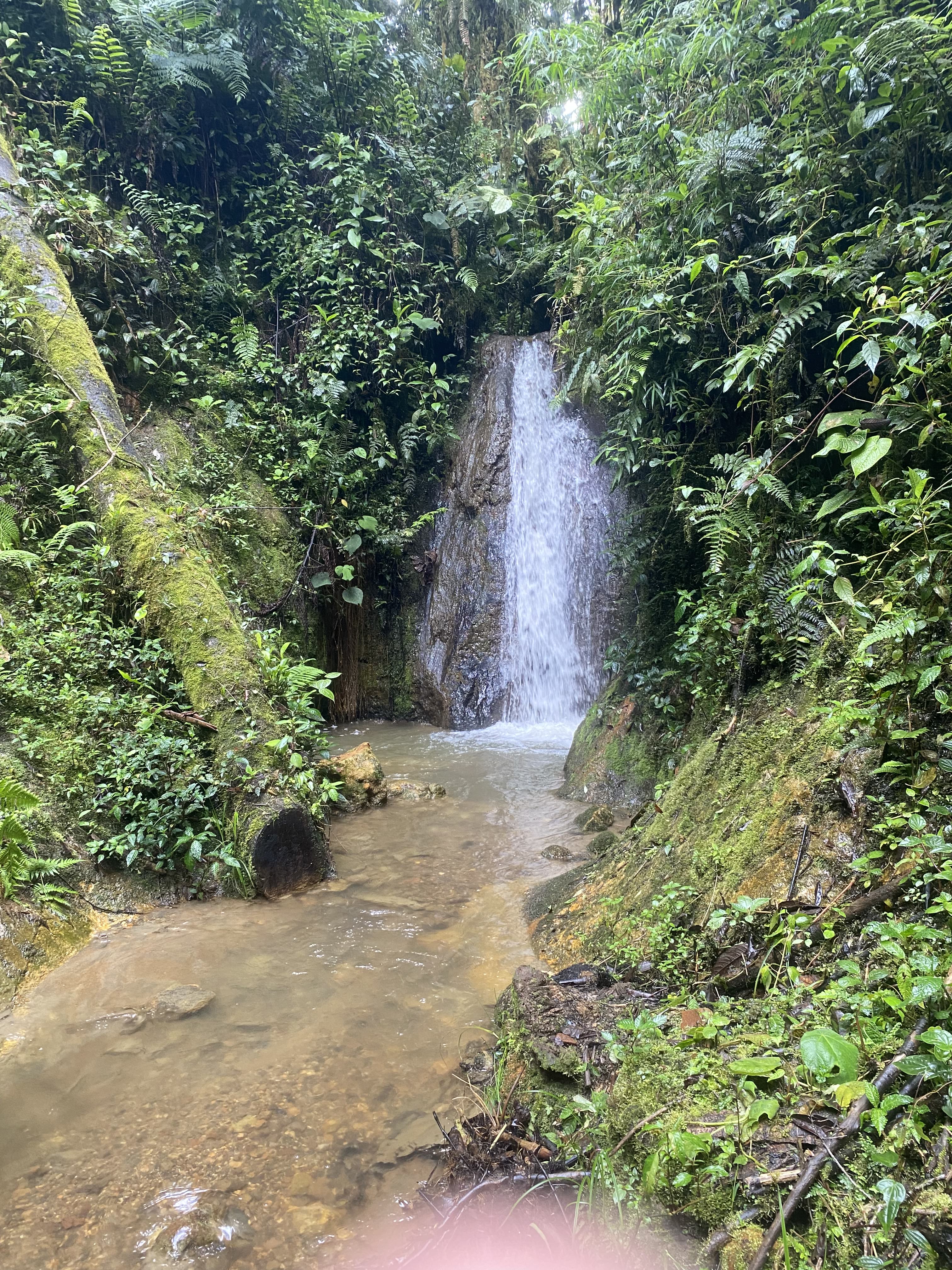


San Isidro waterfall and some of the animal diversity we observed
Exploring the Amazonian rainforest
Our next destination was the Amazon rainforest. Our basecamp, Waita Lodge, not only offered an enchanting setting, but also a mission to protect the land and empower the local communities. The dedication of the lodge’s staff to preserve the forest and support sustainable practices was admirable.
Our time in the Amazon was nothing short of magical. We walked around the terra firme forest, both day and night, guided by experienced locals; Diego and Carlos, who shared their knowledge with us. On these walks, we encountered a stunning array of animals and local plants. Boat rides along the Aguarico and Cuyabeno rivers were amazing. We marvelled at the hidden gems of the rainforest, from playful monkeys swinging through the canopy to graceful caimans gliding through the water. At every turn, nature’s wonders left us speechless.
An important highlight was visiting Zancudococha lake, a research site for paleoecological studies. Bianca Gomes, a member of the Paleolab group at Florida Tech, showed us how to retrieve sediment cores. With this data, Bianca is analysing pollen, charcoal, and phytoliths to reconstruct past ecological changes of this area. After this visit, we prepared ourselves for our camping destination: Lagartococha.
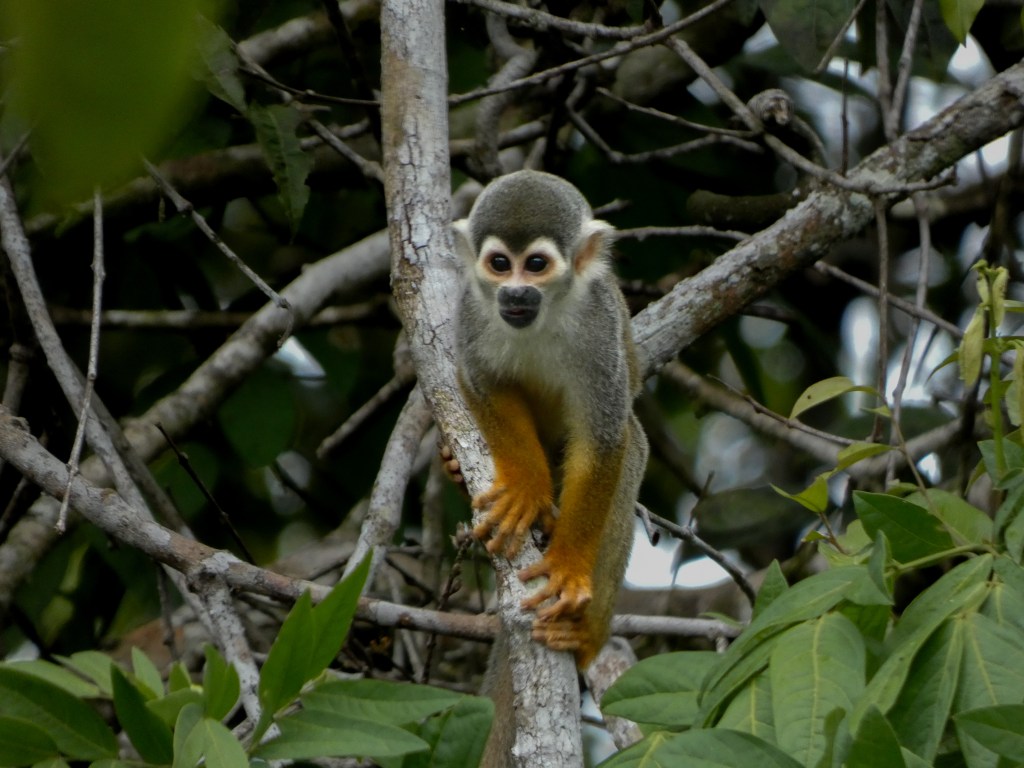
Squirrel monkey (“Bosisi”, in local Paicoca language)
An Immersion in Indigenous Culture of the Siekopai people
Our adventure took a meaningful turn as we ventured into the Peruvian Amazon territory to meet a Siekopai community in “Puerto Estrella.” This warm-hearted community welcomed us with open arms, and we got a firsthand experience of their customs. Together, we prepared traditional delicacies like “A’ ö” and “Piu’ ri” breads using cassava, an essential staple in their diet.
This bread-making process involved several steps, including collecting, washing, grating, and squeezing the cassava using a unique tool called “sënoryo“. Once dried, the cassava was separated using a sifter called “ji’ jepë” and then flattened in pre-heated ceramic pots until it took a circular shape. We relished the delectable bread, enjoying it with “neapia” (a typical spicy sauce) and chocolate, accompanied by traditional drinks like “A’ so cono” (Chicha de yuca) and “Huea cono” (Chicha de maiz). It was an incredible day of cultural exchange and offered us insights into the community’s way of life.
Leaving the Amazon basin left us with mixed emotions as we couldn’t help but notice the various issues plaguing the region. The communities face challenges like monoculture plantations, oil exploitation, land usurpation, burning, deforestation, and violations of indigenous peoples’ rights, which they bravely confront and battle daily.

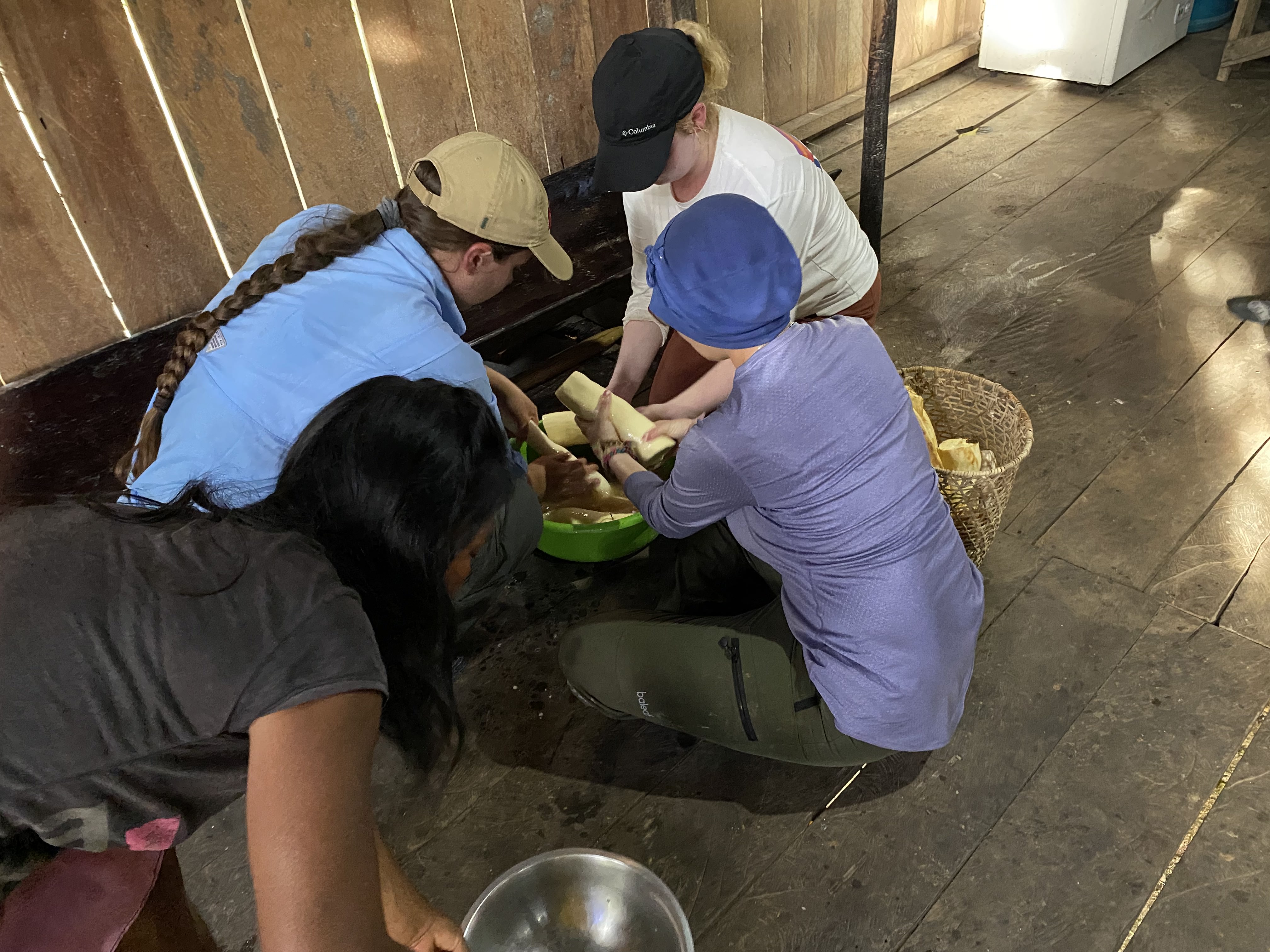

Students learning about “A’ ö” bread preparation with a Siekopai family
Preserving the Highland Heritage
Back in the highlands, we visited the Amarun Pakcha NGO, a sanctuary striving to preserve the life, customs, and forests of the Kichwa indigenous people from the highlands. Eduwin Tanguila, the founder, shared his vision of communitarian ecotourism and the importance of respecting nature. Their commitment to sustainable practices and preserving their environment touched our hearts deeply. Their connection to the land and the belief that everything in nature is alive resonated with us profoundly. The name of the NGO comes from the Kichwa “Amaru”, which means snake, and “Pakcha”, which means waterfall. Based on the beliefs of the wise people, or “Yachak” in Kichwa, the snake is a sacred animal. For them it symbolises “the way to go” or “the route to follow”, and is the animal that safeguard the area and the people that live there.
During our visit, we observed their traditional dances and learnt about the traditional uses of plants, such as the Ayahuasca, Jenjibre, Dunduma, Sillu misi, and Surupanga. Finally, Marcos; the Shaman of the Community performed for us a ritual to ward off the evil spirits.
Donations to Amarun Pakcha NGO can be made at: https://gofund.me/f4abcf4b

Amarun Pakcha NGO entrance
A Glimpse into Ecuador’s Past and Present
As our journey neared its end, our last day was dedicated to understanding the diverse cultures that define Ecuador’s essence. We visited the Pululahua Geobotanical Reserve, where people surprisingly live inside an active volcano crater! The community of San Isidro de Pululahua living here lead a fairly simple lifestyle, dedicating themselves mostly to agriculture. We visited the Intiñan Museum, where artefacts and displays revealed the rich history of this land. Learning about how the Inca communities knew the time of day, their location with respect to the sun, and the harvest seasons. We also learned about the “Equatorial zone” study, and had the opportunity to be part of several fun learning activities at the museum.
The memories of Ecuador’s striking landscapes, cultural treasures, and the warm embrace of its people will forever stay etched in our hearts. We hope you enjoyed this virtual trip with us!
We want to give special thanks to our amazing guides: Patricio Alvarado, Byron Gualavasi, Diego Prado, and Carlos Diaz. The staff that accompanied us during all these days of exploration: Rita, Alexis, Franklin, Marcos Tanguila, Eduwin Tanguila, Carlos Avilez, Carlin Chimbo. And finally, Dr. Mark Bush and Dr. Richard Aronson, supervisors of this trip.

Florida Tech Team at Waita Lodge
 Ecology of the past