
South Africa Research trip (part 2 of 3)
By Jelle Kraak
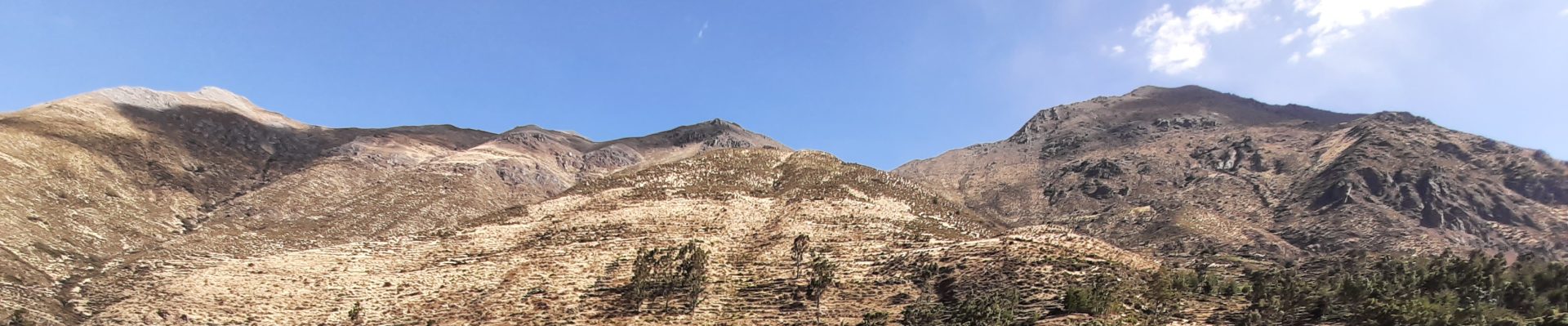
After visiting the SASQUA conference and presenting my work there (see SASQUA Conference post), we travelled to the University of Kwa-Zulu Natal in Pietermaritzburg (UKZN), where I would be staying for three weeks. During this period, my goal was to meet with local experts and to visit my site of study in the Drakensberg mountains. This would help me gain more insight into the environment I’m studying and provide me with an opportunity to collect more samples.

Pietermaritzburg
After the SASQUA congress finished, we flew from Port-Elisabeth to Durban. This would be my first time in one of the highly urbanised parts of South-Africa. We drove about an hour from Durban to Pietermaritzburg, better known locally as PMB, and I immediately noticed the stark difference between the countryside of the Western cape and the urbanised areas of Kwa-Zulu Natal. The city was rough around the edges and felt generally less safe than the laid-back countryside. Luckily, my accommodation was located in one of the better neighbourhoods close to campus. Macho the adorable dog of the AirBnB owners further assured my feeling of safety.
The UKZN
After settling in at my accommodation, I got to work. As stated, one of the main goals of my visit was to chat with local experts. With the help of my supervisors Prof. Dr. Jemma Finch and Prof. Dr. Trevor Hill, I got in contact with the researchers of the Ezemvelo wildlife reserve. These researchers are in charge the fire management in the area surrounding my site of study. Our conversation proved very fruitful, as we managed to introduce our research to the local reserve managers, as well as gather information on the local fire management practices.
Grass collection
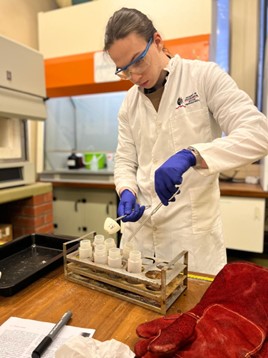
We were not going to travel to the Drakensberg mountains until the last week of my stay, which meant that we had a lot of time to prepare for the fieldwork. This was great, as I could practice lab techniques beforehand so that the processing of acquired samples would proceed smoothly. Our main goal was to collect surface soil samples and plant material of as many grass species as possible. This would enable us to extract phytoliths (amorphous silica particles formed in plant tissues), which may be from the local species, which would help with the interpretation of our future data. In the picture to the right, you can see me intensely focused during one of the phytolith extractions.
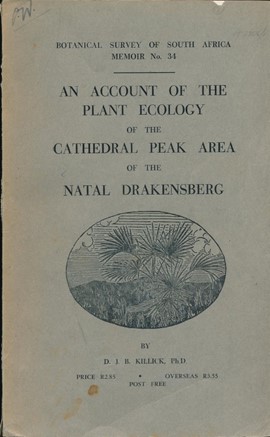
As the days passed, I kept working in the lab. Besides this, I was studying up on the local environment by reading literature such as “An Account Of The Plant Ecology Of The Cathedral Peak Area Of The Natal Drakensberg” written in 1963 by D. J. B. Killick. Although some of the things Killick wrote about have been disproven after years of research, it remains one of the most informative pieces of literature regarding the various types of vegetation in the Drakensberg mountains to this day.
After all the preparations it was finally time to go to Drakensberg, but more on that in the final part of this blog series which will follow soon…
Related posts:
 Ecology of the past
Pingback: Fieldwork in the Drakensberg | Ecology of the past