Just published two articles in a special issue on Gnetales:

Rydin, C. & Hoorn, C. (2016) The Gnetales: past and present. Grana 55, 1-4. DOI: 10.1080/00173134.2015.1118530

Bolinder, K., Norback Ivarsson, L., Humphreys, A.M., Ickert-Bond, S., Han, F., Hoorn, C. & Rydin, C. (2016) Pollen morphology of Ephedra (Gnetales) and its evolutionary implications. Grana 55, 24-51. DOI: 10.1080/00173134.2015.1066424

Published open access:

Hoogakker, B.A.A., Smith, R.S., Singarayer, J.S., Marchant, R., Prentice, I.C., Allen, J.R.M., Anderson, R.S., Bhagwat, S.A., Behling, H., Borisova, O., Bush, M., Correa-Metrio, A., de Vernal, A., Finch, J.M., Frechette, B., Lozano-Garcia, S., Gosling, W.D., Granoszewski, W., Grimm, E.C., Gruger, E., Hanselman, J., Harrison, S.P., Hill, T.R., Huntley, B., Jimenez-Moreno, G., Kershaw, P., Ledru, M.-., Magri, D., McKenzie, M., Muller, U., Nakagawa, T., Novenko, E., Penny, D., Sadori, L., Scott, L., Stevenson, J., Valdes, P.J., Vandergoes, M., Velichko, A., Whitlock, C. & Tzedakis, C. (2016) Terrestrial biosphere changes over the last 120 kyr. Climate of the Past 12, 51-73. DOI: 10.5194/cp-12-51-2016


Online, open access:

McMichael, C., Piperno, D., Neves, E., Bush, M., Almeida, F. & Mongelo, G. (2015) Phytolith assemblages along a gradient of ancient human disturbance in western Amazonia. Frontiers in Ecology and Evolution 3. DOI: 10.3389/fevo.2015.00141

Open access online:

Matthews-Bird, F., Gosling, W.D., Coe, A.L., Bush, M., Mayle, F.E., Axford, Y. & Brooks, S.J. (2015) Environmental controls on the distribution and diversity of lentic Chironomidae (Insecta: Diptera) across an altitudinal gradient in tropical South America. Ecology and Evolution. DOI: 10.1002/ece3.1833


Bermúdez, M.A., Hoorn, C., Bernet, M., Carrillo, E., van der Beek, P.A., Garver, J.I., Mora, J.L. & Mehrkian, K. (2015) The detrital record of late-Miocene to Pliocene surface uplift and exhumation of the Venezuelan Andes in the Maracaibo and Barinas foreland basins. Basin Research. DOI: 10.1111/bre.12154

Open access online:

Flantua, S.G.A., Hooghiemstra, H., Grimm, E.C., Behling, H., Bush, M.B., González-Arango, C., Gosling, W.D., Ledru, M., Lozano-García, S., Maldonado, A., Prieto, A.R., Rull, V. & Van Boxel, J.H. Updated site compilation of the Latin American Pollen Database. Review of Palaeobotany and Palynology 223, 104-115. DOI: 10.1016/j.revpalbo.2015.09.008

Keen PhD Thesis 2015

September 30, 2015
WDG

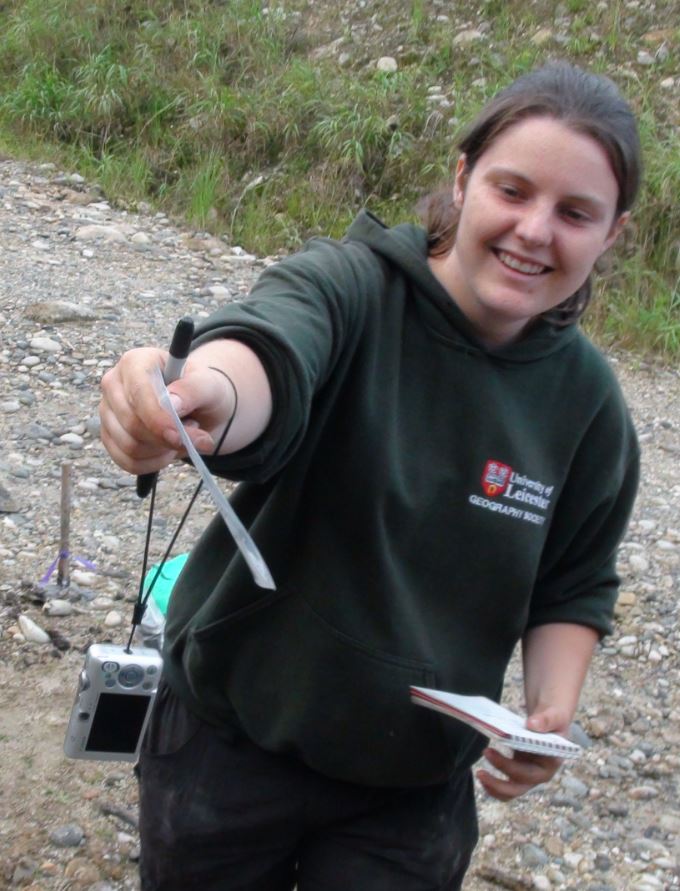
Hayley Keen getting excited about sediments during fieldwork in Ecuador (2012). Photo: J. Malley

Hayley Keen getting excited about sediments during fieldwork in Ecuador (2012). Photo: J. Malley

Keen, H.F. (2015) Past environmental change on the eastern Andean flank, Ecuador. PhD Thesis, Department of Environment, Earth & Ecosystems, The Open University.

Abstract
The eastern Andean flank of Ecuador (EAF) contains some of the world’s most biodiverse ecosystems. Andean montane forests are threatened due to anthropogenic pressures and both current and projected climate change. This thesis examines the palaeoecological history of two stratigraphic sequences (Mera Tigre West [MTW] and Mera Tigre East [MTE]) obtained from the Ecuadorian modern lower montane forest. The sediments preserved were analysed using eight analytical techniques, allowing an insight into the ecosystem’s potential response to projected changes derived from their past responses. Palaeoecological studies on the EAF are rare, and those that do exist are debated relating to: i) the inference of robust ecological data from pollen records in floristically diverse locations, and ii) the past source area of sediments preserved in fluvially exposed sequences, potentially leading to contamination with older material.

A statistical sub-sampling tool was developed (debate i), capable of producing statistically robust count sizes for each pollen sample; MTW and MTE count sizes ranged from 196-982 showing the diversity within sequences. The depositional environment of MTE was analysed, investigating sediment provenance throughout (debate ii). Results found that large scale volcanic events were critical in the preservation of the sediments, whereas fluvial influence caused a regional sediment source area in the upper stratigraphy, impacting on the palynological interpretation of MTE. Pollen records demonstrated the presence of a diverse vegetation community with no modern analogue at MTE (abundant taxa (>15 %): Hedyosmum, Wettinia, Ilex) and upper montane forest at MTW (Alnus, Hedyosmum, Podocarpus). Fire was not the main driver for the vegetation reassortment at either site (MTW correlation coefficient: -0.37, MTE: 0.16). The two sites have demonstrated the EAF plays host to floristically dynamic ecosystems, susceptible to drivers of change (fire and landscape) and should be considered when predicting the montane forests’ future response to environmental change.

Supervisors: Dr. William D. Gosling (The Open University/University of Amsterdam), Dr. Encarni Montoya and Dr. Sarah Sherlock (both The Open University).
Examiners: Dr. Dunia Urrego (University of Exeter), and Prof. David Gowing (The Open University).
Chair: Dr. Mark Brandon (The Open University).

To borrow a copy from The Open University Library click here.

Publications (so far): Continue Reading

Pollen database of Early-Miocene Amazonian palynological diversity

June 29, 2015
milantvm

By Milan Teunissen van Manen
MSc Biological Sciences, University of Amsterdam.

As part of my MSc research project on Early-Miocene paleodiversity shifts due to marine incursions in the Amazon basin, I recorded and photographed large numbers of palynomorphs. The database consists of a set of images (Teunissen van Manen, 2015a) that I took with my smartphone (bundled in pdfs for sharing purposes) and an Excel overview file (Teunissen van Manen, 2015b) where each of the entries is described. Some of the entries are well documented taxa (C’mon, who hasn’t heard of Zonocostites ramonae and Mauritidites franciscoi before?) while others are “types” that are not formally described – mainly because in Amazonian sediments new, unseen palynomorphs pop up all the time. Indeed, this was the reason why I started the database in the first place: I was merely trying to keep up with the vast diversity that I encountered during sample counting.

Seeing the added value of having a digital record of the palynological diversity from the Amazon basin samples, my project supervisor, Carina Hoorn (UvA), encouraged me to publish the database online so others could also access it. I’d like to invite you to take a look. I hope it can maybe help you with identifying taxa or, who knows, linking taxa across the Amazon basin… if you do, please let me know!

…or maybe it will have you rejoice in the huge diversity and alien beauty of pollen morphology, just as it rejoiced me as I was working through my (seemingly endless) samples.

REFERENCES

Teunissen van Manen, Milan (2015a): Miocene Amazonian Palynological Diversity – Image files. figshare. http://dx.doi.org/10.6084/m9.figshare.1396453

Teunissen van Manen, Milan (2015b): Miocene Amazonian palynological diversity database – Entries record. figshare. http://dx.doi.org/10.6084/m9.figshare.1396562

This project was conducted with Research Group of Palaeoecology & Landscape Ecology, part of the Institute for Biodiversity & Ecosystem Dynamics.

Blog at WordPress.com.