Keen PhD Thesis 2015

September 30, 2015
WDG

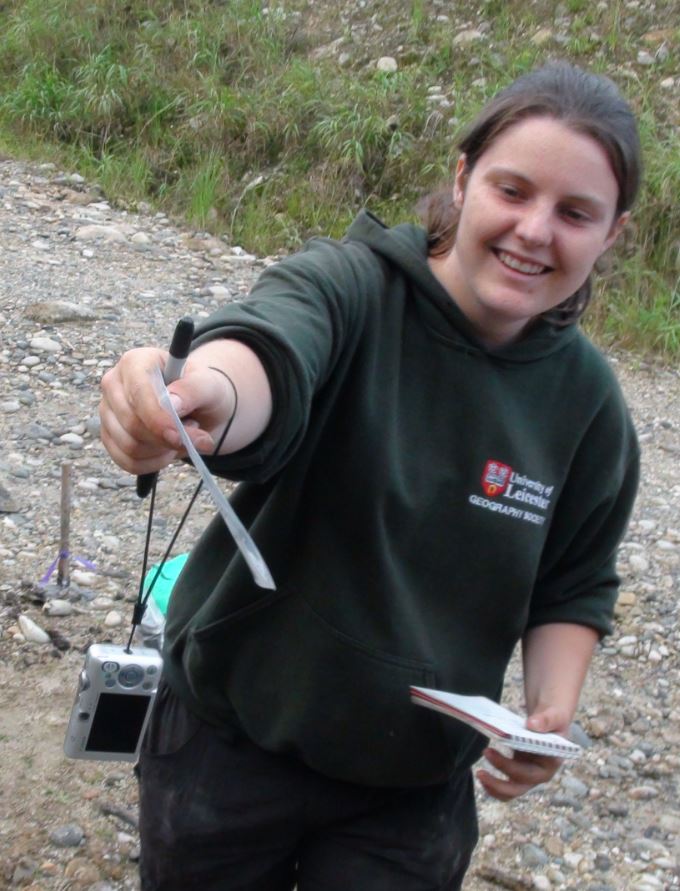
Hayley Keen getting excited about sediments during fieldwork in Ecuador (2012). Photo: J. Malley

Hayley Keen getting excited about sediments during fieldwork in Ecuador (2012). Photo: J. Malley

Keen, H.F. (2015) Past environmental change on the eastern Andean flank, Ecuador. PhD Thesis, Department of Environment, Earth & Ecosystems, The Open University.

Abstract
The eastern Andean flank of Ecuador (EAF) contains some of the world’s most biodiverse ecosystems. Andean montane forests are threatened due to anthropogenic pressures and both current and projected climate change. This thesis examines the palaeoecological history of two stratigraphic sequences (Mera Tigre West [MTW] and Mera Tigre East [MTE]) obtained from the Ecuadorian modern lower montane forest. The sediments preserved were analysed using eight analytical techniques, allowing an insight into the ecosystem’s potential response to projected changes derived from their past responses. Palaeoecological studies on the EAF are rare, and those that do exist are debated relating to: i) the inference of robust ecological data from pollen records in floristically diverse locations, and ii) the past source area of sediments preserved in fluvially exposed sequences, potentially leading to contamination with older material.

A statistical sub-sampling tool was developed (debate i), capable of producing statistically robust count sizes for each pollen sample; MTW and MTE count sizes ranged from 196-982 showing the diversity within sequences. The depositional environment of MTE was analysed, investigating sediment provenance throughout (debate ii). Results found that large scale volcanic events were critical in the preservation of the sediments, whereas fluvial influence caused a regional sediment source area in the upper stratigraphy, impacting on the palynological interpretation of MTE. Pollen records demonstrated the presence of a diverse vegetation community with no modern analogue at MTE (abundant taxa (>15 %): Hedyosmum, Wettinia, Ilex) and upper montane forest at MTW (Alnus, Hedyosmum, Podocarpus). Fire was not the main driver for the vegetation reassortment at either site (MTW correlation coefficient: -0.37, MTE: 0.16). The two sites have demonstrated the EAF plays host to floristically dynamic ecosystems, susceptible to drivers of change (fire and landscape) and should be considered when predicting the montane forests’ future response to environmental change.

Supervisors: Dr. William D. Gosling (The Open University/University of Amsterdam), Dr. Encarni Montoya and Dr. Sarah Sherlock (both The Open University).
Examiners: Dr. Dunia Urrego (University of Exeter), and Prof. David Gowing (The Open University).
Chair: Dr. Mark Brandon (The Open University).

To borrow a copy from The Open University Library click here.

Publications (so far): Continue Reading

Pollen database of Early-Miocene Amazonian palynological diversity

June 29, 2015
milantvm

By Milan Teunissen van Manen
MSc Biological Sciences, University of Amsterdam.

As part of my MSc research project on Early-Miocene paleodiversity shifts due to marine incursions in the Amazon basin, I recorded and photographed large numbers of palynomorphs. The database consists of a set of images (Teunissen van Manen, 2015a) that I took with my smartphone (bundled in pdfs for sharing purposes) and an Excel overview file (Teunissen van Manen, 2015b) where each of the entries is described. Some of the entries are well documented taxa (C’mon, who hasn’t heard of Zonocostites ramonae and Mauritidites franciscoi before?) while others are “types” that are not formally described – mainly because in Amazonian sediments new, unseen palynomorphs pop up all the time. Indeed, this was the reason why I started the database in the first place: I was merely trying to keep up with the vast diversity that I encountered during sample counting.

Seeing the added value of having a digital record of the palynological diversity from the Amazon basin samples, my project supervisor, Carina Hoorn (UvA), encouraged me to publish the database online so others could also access it. I’d like to invite you to take a look. I hope it can maybe help you with identifying taxa or, who knows, linking taxa across the Amazon basin… if you do, please let me know!

…or maybe it will have you rejoice in the huge diversity and alien beauty of pollen morphology, just as it rejoiced me as I was working through my (seemingly endless) samples.

REFERENCES

Teunissen van Manen, Milan (2015a): Miocene Amazonian Palynological Diversity – Image files. figshare. http://dx.doi.org/10.6084/m9.figshare.1396453

Teunissen van Manen, Milan (2015b): Miocene Amazonian palynological diversity database – Entries record. figshare. http://dx.doi.org/10.6084/m9.figshare.1396562

This project was conducted with Research Group of Palaeoecology & Landscape Ecology, part of the Institute for Biodiversity & Ecosystem Dynamics.

The resilient Dodo

April 6, 2015
Erik de Boer

Picture 1: Mare aux Songes

Picture 1: Mare aux Songes

The extinction of the Dodo is an iconic example of the detrimental impact humans can have on their environment. Because so little is known about this enigmatic flightless bird, we gave it an image of an infinitely silly and ungainly creature. This image has been taken to full advantage by film studios Aardman (Pirates), Disney (Alice in Wonderland), and Blue Sky Studios (Ice Age). Recent scientific publications however show the dodo in a completely different light (Hume 2012; Winters et al. 2014). In the May edition of The Holocene we discuss how the Dodo was well-equipped to the tough challenges it faced in its natural environment.

Continue Reading

Valencia PhD thesis 2014

March 5, 2015
WDG

Bryan-Kuelap-gate-2010-smallValencia Castillo, B.G. (2014) From glacial to modern conditions: Vegetation and climate change under human influence in the Central Andes. PhD Thesis, Department of Environment, Earth & Ecosystems, The Open University.

Abstract
Conservation, restoration and management strategies are employed to maintain Earth’s biological diversity and physical environment to a near “natural” state. However, the concept of “natural” is generally inexact and may include degraded landscapes. In absence of long-term empirical data of natural baselines, impacted assemblages (human altered baselines) could be falsely assumed to be natural and set as conservation or restoration goals. Therefore, the identification of long-term ecological baselines becomes a pressing requirement especially in threatened biodiversity hotspots such as the tropical Andes that were under human pressure for several millennial.

This thesis aims to identify ecological baselines for tropical Andean ecosystems based on multi-proxy palaeoecological reconstructions from three Andean lakes. Trends of vegetation change are used to identify when landscapes became anthropogenic in the Andes. Because vegetation assemblages at c. 10 ka experienced negligible anthropogenic impacts and had modern-like climate condition, this time was considered the most recent period likely to provide insight into natural ecological baseline conditions.

Changes in vegetation assemblages were evaluated over time departing from 10 ka around Miski and Huamanmarca, two sites that remained virtually impervious to human impacts. Baselines in Miski and Huamanmarca drifted continuously over time and showed that baselines are dynamic entities. The vegetation assemblages derived from Miski and Huamanmarca suggest that that human impact was not homogeneous throughout the Andean landscape.

Once baselines were defined it was possible to evaluate if the spatial distribution of Andean woodlands represented by Polylepis was a product of human impacts. A MaxEnt model generated based on 22 modern environmental variables and 13 palaeoecological vegetation reconstructions showed that Polylepis woodlands were naturally fragmented before humans arrived in South America (14 ka). However, the influence of humans during the mid and late Holocene enhanced the patchiness of the forest generating a hyper-fragmented landscape.

Supervisors: Dr. William D. Gosling , Dr. Angela L. Coe (both The Open University) and Prof. Mark B. Bush (Florida Institute of Technology).

Examined by: Dr. Robert Marchant (University of York), and Prof. David Gowing (The Open University).

To borrow a copy from The Open University Library click here.

Flantua, S.G.A., Hooghiemstra, H., Van Boxel, J.H., Cabrera, M., Gonzlez-Carranze, Z., Gonzlez-Arrango, C. (2014) Connectivity dynamics since the last glacial maximum in the northern Andes: a pollen-driven framework to assess potential migration. Monographs Systematic Botany Missouri Botanical Garden, 128: 98-123. In: Stevens, W.D., Montiel, O.M. Raven, P.H. (eds.), Paleobotany and biogeography; A Festschrift for Alan Graham in his 80 year. Missouri Botanical Garden Press, St. Louis, USA. ISBN 978-0-915279-97-5.

Paleontologia: Cenários de Vida – Paleoclimas Volume 5Bush, M.B., de Oliveira, P.E., Raczka, M.F., Gosling, W.D., Mayle, F.E., McMichael, C.H. & Urrego, D.H. (2014) Paleoclimates of Amazonia: An ice-age view. IN: Ribeiro F. & Carvalho, I. (eds.) Paleontologia: Cenários de Vida – Paleoclimas Volume 5. Editora Interciência Ltda., Brazil, pp. 353-368. ISBN: 9788571933439

Blog at WordPress.com.