Bulian, F., Aukes, T. F. N., Vittori, C., Du Plessis, J., Nascimento, M. N., Mazzini, I., Gravina, M. F., Maurer, A., Petrosino, P., Arienzo, I., Marra, F., & Sevink, J. (2026). A palaeoenvironmental reconstruction of the southern sector of the Ostia palaeolagoon and its implications for the reconstruction of late Holocene Sea level variations in central Tyrrhenian Italy. Palaeogeography, Palaeoclimatology, Palaeoecology, 695, 113873. https://doi.org/10.1016/j.palaeo.2026.113873
Although the Mapping Ancient Africa project is officially drawing to a close, researchers within the network are still actively collaborating and publishing. Periodically I will aim to collate and comment on member outputs that I come across. If you have a paper that should be highlighted here please get in contact and I will be happy to include it.
I have recently come across four papers these cover the role of disease in human evolution (Colucci et al., 2026), the identification and interpretation of charcoal fragments in sedimentary records from western Africa (Cornet et al., 2026), and archaeological evidence for past human activity in Nigeria (Omigbule et al. 2026; Orijemie et al., 2026).
Colucci, M., Leonardi, M., Blinkhorn, J., Irish, S. R., Padilla-Iglesias, C., Kaboth-Bar, S., Gosling, W. D., Snow, R. W., Manica, A., & Scerri, E. M. L. (2026). Malaria shaped human spatial organization for the past 74 thousand years. Science Advances, 12(17), eaea2316. https://doi.org/10.1126/sciadv.aea2316
Cornet, F., Montade, V., Bodin, S. C., Descloitre, J., Réjou‐Méchain, M., Viennois, G., Aleman, J. C., Assi‐Kaudjhis, C., Kenney, W. F., Oslisly, R., Tossou, M. G., Bremond, L., & Favier, C. (2026). From shape to source: Sedimentary charcoal morphology as a proxy for tropical burned biomass composition. Journal of Quaternary Science, 41(3), 490–506. https://doi.org/10.1002/jqs.70053
Omigbule, A. O., Akogun, M. O., Orijemie, E. A., & Ogunfolakan, A. B. (2026). Aspects of garden-based agroforestry at Igbó-Orítàá, Ìwó, southwest Nigeria (c.14th-17th centuries CE). Journal of Archaeological Science: Reports, 72, 105768. https://doi.org/10.1016/j.jasrep.2026.105768
Orijemie, E. A., Opadeji, O. A., & Alabi, R. A. (2026). Archaeological and palynological evidence of iron smelting and its ecological consequences in the Ijebu Forest, Nigeria. Azania: Archaeological Research in Africa, 61(1), 110–139. https://doi.org/10.1080/0067270X.2025.2594901
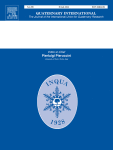
We got the cover photo! Credit: Martin & Ondrej Pelanek, www.phototrip.cz
Open access:
Colucci, M., Leonardi, M., Blinkhorn, J., Irish, S. R., Padilla-Iglesias, C., Kaboth-Bar, S., Gosling, W. D., Snow, R. W., Manica, A., & Scerri, E. M. L. (2026). Malaria shaped human spatial organization for the past 74 thousand years. Science Advances, 12(17), eaea2316. https://doi.org/10.1126/sciadv.aea2316
The Mapping Ancient Africa (MAA) special issue in Quaternary International (QI) is now complete. Many thanks to all who contributed to the issue, and special thanks to my co-guest editors Stefanie Kaboth-Bahr and Rahab Kinyanjui, and QI editor Evdokia Tema, for their efforts in putting this together.
To wrap up the MAA special issue the guest editors have written an editorial covering the work of this multi-year project. In this we draw out key themes that have emerged from the work (vegetation dynamics, fire, and human behavior), review the project activities (including workshop photos), and highlight other publications by MAA members (lots of other exciting work going on). You can read all about it in:
The MAA multi-year project supported by INQUA is now in its final stages. We have delivered our final workshop (South Africa), our special issue, and created a body of online resources via this blog and the YouTube channel (>50 MAA videos!) that will hopefully inform and inspire researchers interested in past environmental change in Africa. Most importantly I hope that we have build a network of people (>140 members on our email list at the time of writing) who are passionate and engaged with understanding how climate, vegetation and humans have helped shape the African continent. I hope that these connections will keep building over the coming years and new projects, papers and insights will emerge.
The Ecology of the Past blog will continue, however, it will – of course – miss the regular input from the MAA project. Therefore, if anyone has suitable academic content that they wish to communicate through the blog please do not hesitate to get in contact.
Mapping Ancient Africa Quaternary International Special Issue #10
Kinyanjui, R. N., Mashaka, H. K., Chritz, K. L., Wemanya, S. N., Ndiema, E. K., Braun, D. R., & Bamford, M. (2026). Holocene vegetation dynamics of the Koobi Fora Basin, East Turkana, Kenya: Insights from phytolith analysis. Quaternary International, 759, 110131. https://doi.org/10.1016/j.quaint.2026.110131
To find the complete list of articles in the Mapping Ancient Africa special issue of Quaternary International click here.
Gosling, W. D., de Wolf, I. K., Witteveen, N. H., de Zwaan, S. B., Van Teulingen, C., Föllmi, D., Thissen, W., Vink, V. B., Woutersen, A., Philip, A. L., van Herk, M. J., Nascimento, M. N., Prins, M. A., & McMichael, C. N. H. (2025). Herbivory and vegetation openness in a pre-farming European landscape. Plant Ecology & Diversity, 1–22. https://doi.org/10.1080/17550874.2025.2576566
This manuscript has been developed over many years through the contributions of many MSc and BSc students based at the University of Amsterdam.
Mapping Ancient Africa Quaternary International Special Issue #9
Dabengwa, A. N., Scott, L., & Bamford, M. (2025). Reinterpretation of palaeoecological records from Tswaing crater (South Africa) reveals the crucial role of fire in shaping savanna. Quaternary International, 750, 110010. DOI: 10.1016/j.quaint.2025.110010
To find the complete list of articles in the Mapping Ancient Africa special issue of Quaternary International click here.
Paine AR, Frieling J, Shanahan TM, Mather TA, McKay N, Robinson SA, Pyle DM, Fendley IM, Kiely R, Gosling WD. 2025. Evidence for millennial-scale interactions between Hg cycling and hydroclimate from Lake Bosumtwi, Ghana. Climate of the Past21(4): 817–839. DOI: 10.5194/cp-21-817-2025
Mapping Ancient Africa Quaternary International special issue article #6
Hlophe B. & Bamford M.K. (2025) Charcoal insights on the vegetation, climate and subsistence patterns at Wonderwerk Cave. Quaternary International728,109755. DOI: 10.1016/j.quaint.2025.109755
To find the complete list of articles in the Mapping Ancient Africa special issue of Quaternary International click here.
Mapping Ancient Africa Quaternary International special issue article #5
Kiely, R.E., Paine, A.R., McMichael, C.H. & Gosling, W.D. (2025) Heat, hydroclimate and herbivory: A late-Pleistocene record of environmental change from tropical western Africa. Quaternary International 717, 109636. DOI: 10.1016/j.quaint.2024.109636
To find the complete list of articles in the Mapping Ancient Africa special issue of Quaternary International click here.



 Ecology of the past