Mapping Ancient Africa: Climate, vegetation & humans

April 14, 2026
WDG

The Mapping Ancient Africa (MAA) special issue in Quaternary International (QI) is now complete. Many thanks to all who contributed to the issue, and special thanks to my co-guest editors Stefanie Kaboth-Bahr and Rahab Kinyanjui, and QI editor Evdokia Tema, for their efforts in putting this together.

To wrap up the MAA special issue the guest editors have written an editorial covering the work of this multi-year project. In this we draw out key themes that have emerged from the work (vegetation dynamics, fire, and human behavior), review the project activities (including workshop photos), and highlight other publications by MAA members (lots of other exciting work going on). You can read all about it in:

The MAA multi-year project supported by INQUA is now in its final stages. We have delivered our final workshop (South Africa), our special issue, and created a body of online resources via this blog and the YouTube channel (>50 MAA videos!) that will hopefully inform and inspire researchers interested in past environmental change in Africa. Most importantly I hope that we have build a network of people (>140 members on our email list at the time of writing) who are passionate and engaged with understanding how climate, vegetation and humans have helped shape the African continent. I hope that these connections will keep building over the coming years and new projects, papers and insights will emerge.

The Ecology of the Past blog will continue, however, it will – of course – miss the regular input from the MAA project. Therefore, if anyone has suitable academic content that they wish to communicate through the blog please do not hesitate to get in contact.

A final thanks to INQUA Palaeoclimate commission (PALCOM) and Humans and Biosphere commission (HABCOM) for their support for MAA since its inception in 2021. Without this funding none of the work would have been possible.

For full list of MAA articles click here.

INQUAlogo

“Plant Ecology & Diversity” & Biogeography

July 6, 2023
WDG

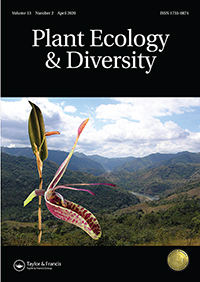
Plant Ecology & Diversity

A recent open letter to Wiley from Associate Editors working for the Journal of Biogeography posted by Lucie Zinger and others highlighted a dispute between the editors and the publishers in relation to: (i) the proposed switch of the journal to a pure open access model, (ii) financial barriers to publication, (iii) the proposed increase in throughput of manuscripts to maximise profits, and (iv) the manuscript referral process (see @LucieZinger, read tweet here, dated 28 June 2023). This got me thinking about these issues in relation to the journal that I am most involved with editing which also published papers related to biogeography; Plant Ecology & Diversity.

Plant Ecology & Diversity is the journal of the Botanical Society of Scotland. It is published in association with Taylor & Francis and any profits are split between the publishers and the academic society. To promote diversity and inclusion among authors the journal has a policy of double blind peer review (and has done for many years). Further, there are no publication fees for authors to publish in this journal, however, this does mean that published papers are behind a pay wall. An “Open Access” option is available to all authors for a fee (hybrid model), although the invited “Grubb Reviews” series is automatically published Open Access. Subject Editors and Associate Editors “work” for the journal gratis (for free) and the love of furthering the field.

If you have manuscripts related to biogeography, and prefer this mode of publishing, then please consider the fit of your paper to Plant Ecology & Diversity and send them our way. Or indeed if you have manuscripts related to one of our other key themes:

  • evolution and systematics,
  • global change and vegetation dynamics,
  • environment and plant functioning, and
  • biotic interactions.

The journal accepts original research articles (c. 7000 words), rapid communications (c. 2500 words), review articles (c. 12,000 words), and perspectives (c. 2500 words). Other options for publishing are of course also available 🙂

Meet team “Global change & vegetation dynamics” @ Plant Ecology & Diversity

August 4, 2020
WDG

Plant Ecology & DiversityWithin the overarching context of Plant Ecology & Diversity the “Global change & vegetation dynamics” subject area aims to place a temporal component on key themes such as biodiversity, conservation and ecosystem function. Manuscripts are welcome that use long-term (palaeo-) ecological approaches, modern field observations and laboratory experiments, and computational modelling to explore change and dynamics within ecosystems. We welcome all formats of manuscripts to this section (original research articles,  rapid communication articles, review articles, and perspectives articles). If you have any questions about the potential suitability of your research in the journal please do not hesitate to get in contact.

The editorial team handling this section of the journal currently comprises myself as Subject Editor and six Associate Editors. To find out more about us, our research interests and expertise read on…

Continue Reading

Plant Ecology & Diversity: Global Change & Vegetation Dynamics

February 10, 2020
WDG

As a palaeoecologist and biogeographer I am delighted to have become a Subject Editor for Plant Ecology & Diversity (PE&D). In my new role for the journal I hope to handle a broad range of articles within my area “Global Change & Vegetation Dynamics: Past, Present & Future”. As Subject Editor, as well as organizing general submissions, I would also like to promote a range of articles focused on scientific themes that build upon key publications.

The first of these themes will be “long-term ecology” and will build upon the recent ‘monster’ Grubb Review written by John Birks (Birks, 2019). The Birks manuscript covers a vast range of topics centred on the contribution of Quaternary botany to understanding modern ecology and biogeography. Topics covered within the Birks manuscript include:

  • Vegetation range shifts
  • Extinction events
  • Human impacts on ecosystems
  • Biodiversity trends
  • Conservation

I plan to pull together the “long-term ecology” set of manuscripts for PE&D during 2020, and contributions are welcome on any of the issues and research areas highlighted in the Birks manuscript.

Continue Reading

Blog at WordPress.com.