By Bouwe Groeneveld (MSc Biological Sciences, track Ecology & Evolution, University of Amsterdam)
From data to reality
Last year, between April and June, I worked on my bachelor project on the fire history of a site in South Africa called Giant’s Castle. From the Netherlands, I analysed sediment cores by counting charcoal fragments and looking at their shape to determine whether they likely came from grass or wood. The results were largely what you would expect in a mountain grassland. Most of the charcoal came from grasses. At the same time, there were clear changes in the composition of the fuel reflected in the charcoal record. I linked the increase in fire activity to the presence of people, and also observed shifts in the types of fuel being burned over time. It felt like slowly unravelling a story from the past. But it also remained abstract. I was working with numbers, figures, and photos of a place I had never actually been to. I had a sense of it, but it did not fully feel real. A year later, I was standing there myself.
From analysis to experience
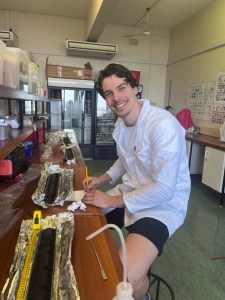
For my MSc research, I returned to the same system, but this time physically. In the meantime, I had already expanded my earlier work by looking at dung fungal spores, as an indicator for grazing animals, and pollen to reconstruct vegetation dynamics. But to describe vegetation properly, you really have to see it. After a five-day workshop, which I described in a previous blogpost, I spent a weekend at the home of Prof. Trevor Hill and Prof. Jemma Finch. That weekend turned into something like a crash course in South African life. It even included watching their son play a cricket match. What stood out most to me was how much more outdoor-oriented life felt compared to what I am used to in the Netherlands. After that, I was introduced to the University of KwaZulu-Natal in Pietermaritzburg, where I spent three weeks working in the lab. Interesting work, but I had really come for something else. The field.
First fieldwork: Cathedral Peak
Our first trip took us to Cathedral Peak in the Drakensberg, a mountain range shared by South Africa and Lesotho and dominated by mountain grasslands. The productivity of the area is not particularly high, but it is visually striking. It almost feels like standing on a film set from Lord of the Rings. Large, quiet landscapes with the sense that something might be hiding behind the next ridge. We set out two transects, taking topsoil samples every 5 metres over a distance of 45 metres. Straightforward work, but important for later analyses. On the way back to the car, we spotted a South African eland, which should not be confused with the animal known as “eland” in Dutch, as they are entirely different species. Back at the car, we had lunch and I was introduced to a classic Trevor and Jemma fieldwork lunch. Soft white bread rolls with crisps inside. It sounded odd at first, but it works surprisingly well.
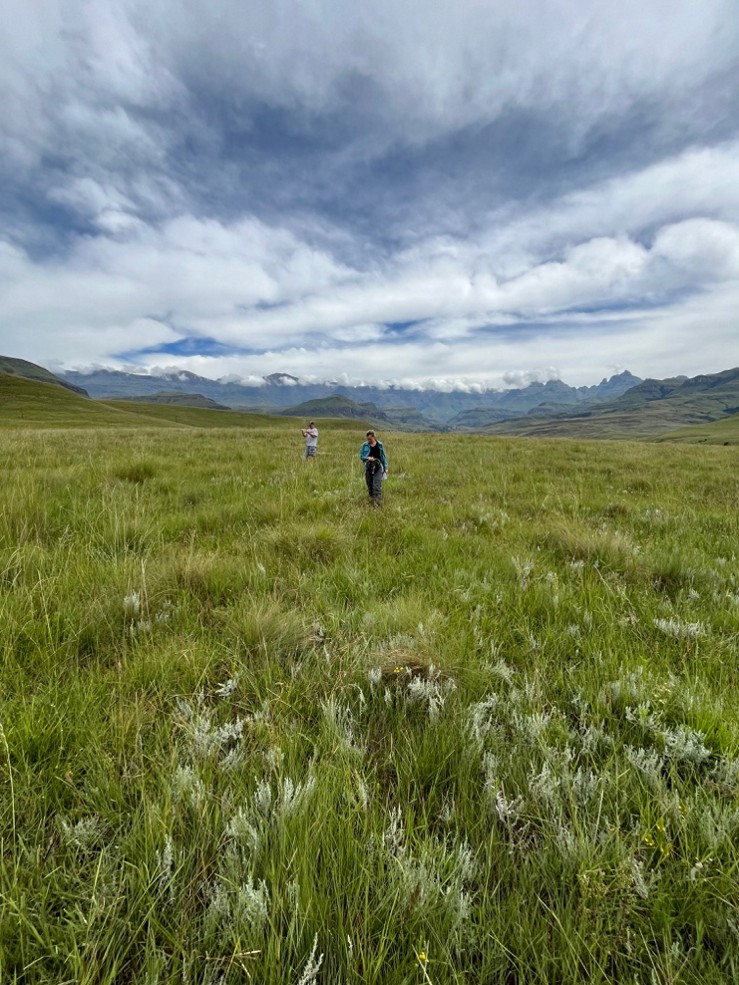
That same weekend, we went for a hike near Underberg, this time without transects and just to experience the landscape. In the afternoon, the weather suddenly turned and we had to head back quickly. A thunderstorm in the mountains makes the landscape even more impressive, but also much more dangerous. There is no shelter, so you effectively become the highest point yourself. Still, it was an experience I would not have wanted to miss.
Impendle: Working in a communal landscape
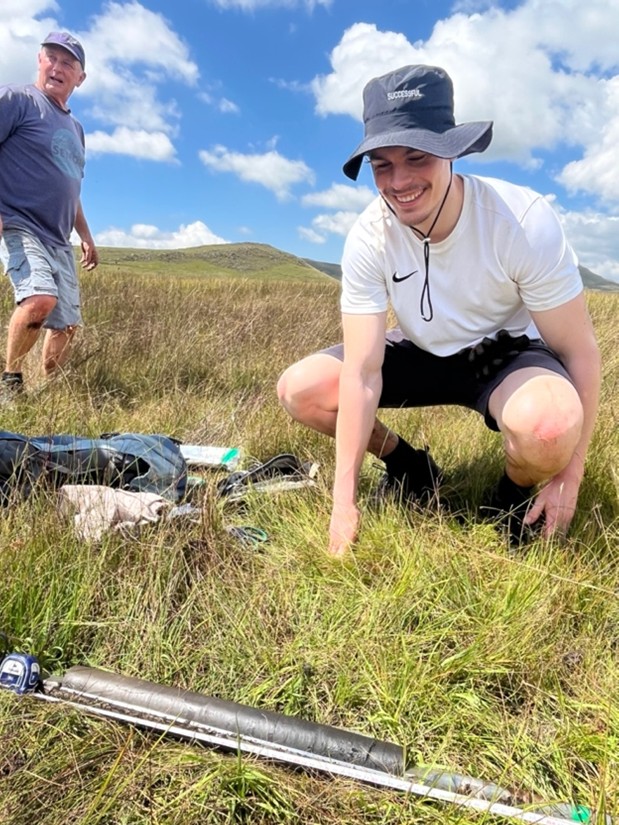
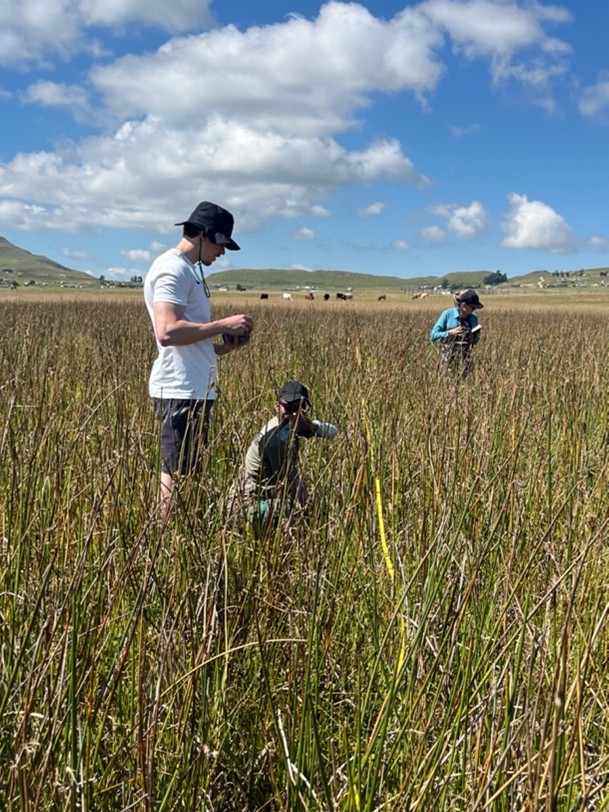
A week later, we visited a wetland site near Impendle, this time in a communal area with a lot of grazing livestock. We were joined by Wendy, a local field guide in training. Again, we laid out transects to send samples back to the Netherlands. In addition, Jemma and I collected dung samples to analyse dung fungal spores. Some of the dung was completely dried out and even had fungi growing on it. Other samples were fresh. Very fresh. While Jemma and I were still figuring out how to sample a fresh cow pat without covering ourselves in it, Wendy simply stepped in and collected a sample by hand without hesitation. It was a great example of the kind of hands-on, get-it-done mentality that fieldwork often requires, and one I really came to appreciate. At the same site, we used a Russian peat corer to extract sediment cores. I had never done this before. Trevor had warned me that it would be heavy, but I did not expect it to be that heavy. I have been going to the gym regularly for years, but this still surprised me. It honestly felt like lifting something in the range of a 150 kg deadlift. Pulling the core out of the ground and laying it out smoothly was a highlight in itself. It might sound like an odd comparison, but it felt a bit like taking a perfectly baked apple pie out of the oven. Everything intact and exactly how you hoped it would be.
The highlight: My site
The clear highlight of the trip was visiting Giant’s Castle itself. My site. Trevor and I left on Saturday and stayed overnight in the reserve. The drive was too long to combine with the hike in a single day. When we arrived, it was raining heavily, which raised doubts about whether we would be able to reach the site the next day. The road becomes impassable with mud, especially on the steeper sections. That evening, we had a classic South African bobotie with a glass of red wine while listening to the rain hitting the roof. The next morning was the moment of truth. Could we go? We could.
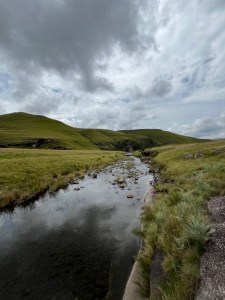
After some more rain overnight, the weather had cleared enough. We drove up into the mountains, partly off-road, and then I finally saw it. My site, a few kilometres away. From above, you could see a meandering stream cutting through the valley, with a small waterfall near the site. To get there, we first had to descend into tall grass. What had looked straightforward from a distance turned out to be anything but. The vegetation was dense, sharp, sometimes even cutting like a blade. You had to carefully place every step, often without knowing what the ground underneath looked like. But that was exactly why I was there. To experience the landscape as it is. In the distance, we saw two rhebok that had clearly noticed us long before we noticed them. And then we arrived.
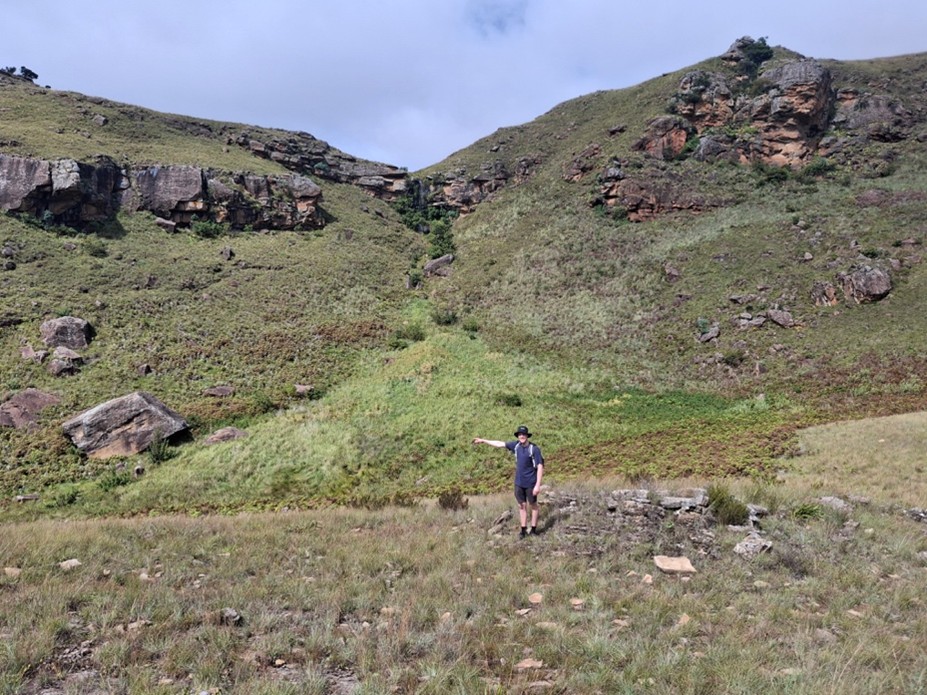
The site itself is formed by a landslide, after which a small waterfall split into two channels and deposited sediment into a wetland. This wetland has accumulated more than two metres of sediment in roughly 1500 years, which is relatively fast. We took transects again, but what stood out most to me was seeing the exact location where my earlier samples had been taken two years ago. It almost felt like nothing had changed in that time. Standing there, after having read so much about the site and analysed its data, made everything click. The vegetation, the scale, the structure of the landscape. It gave me a much clearer sense of how to interpret the past changes I had been working on.
The way back and closing the trip
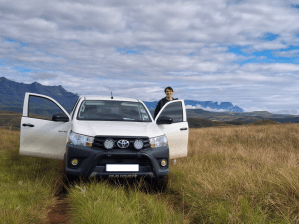
The way back was harder, mainly because we had to climb back up through the same terrain. What stood out was how easily Trevor moved through it, which probably says a lot about his forty years of experience in the area. After about 13 kilometres of hiking, we made it back to the car. Completely exhausted, but very satisfied.
I finished the trip with a visit to Tala Game Reserve, as I also wanted to see some larger wildlife. As a biologist, that interest is hard to ignore. I had booked a guided game drive at 08:00 in the morning, and it turned out I was the only one there. The others were stuck in traffic. That worked out well for me. I ended up with a private tour with my guide, Josh, which meant we could take our time and talk about everything we saw.
Reflection
What this trip gave me, more than anything else, is an aspect of research that we do not experience as much in the Netherlands. Fieldwork in large, open landscapes. It changed how I think about ecological research. Data on its own is not enough. Being in the field adds context, detail, and sometimes uncertainty. But that is exactly what makes the interpretations stronger.
Acknowledgements
I would like to thank Trevor Hill and Jemma Finch for their guidance in South Africa and beyond. I am also grateful to my supervisor William Gosling for giving me the opportunity to start this project. In addition, I would like to thank Adrian Nel for helping with accommodation and local advice, and the University of KwaZulu-Natal for their support.


 Ecology of the past