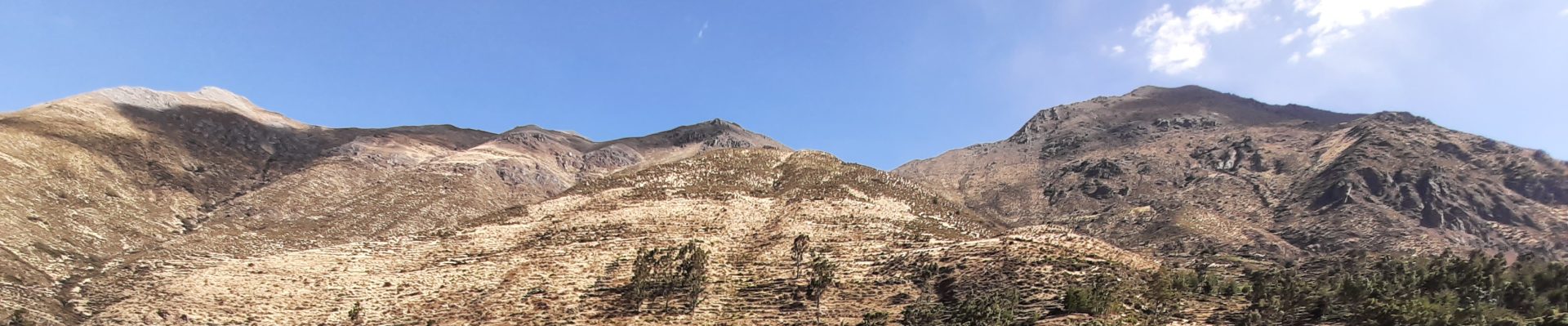
Fieldwork in South Africa

April 27, 2026
WDG

By Bouwe Groeneveld (MSc Biological Sciences, track Ecology & Evolution, University of Amsterdam)

From data to reality
Last year, between April and June, I worked on my bachelor project on the fire history of a site in South Africa called Giant’s Castle. From the Netherlands, I analysed sediment cores by counting charcoal fragments and looking at their shape to determine whether they likely came from grass or wood. The results were largely what you would expect in a mountain grassland. Most of the charcoal came from grasses. At the same time, there were clear changes in the composition of the fuel reflected in the charcoal record. I linked the increase in fire activity to the presence of people, and also observed shifts in the types of fuel being burned over time. It felt like slowly unravelling a story from the past. But it also remained abstract. I was working with numbers, figures, and photos of a place I had never actually been to. I had a sense of it, but it did not fully feel real. A year later, I was standing there myself.

From analysis to experience

For my MSc research, I returned to the same system, but this time physically. In the meantime, I had already expanded my earlier work by looking at dung fungal spores, as an indicator for grazing animals, and pollen to reconstruct vegetation dynamics. But to describe vegetation properly, you really have to see it. After a five-day workshop, which I described in a previous blogpost, I spent a weekend at the home of Prof. Trevor Hill and Prof. Jemma Finch. That weekend turned into something like a crash course in South African life. It even included watching their son play a cricket match. What stood out most to me was how much more outdoor-oriented life felt compared to what I am used to in the Netherlands. After that, I was introduced to the University of KwaZulu-Natal in Pietermaritzburg, where I spent three weeks working in the lab. Interesting work, but I had really come for something else. The field.

First fieldwork: Cathedral Peak

Continue Reading

MSc track Earth System Science

February 17, 2023
WDG

At the University of Amsterdam the MSc Earth Science is split into two tracks, one of these is entitled: “Earth System Science”. Earth System Science is a research intensive track focused on understanding the fundamentals of abiotic and biotic interactions across the globe and through time. During this degree you will spend around 6 months studying to pick up specialist knowledge and skills, and around 18 months actively developing yourself – in your key areas of interest – through project work.

The taught part of the Earth System Science track includes courses such as:

  • The Earth System: Learn how to analyse Earth system function across space and through time.
  • Analysis & Modelling Lab: Develop skills in data handeling, analysis and modeling relevant to Earth science.
  • Biogeochemical Cycles in the Earth System: Study how the dynamics of carbon and nitrogen link to societal challenges.
  • Climate Change: Explore the scientific basis for climate change an its implications for the environment and society.
  • Environments Through Time: Consider and analyse environmental change on timescale relevant to landscapes, societies and climates.
  • GIS and Remote Sensing in Ecosystem Dynamics: Learn how to use large remotely sensed datasets to gain insights into geological, geomorphological and soil systems.
  • Click here for further details and a full list of courses.
Clare Lee (on one leg, left) during field course in Peru successfully published her literature review which she conducted as part of her MSc in Earth Sciences at the University of Amsterdam.

In addition, free elective courses are possible from across the University of Amsterdam, or at other approved organizations or universities, i.e. it is possible to pick up skills in other specialisms (for example in languages, AI, or programming), or study a course at a university abroad, and have this included within your University of Amsterdam MSc Earth Science degree.

The project part of the Earth System Science track includes two research projects, or one research project and one internship with an external organization (such as a company or NGO). MSc research projects are often closely linked to active research within the Institute for Biodiversity & Ecosystem Dynamics. Some projects and literature reviews conducted by our MSc researchers reach a high enough level to be published in international scientific journals, either on there own or as part of a wider collaboration. Examples of recent papers including MSc researchers (highlighted in bold) are:

  • Lee, C.M., van Geel, B. & Gosling, W.D. (2022) On the use of spores of coprophilous fungi preserved in sediments to indicate past herbivore presence. Quaternary 5, 30. DOI: 10.3390/quat5030030
  • de Nijs, E.A. & Cammeraat, E.L. (2020) The stability and fate of Soil Organic Carbon during the transport phase of soil erosion. Earth-Science Reviews 201, 103067. DOI: 10.1016/j.earscirev.2019.103067
Blog at WordPress.com.