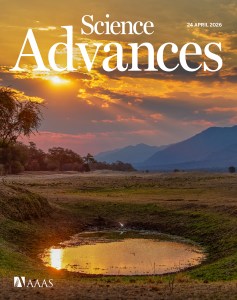
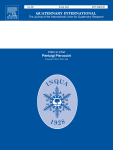
We got the cover photo! Credit: Martin & Ondrej Pelanek, www.phototrip.cz
Open access:
Colucci, M., Leonardi, M., Blinkhorn, J., Irish, S. R., Padilla-Iglesias, C., Kaboth-Bar, S., Gosling, W. D., Snow, R. W., Manica, A., & Scerri, E. M. L. (2026). Malaria shaped human spatial organization for the past 74 thousand years. Science Advances, 12(17), eaea2316. https://doi.org/10.1126/sciadv.aea2316
The Mapping Ancient Africa (MAA) special issue in Quaternary International (QI) is now complete. Many thanks to all who contributed to the issue, and special thanks to my co-guest editors Stefanie Kaboth-Bahr and Rahab Kinyanjui, and QI editor Evdokia Tema, for their efforts in putting this together.
To wrap up the MAA special issue the guest editors have written an editorial covering the work of this multi-year project. In this we draw out key themes that have emerged from the work (vegetation dynamics, fire, and human behavior), review the project activities (including workshop photos), and highlight other publications by MAA members (lots of other exciting work going on). You can read all about it in:
The MAA multi-year project supported by INQUA is now in its final stages. We have delivered our final workshop (South Africa), our special issue, and created a body of online resources via this blog and the YouTube channel (>50 MAA videos!) that will hopefully inform and inspire researchers interested in past environmental change in Africa. Most importantly I hope that we have build a network of people (>140 members on our email list at the time of writing) who are passionate and engaged with understanding how climate, vegetation and humans have helped shape the African continent. I hope that these connections will keep building over the coming years and new projects, papers and insights will emerge.
The Ecology of the Past blog will continue, however, it will – of course – miss the regular input from the MAA project. Therefore, if anyone has suitable academic content that they wish to communicate through the blog please do not hesitate to get in contact.
The annual Dutch Earth & Environmental Science conference took place at the NH Noordwijk Conference Centre Leeuwenhorst in Noordwijkerhout amoung some of the many Dutch flower fields.
Before the conference was a “Strategic evening” which provided an opportunity to meet scientists from other universities and organisations, and to discuss topical issues. This included a presentation of the recently completed “Earth & Environmental Science Vision” document (which can be dowloaded from the AMW Raad [Earth & Environmental Science Council] web page).
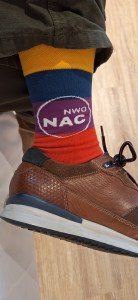
On the first day of the conference proper I was involved in chairing two sessions on “Palaeoclimate”. These sessions covered a wide range of topics, proxies and time periods, and included work on the Paleocene-Eocene Thermal Maximum, tipping points, and the Younger Dryas period. Excitingly for chairing these sessions I recieved a pair of NWO NAC socks!
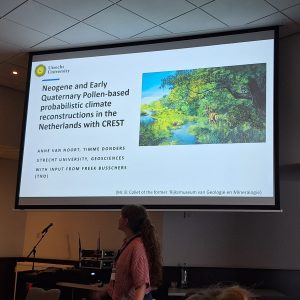
On the second day of the conference – sporting my new NAC socks – I presented our recently published work on landscape openness in the pre-farming European landscape. This was centred upon the recent publication of the palaeoecological record from Well-Aijen (Limburg, the Netherlands) which was the culmination of many years, and many students, research (Gosling et al., 2025). It was great to get positive feedback from the Dutch scientific community on this study. The session also included exciting work on reconstructing past climate from pollen data using the CREST model (Chevalier, 2022) and the extraction of biodiversity data from sedimentary pollen records.
As well as the science talks the meeting had posters, exhibitors, workshops (I attended the one of scientific drilling) and social events (pub quiz, bowling, dancing). The atmosphere was very friendly and it was very easy to meet new people. The area around is very pretty and I even managed to get out for a short run on one of the days. I would recommend this event to anyone working in Earth or environmental sciences in the Netherlands.
References
Chevalier, M. (2022). crestr: An R package to perform probabilistic climate reconstructions from palaeoecological datasets. Climate of the Past, 18(4), 821–844. https://doi.org/10.5194/cp-18-821-2022
Gosling, W. D., de Wolf, I. K., Witteveen, N. H., de Zwaan, S. B., van Teulingen, C., Föllmi, D., Thissen, W., Vink, V. B., Woutersen, A., Philip, A. L., van Herk, M. J., Nascimento, M. N., Prins, M. A., & McMichael, C. N. H. (2025). Herbivory and vegetation openness in a pre-farming European landscape. Plant Ecology & Diversity, 1–22. https://doi.org/10.1080/17550874.2025.2576566
The third Mapping Ancient Africa (MAA) workshop took place in South Africa during March 2026. This workshop was supported by the International Union for Quaternary Research as part of the MAA multi-year project. The aim of this work shop was to provide specialist training in developing research projects and writing of scientific articles. During the workshop each participant developed, and progressed, their own personal work plan. These personal programs allowed the training to be tailored to the participants needs. They included a wide range of challenged ranging from the development of project ideas through to dealing with reviewer comments on manuscripts, and inclusivity, equality and diversity issues.
In addition to the academic program, social activities and excursions were designed to help build academic networks and promote informal discussion of past environmental change issues. These included hikes to the Holley Shelter archaeological site (Bader & Conrad, 2023) and Game Pass shelter rock art site (Hoerle, 2005).
Mapping Ancient Africa Quaternary International special issue article #8
Open access:
Neumann, F. H., Finch, J., Hahn, A., Miller, C. S., Scott, L., Schefuß, E., Dupont, L., Cawthra, H. C., & Engelbrecht, F. (2025). Vegetation and climate dynamics in a 16,600-year marine sequence offshore Mozambique in Delagoa Bight, south-eastern Africa. Quaternary International, 747, 109956. DOI: 10.1016/j.quaint.2025.109956
To find the complete list of articles in the Mapping Ancient Africa special issue of Quaternary International click here.
Mapping Ancient Africa Quaternary International special issue article #7
Open access:
Gosling, W.D., Chevalier, M., Fischer, M.L., Holewijn, M., Finch, J., Gil-Romera, G., Hill, T., Houngnon, A., Leonardi, M., Manica, A., & Kaboth-Bahr, S. (2025). A multi-model approach to the spatial and temporal characterization of the African Humid Period. Quaternary International744, 109933. https://doi.org/10.1016/j.quaint.2025.109933
Gosling, W.D., Chevalier, M., Lothar Fischer, M., Holewijn, M., Finch, J. M., Gil-Romera, G., Hill, T. R., Houngnon, A., Leonardi, M., Manica, A., & Kaboth-Bahr, S. (2025). Code from: A multi-model approach to the spatial and temporal characterization of the African Humid Period. Figshare. https://doi.org/10.6084/M9.FIGSHARE.29608400.V1
To find the complete list of articles in the Mapping Ancient Africa special issue of Quaternary International click here.
Ivory, S.J., MacDougal, E., Mason, A., Pereboom, E., Garelick, S., Ficken, K., Wooller, M.J., Nakileza, B. & Russell, J. (2024) Highland forest dynamics across equatorial East Africa during the end of the African humid period. Quaternary International. DOI: 10.1016/j.quaint.2024.10.007
INQUA fellow Alfred Hougnon continues his research into past environmental change in the Dahomey Gap (Benin). In the fourth video documenting his progress a short background to the project, and insights into field work, are given. Field work took place near the Ewe-Adakplame forest in the south east of Benin and involved the recovery of sediments using a Russian corer. The video also shows how interactions and engagement with the local community was developed during the research expedition.
To find out more above Alfreds project read posts on:




 Ecology of the past