From palaeoecological knowledge to sustainable environmental management

August 4, 2026
WDG

By Sam Beudeker

BSc Future Planet Studies, Future Earth track, University of Amsterdam

Check out the ArcGIS Storymap of this blog at: https://arcg.is/0HSn480

Climate change is one of the greatest challenges of our time. It reflects a growing imbalance between people and the natural systems that support life on Earth. Building a more sustainable future requires more than understanding present-day environmental problems. It requires a deeper perspective on how ecosystems function, how they have changed over time, and how humans have interacted with them over long periods.

As a third-year bachelor student in biological and Earth sciences, I have become increasingly interested in these long-term interactions between climate, ecosystems, and human land use. I have learned that ecosystems are not stable systems, but dynamic ones that continuously respond to changes in climate, fire, and land use. Palaeoecology provides a way to reconstruct these long-term dynamics and place modern environmental change in a much deeper temporal context.
Although environmental change has always been part of Earth’s history, the current situation is characterised by a particularly rapid combination of climate change and human pressure on land systems. This makes long-term knowledge especially important, as it helps us distinguish natural variability from human-driven change and understand whether current ecosystems are within historical ranges of behaviour or entering new states.

Honours Program Thesis Extension

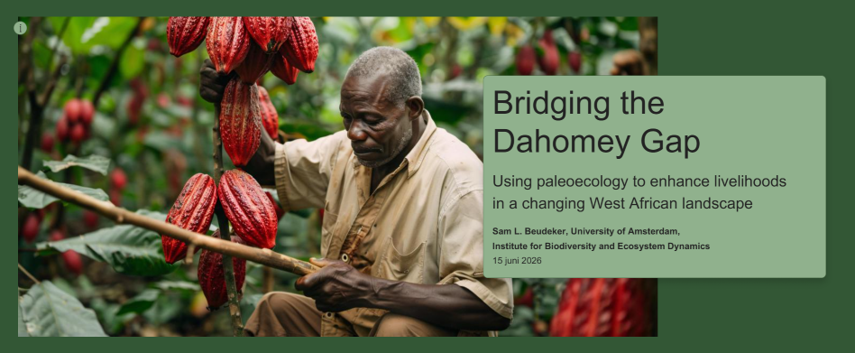
For the Honours Program alongside my bachelor’s degree, I extended my palaeoecology thesis with an interdisciplinary perspective focused on how long-term environmental knowledge can inform future land management. Rather than treating palaeoecology only as a reconstructive science, I explored its role as a bridge between past ecosystem dynamics and present-day sustainability challenges.

As a case study, I focused on the Dahomey Gap in West Africa, a forest–savanna transition zone that interrupts the continuous Guineo-Congolese rainforest belt. This region is not a fixed ecological boundary, but a shifting mosaic shaped over time by climate variability, fire, and human land use.
ArcGIS Storymap

Continue Reading

Mapping Ancient Africa: Scientists

March 31, 2026
WDG

The Mapping Ancient Africa (MAA) research and writing workshop took place in South Africa during March 2026 (click here for more details). During the workshop four of the scientists participating were interviewed by MAA leader Stefanie Kaboth-Bahr to find out more about them, what they are focused on, and their aspirations for the future. These are now avaliable on the Mapping Ancient Africa YouTube playlist along with all the other videos from the project.

Participants

Zahra Omarjee (University of KwaZulu-Natal, South Africa)

Continue Reading

Heat, hydroclimate and herbivory

January 6, 2025
WDG

Mapping Ancient Africa Quaternary International special issue article #5

Kiely, R.E., Paine, A.R., McMichael, C.H. & Gosling, W.D. (2025) Heat, hydroclimate and herbivory: A late-Pleistocene record of environmental change from tropical western Africa. Quaternary International 717, 109636. DOI: 10.1016/j.quaint.2024.109636

To find the complete list of articles in the Mapping Ancient Africa special issue of Quaternary International click here.

Mapping Ancient Africa: Seminar 17

May 15, 2024
WDG

The next Mapping Ancient Africa seminar will take place online at 17:00 CEST on 16 May 2024.

  • Speaker: N’dji dit Jacques Dembele (President of WAQUA, Université des sciences sociales et de gestion de Bamako, Mali)
  • Title: Quaternary period seismicity on the West African Craton

The seminar will be delivered via Zoom. The link for the seminar can be obtained from the MAA Slack channel or by contacting the chair of this seminar (Stefanie Kaboth-Bahr). If you want to know more about the Mapping Ancient Africa project visit our web pages and please do not hesitate to get in contact if you want to get involved.

INQUAlogo

Mapping Ancient Africa: Seminar 14

February 28, 2024
WDG

The first Mapping Ancient Africa online seminar of 2024 will take place on 28 February (17:00 CET). 

  • Speaker:  Mathias Vinnepand (Leibniz-Institute for Applied Geophysics Hannover, Germany)
  • Title: An age-depth model for Lake Bosumtwi (Ghana) to reconstruct one million years of West African climate and environmental change
  • Related publication: Vinnepand, M., Zeeden, C., Wonik, T., Gosling, W., Noren, A., Kück, J., Pierdominici, S., Voigt, S., Abadi, M.S., Ulfers, A., Danour, S., Afrifa, K. & Kaboth-Bahr, S. (2024) An age-depth model for Lake Bosumtwi (Ghana) to reconstruct one million years of West African climate and environmental change. Quaternary Science Reviews 325, 108478. DOI: 10.1016/j.quascirev.2023.108478

The seminar will be delivered via Zoom. The link for the seminar can be obtained from the MAA Slack channel or by contacting the chair of this seminar (Stefanie Kaboth-Bahr). If you want to know more about the Mapping Ancient Africa project visit our web pages and please do not hesitate to get in contact if you want to get involved.

INQUAlogo

INQUA Fellowship Award: Alfred Houngnon

December 20, 2023
WDG

I am delighted to be able to report that Alfred Houngnon (University of Abomey-Calavi, Benin) has beenawarded an INQUA Fellowship for 2024 to develop his research into past environmental change in the Dahomey Gap. This research will link up my laboratory, at the Institute of Biodiversity & Ecosystem Dynamics (University of Amsterdam), and the group of Dr Mireille S.S. Toyi (Laboratory of Applied Ecology, University of Abomey-Calavi). Below, and in the associated video report, Alfred explains the project and what he hopes to achieve during the project.

The Dahomey Gap project is designed to gain new insights on the West African palaeoenvironments using pollen, charcoal and dung fungal spore records to reconstruct past vegetation, fire and animal abundances. These empirical data will then be compared against paleoclimate models. Specifically, we will explore the interactions between fire, animals and vegetation around the Ewe-Adakplame forest in the south east of Benin Republic and highlight the role humans would have previously played in the modification of the landscape for millennia.

Continue Reading

Mapping Ancient Africa: INQUA Rome session (updated)

July 16, 2023
WDG

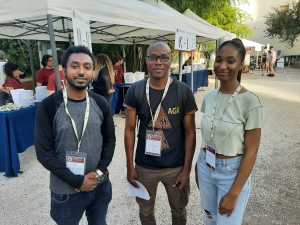
Mapping Ancient Africa participants at the INQUA Rome ice breaker event ready for action! Left to right: Bahru Zinaye Asegahegn, Alfred Houngnon, Busisiwe Hlophe.

The Mapping Ancient Africa (MAA) project has a double session of talks and a poster session at the INQUA congress in Rome 2023. Our session will be on Wednesday 19 July. Unfortunately a number of the originally planned speakers could not make it to Rome due to a combination of not obtaining visas, logistical challenges and ill health. We wish them all well and hope that they will continue to be involved in the project. Further, many thanks to all those who have agreed to step up and give a presentation at a late notice. Below is an updated schedule correct as of Sunday 16 July based on the information contained on the INQUA Rome App; if you are aware of any further problems or changes please let me know ASAP!

If you are at the INQUA Rome congress please come along to our talks and posters in Session 64: Mapping Ancient Africa: Climate, Vegetation & Humans.

Part 1: 08:30-11:00

  • Giosan et al. When the desert was a lake: Providing context for Homo sapiens development in the northern Kalahari
  • Chase et al. Paleolakes and socioecological implications of glacial “greening” of the South African interior
  • Blinkhorn et al. Evaluating refugia in recent human evolution in Africa
  • Aureli et al. Homo sapiens behaviour and adaptation in East Africa. New evidence from an open-air site in a modern Ethiopian savannah environment: the GOT10 site
  • Effiom et al. Late Holocene palaeoecological studies at Lake St Lucia, KwaZulu-Natal
  • Tallavaara et al. Pan-African Climate and Vegetation over the Quaternary and Implications for Human Distribution
  • Quick et al. Palaeoenvironments of the Cape Floristic Region: New research & current developments

Part 2: 11:00-13:00

Continue Reading

OPEN ACCESS ONLINE:

Miller, C.S., Gosling, W.D., Kemp, D.B., Coe, A.L. & Gilmour, I. (2016) Drivers of ecosystem and climate change in tropical West Africa over the past ∼540 000 years. Journal of Quaternary Science online. DOI: 10.1002/jqs.2893

Blog at WordPress.com.