Dutch Earth & Environmental Science Conference 2026

April 11, 2026
WDG

“Common Ground”

NWO NAC (Dutch Earth & Environmental Sciences Conference)

9-10 April 2026

The annual Dutch Earth & Environmental Science conference took place at the NH Noordwijk Conference Centre Leeuwenhorst in Noordwijkerhout amoung some of the many Dutch flower fields.

Before the conference was a “Strategic evening” which provided an opportunity to meet scientists from other universities and organisations, and to discuss topical issues. This included a presentation of the recently completed “Earth & Environmental Science Vision” document (which can be dowloaded from the AMW Raad [Earth & Environmental Science Council] web page).
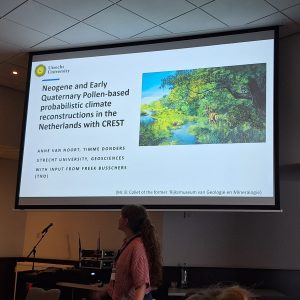
On the first day of the conference proper I was involved in chairing two sessions on “Palaeoclimate”. These sessions covered a wide range of topics, proxies and time periods, and included work on the Paleocene-Eocene Thermal Maximum, tipping points, and the Younger Dryas period. Excitingly for chairing these sessions I recieved a pair of NWO NAC socks!
On the second day of the conference – sporting my new NAC socks – I presented our recently published work on landscape openness in the pre-farming European landscape. This was centred upon the recent publication of the palaeoecological record from Well-Aijen (Limburg, the Netherlands) which was the culmination of many years, and many students, research (Gosling et al., 2025). It was great to get positive feedback from the Dutch scientific community on this study. The session also included exciting work on reconstructing past climate from pollen data using the CREST model (Chevalier, 2022) and the extraction of biodiversity data from sedimentary pollen records.
As well as the science talks the meeting had posters, exhibitors, workshops (I attended the one of scientific drilling) and social events (pub quiz, bowling, dancing). The atmosphere was very friendly and it was very easy to meet new people. The area around is very pretty and I even managed to get out for a short run on one of the days. I would recommend this event to anyone working in Earth or environmental sciences in the Netherlands.

References

  • Chevalier, M. (2022). crestr: An R package to perform probabilistic climate reconstructions from palaeoecological datasets. Climate of the Past, 18(4), 821–844. https://doi.org/10.5194/cp-18-821-2022
  • Gosling, W. D., de Wolf, I. K., Witteveen, N. H., de Zwaan, S. B., van Teulingen, C., Föllmi, D., Thissen, W., Vink, V. B., Woutersen, A., Philip, A. L., van Herk, M. J., Nascimento, M. N., Prins, M. A., & McMichael, C. N. H. (2025). Herbivory and vegetation openness in a pre-farming European landscape. Plant Ecology & Diversity, 1–22. https://doi.org/10.1080/17550874.2025.2576566

Mapping Ancient Africa: INQUA Rome session

July 3, 2023
WDG

The Mapping Ancient Africa (MAA) project has a double session of talks and a poster session at the INQUA congress in Rome 2023. Our session will be on Wednesday 19 July.

If you are at the INQUA Rome congress please come along to our talks and posters in Session 64: Mapping Ancient Africa: Climate, Vegetation & Humans.

Part 1: 08:30-10:30

  • Giosan et al. When the desert was a lake: Providing context for Homo sapiens development in the northern Kalahari
  • Chase et al. Paleolakes and socioecological implications of glacial “greening” of the South African interior
  • Biddulph et al. Spatiotemporal variability in the initiation and development of peatlands across the central Congo Basin
  • Blinkhorn et al. Evaluating refugia in recent human evolution in Africa
  • Aureli et al. Homo sapiens behaviour and adaptation in East Africa. New evidence from an open-air site in a modern Ethiopian savannah environment: the GOT10 site
  • Dembele Climatic fluctuations during the last millenium and their impact on political history and human settlements in West Africa
  • Porchier et al. Annually resolved hydroclimate variability in the East African Rift Valley at a time critical for hominin dispersion
  • Effiom et al. Late Holocene palaeoecological studies at Lake St Lucia, KwaZulu-Natal

Part 2: 11:00-13:00

Continue Reading

AFQUA 2018 – day 1

July 15, 2018
WDG

AFQUA: The African Quaternary environments, ecology and humans
2ndInternational Conference and Workshops
14-22 July 2018-07-15 National Museum, Nairobi, Kenya

My first AFQUA conference really began the day before the conference proper started in the Kenyan immigration queue where I met a number of fellow delegates who were flying in from all over the world.  It was great to start to put faces to names of people who’s work I had read for many years. Once out of the airport transfer to the hotel was smooth, and it was with some excitement that the following morning I made the short walk from the hotel to the famous Nairobi National Museum for the start of the conference.

Day 1

Prof. Andy Cohen (one of my fellow delegates in the immigration line) kicked off the AFQUA conference with a plenary giving an overview of African continental drilling projects. He traced the dream of the recovery of long continental records back to Daniel Livingstone and Neil Opdyke’s workshop from 1980 that set out the dream of obtaining long records from the continent. He then went on to give examples of how multi-millennial lake records, including Lake Malawi, can be used to understand the tempo of ecological change.

The first session of the conference, entitled “East Africa”, included: exciting evidence of Deinotherium the largest land mammal of the Quaternary (J.-P. Brugal), the use of d13C in determining homonin ecology (V.M. Iminjili), and evidence from a new c. 200,000 year old site at Natodomeri (Kenya) that contains evidence of homonids, elephids, giant lions and pigmy hippos (F.K. Manthi).

The second session of AFQUA covered “The environmental context for homonin evolution and dispersal”. This started with geochemical data from Chew Bahir that sheds light on potential drivers of climatic shifts (F. Schabitz), and included examination of changes climate between c. 500,000 and 320,000 years ago that coincided with the shift from hominid use of large cutting tools to smaller implements (R. Potts), and discussion of the environment the route which hominids took out of Africa (F. Henselowsky).

Blog at WordPress.com.