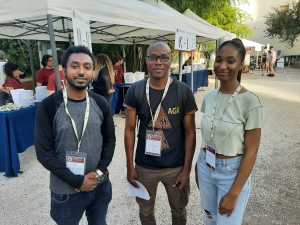
The Mapping Ancient Africa (MAA) project has a double session of talks and a poster session at the INQUA congress in Rome 2023. Our session will be on Wednesday 19 July. Unfortunately a number of the originally planned speakers could not make it to Rome due to a combination of not obtaining visas, logistical challenges and ill health. We wish them all well and hope that they will continue to be involved in the project. Further, many thanks to all those who have agreed to step up and give a presentation at a late notice. Below is an updated schedule correct as of Sunday 16 July based on the information contained on the INQUA Rome App; if you are aware of any further problems or changes please let me know ASAP!
If you are at the INQUA Rome congress please come along to our talks and posters in Session 64: Mapping Ancient Africa: Climate, Vegetation & Humans.
Part 1: 08:30-11:00
- Giosan et al. When the desert was a lake: Providing context for Homo sapiens development in the northern Kalahari
- Chase et al. Paleolakes and socioecological implications of glacial “greening” of the South African interior
- Blinkhorn et al. Evaluating refugia in recent human evolution in Africa
- Aureli et al. Homo sapiens behaviour and adaptation in East Africa. New evidence from an open-air site in a modern Ethiopian savannah environment: the GOT10 site
- Effiom et al. Late Holocene palaeoecological studies at Lake St Lucia, KwaZulu-Natal
- Tallavaara et al. Pan-African Climate and Vegetation over the Quaternary and Implications for Human Distribution
- Quick et al. Palaeoenvironments of the Cape Floristic Region: New research & current developments
Part 2: 11:00-13:00
- Hlophe Late Holocene vegetation and climate of Wonderwerk Cave, South Africa, from charcoal
- Kinyanjui et al. Middle Pleistocene Vegetation dynamics at Yiapan, a high elevation extra-basinal Site complex: Significance to human behavioral adaptations
- Manzano et al. Holocene palaeoecological reconstructions of landscape dynamics at the year-round/winter rainfall boundary in the Cape Floristic Region (Southwestern South Africa)
- Mosher et al. High-resolution sedimentary charcoal records of fire link burning, vegetation change, climate, and pastoralism in the Cape Floristic Region, South Africa
- Ntsondwa et al. Reconstructing the fire history and palaeoenvironment at Thyspunt, southern Cape coast, South Africa
- Julier et al. Filling the calibration gap: The importance of modern pollen studies from dry and transitional regions in Africa, and a case study from North-East Namibia
- Poretti et al. Investigating the potential of high-resolution carbon isotopes in archaeological Protea and Podocarpus charcoal as a rainfall seasonality proxy
- Houngnon et al. Floristic clues to the origins of the Dahomey Gap from the Ewe-Adakplame forest (Benin, West Africa)
Posters
- Adamu Isa Climatic and Cultural Dynamics in West Africa’s Sahel: a view from Surame, Nigeria
- Asegahegn et al. A multi-proxy paleoenvironmental reconstruction from the southeastern Ethiopian highlands during the Late Quaternary, as recorded in the sediments of Lake Haramaya
- Boboye Coastal lithofacies appraisals of Quaternary sequences in Dahomey Basin, southwestern Nigeria: implications of the granulometrical, palynological and isotopic studies
- Fischer et al. A pan-African spatiotemporal framework of the past one million years using advanced multi-record time-series analysis
- Foerster et al. Towards Deep Drilling in the Turkana Basin (DDTB): Tracking the Environmental Forces Driving Hominin Evolution
- Gosling et al. The role of tropical climate systems in driving humidity during the African Humid Period
- Hlophe & Bamford Late Holocene vegetation and climate of Wonderwerk Cave, South Africa, from charcoal
- Houngnon et al. Floristic clues to the origins of the Dahomey Gap from the Ewe-Adakplame forest (Benin, West Africa)
- Kaboth-Bahr et al. Tracing the impact of Walker Circulation changes on pan-African climate variability during the past 550,000 years using proxy and model results
- Kolb et al. Terrestrial ecosystem change during critical periods of early hominin evolution in SE Africa over the past 4 Ma
- Ogunfolakan The scar of migration: Sourcing for material evidences
- Orijemie Late Holocene Palaeoecology of Rainforest Reserve Sites
- Quick et al. Palaeoenvironments of the Cape Floristic Region: New research & current developments
- Vinnepand et al. An astronomical age model for Lake Bosumtwi (Ghana) to reconstruct West African climate and environmental change in the last million years
Further details of the congress can be found on the INQUA Rome congress web page here.

 Ecology of the past
Pingback: Mapping Ancient Africa: Writing an article | Ecology of the past