
On Wednesday 19 July 2023 the Mapping Ancient Africa session of the INQUA Rome congress took place. We were delighted to have an full program of speakers despite some late cancellations. The first session featured seven speakers.
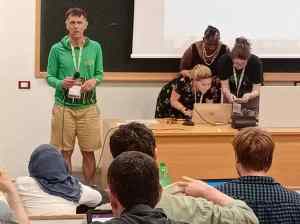
The first two talks focused on southern Africa. The first talk by Liviu Giosan (Woodshole Oceanographic Institute) focused on new sediment cores extracted from the Okavango – Makgadikgadi region and new efforts to obtain sediment cores that can provide information on the dispersal of hominins. Brian Chase (CNRS) then looks us to the Karoo highlighting recent findings that suggest that this currently arid region was more habitable in the past and that a proliferation of stone tools suggests past peoples utilised the region extensively (Carr et al., 2023).
We then crossed to the northern-eastern part of the continent to think about how vegetation refugia could have provided valuable resources for hominins during arid periods in a talk by James Blinkhorn (Max Planck Institute for Geoanthropology). This was then followed by Caterina Aureli (Sapienza), a first year PhD researcher, who took us to the archaeological site of Gotera (Ethiopia) presenting evidence for changes in animal populations, including a big rise in bovids.
Angela Effiom (University of the Witwatersrand) then took us back south to Lake St Lucia which has yielded a c. 7000 year pollen record that shows a major vegetation transition c. 2600 years ago from a Podocarpus to a Spirostachys dominated system due to drought. Miikka Tallavaare (University of Helsinki) then presented some model simulations of potential past climate across Africa, which supported the idea of a east-west gradient in precipitation across the continent due to changes in Walker circulation as proposed by Kaboth-Bahr et al. (2021); although this was not found to be the major driver.
The final talk of this session was delivered by Lynne Quick (Nelson Mandela University) who highlighted the amazingly broad range of research activities her team is engaged with, ranging from pollen trapping and areaobiology, thorough to palaeoecological studies focused on pollen and charcoal. Check out her lab pages here.
- If you are a researcher based in a developing country and would like to be part of a wider network of researchers please consider joining the “Developing Country Palaeoscience Network”.
- If you want to find out more about the Mapping Ancient Africa project click here.
References
- Carr, A.S., Chase, B.M., Birkinshaw, S.J., Holmes, P.J., Rabumbulu, M. & Stewart, B.A. (2023) Paleolakes and socioecological implications of last glacial “greening” of the South African interior. Proceedings of the National Academy of Sciences 120, e2221082120. DOI: 10.1073/pnas.2221082120
- Kaboth-Bahr, S., Gosling, W.D., Vogelsang, R., Bahr, A., Scerri, E.M.L., Asrat, A., Cohen, A.S., Düsing, W., Foerster, V., Lamb, H.F., Maslin, M.A., Roberts, H.M., Schäbitz, F. & Trauth, M.H. (2021) Paleo-ENSO influence on African environments and early modern humans. Proceedings of the National Academy of Sciences 118, e2018277118. DOI: 10.1073/pnas.2018277118

 Ecology of the past
Pingback: Mapping Ancient Africa: Quaternary International special issue | Ecology of the past