In the news:

First Farmers Were Also Sailors, by Michael Balter in Science.

John Bostock: The man who ‘discovered’ hay fever, by Justin Parkinson in BBC News Magazine.

DNA study shows yeti is real (sort of) – and Oxford scientist prepares expedition to find it, by Adam Withnall in The Independent.

Tibetan altitude gene inherited ‘from extinct species’, by Paul Rincon BBC News Website

Scientific articles:

Bonatelli, I.A.S., Perez, M.F., Peterson, A.T., Taylor, N.P., Zappi, D.C., Machado, M.C., Koch, I., Pires, A.H.C. & Moraes, E.M. (2014) Interglacial microrefugia and diversification of a cactus species complex: phylogeography and palaeodistributional reconstructions for Pilosocereus aurisetus and allies. Molecular Ecology, 23, 3044-3063.

Bush, M.B., Restrepo, A. and Collins, A.F. (2014) Galápagos history, restoration, and a shifted baseline. Restoration Ecology, 22, 3, 296-298.
Summary (Nick): A concise and pithy look at how a robust long-term ecological system can be transformed rapidly by human impact. The paper demonstrates how the fossil pollen record is fundamental if a near-natural vegetation state is to be restored to the Galápagos islands, to avoid restoration to a shifted baseline.

Froyd, C.A., Coffey, E.E.D., van der Knaap, W.O., van Leeuwen, J.F.N., Tye, A. & Willis, K.J. (2014) The ecological consequences of megafaunal loss: giant tortoises and wetland biodiversity. Ecology Letters, 17, 144-154.

Giguet-Covex, C., Pansu, J., Arnaud, F., Rey, P.-J., Griggo, C., Gielly, L., Domaizon, I., Coissac, E., David, F., Choler, P., Poulenard, J. & Taberlet, P. (2014) Long livestock farming history and human landscape shaping revealed by lake sediment DNA. Nat Commun, 5

Gillson, L. & Marchant, R. (2014) From myopia to clarity: sharpening the focus of ecosystem management through the lens of palaeoecology. Trends in Ecology & Evolution, 29, 317-325.
Comment (Will): For a good example of feeding palaeoecology into management see Bush et al. above.

One short story and five scientific papers thinking about different aspects of ecological change through time.

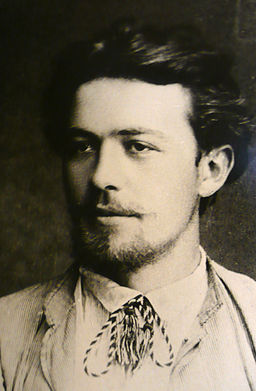
Chekhov in 1889

Chekhov in 1889 (http://tinyurl.com/ny2msd9)

Short story:

Checkhov, A. (1889) The Pipe

SUMMARY (Will): People have long been concerned about environmental change. Observations of phenological shifts, degradation of ecosystem services and climate change are clearly presented in Checkhov’s “The Pipe” (1889).The key difference is today we have a better idea of why these things are happening!?

Scientific papers:

Garcia, R.A., Cabeza, M., Rahbek, C. & Araújo, M.B. (2014) Multiple dimensions of climate change and their implications for biodiversity. Science 344 1247579
SUMMARY (Phil): This review highlights the alternative metrics used to quantify climate change at different spatial scales, each with its own set of threats and opportunities for biodiversity. It’s a very relevant paper for palaeoecologists, with implications for how we think about climatic estimates we generate, how we interpret ecological shifts in the assemblages we study, and for demonstrating the importance thinking spatially as well as temporally. It also shows how important palaeoecological data is for setting baselines and putting projected climatic change into context.

Garzón-Orduña, I.J., Benetti-Longhini, J.E. & Brower, A.V.Z. (2014) Timing the diversification of the Amazonian biota: butterfly divergences are consistent with Pleistocene refugia. Journal of Biogeography, early online.
SUMMARY (Will): Butterfly species diverged in the Neotropics during the Pleistocene (probably).

Mitchard, E.T.A. et al. (2014) Markedly divergent estimates of Amazon forest carbon density from ground plots and satellites. Global Ecology and Biogeography, early online.
SUMMARY (Will): It is difficult to work out how much carbon is in a tropical forest.

Stansell, N.D., Polissar, P.J., Abbott, M.B., Bezada, M., Steinmann, B.A. and Braun, C. (2014) Proglacial lake sediment records reveal Holocene climate changes in the Venezuelan Andes. Quaternary Science Reviews. 89, 44 – 55.
SUMMARY (Hayley): A study of three lake sediment records in the Venezuelan Andes to look at patterns of glacial variability, and how glaciers might have responded to changing climatic conditions during the last c. 12,000 years.

Still, C.J., Foster, P.N. & Schneider, S.H. (1999) Simulating the effects of climate change on tropical montane cloud forests. Nature, 398, 608–610.
SUMMARY (Nick): The paper attempts to model the impact of climate change on a number of cloud forests around the world by simulating atmospheric parameters at the last glacial maximum (LGM) and at twice today’s CO2 level. The models agrees with palaeoecological data of a downslope migration of the cloud forest at the LGM, while the 2xCO2 model shows reduced cloud cover and increased evapotranspiration, which results in a significant reduction in cloud forest supporting land area.

The Anthropocene: A governance perspective

March 31, 2014
nicholasloughlin

EarthSystemGovernanceNick Loughlin on:

Biermann, F. (2014) The Anthropocene: A governance perspective. The Anthropocene Review, 1, 57-61.

This comment piece looks at the Anthropocene as a political construct and a tool to constrain the concept of ‘Earth System Governance’ within the social sciences. To quote the author ‘the Anthropocene is political’ and this is indeed the case when attempting to organise disparate and often conflicting bodies into a global community that can guide society to a way of working within nature, but it is also a biological, ecological and geological term and as such a scientific rational to understanding our Anthropocene is required not just a political one.

The writer succinctly demonstrates the interdependence of countries, social groups and global organisations within the modern era along with the intergenerational aspect of a range of social and environmental issues. However it places the Anthropocene as a marketing tool targeted at a political audience rather than a scientific term that denotes a currently unverified chronostratigraphic unit.

It is in no doubt that humans are a significant driving force behind changes to the biosphere and the concept of ‘Earth System Governance’ as described within this paper demonstrates the wide ranging global issues that require consensus.

The Anthropocene Review – reviewed

March 26, 2014
WDG

AnthropoceneReviewThe Anthropocene Review is a new journal focusing on the impact of humans on planet Earth through time; information on the latest publications can be found on the associated blog.

Given that much of the research we are interested in relates human-environment interactions in the past we decided to take a closer look at the range of articles being covered by this journal. Our thoughts on seven articles published in the first issue of The Anthropocene Review will appear in a series of blog posts soon. To get started here are a list of the papers we will be covering:

Full Anthropocene Review table of contents here.


Ecuador Fieldwork : Lake Huila

January 14, 2014
nicholasloughlin

Lake Huila

Lake Huila

So we’re back from a hot and humid Ecuador to the joys of a British winter. Ecuador is an amazing country and the diversity of the flora and fauna surpasses anything that I have experienced before. Continue Reading

Introducing Nick Loughlin: New PCRG PhD researcher

October 15, 2013
adelecmj

Nick Loughlin working...

Nick Loughlin working…

Hi, my name’s Nick and I’m joining the Palaeoenvironmental Change Research Group as a PhD student on a NERC funded project looking at the response of tropical forests to past changes in global climate.

I’m excited to be going off to Ecuador in November (with Encarni and Will) to undertake the sampling of lake sediments around the Estación Biológica Pindo Mirador and the National Park of Cayambe Coca, from which I hope to be able to determine changes in the ecology of the mountainous flora of the Andean regions of Ecuador during the last glacial and current interglacial periods.

Before starting at the OU I undertook a BSc in Geological Sciences at the University of Plymouth and an MSc in Palaeobiology at the University of Bristol working on the palaeoecology of lower Cambrian trace fossils in brackish water environments in an attempt to constrain the evolution and radiation of early metazoans.

I’m thrilled to be starting at the OU and am looking forward to splitting my time trekking through tropical rainforests and staring at microscopic pollen in a lab in Milton Keynes.

To date I have published one scientific paper, I hope to produce many more over the next few years…

Loughlin, N.J.D. & Hillier, R.D. (2010) Early Cambrian Teichichnius-dominated ichnofabrics and palaeoenvironmental analysis of the Caerfal Group, Southwest Wales, UK. Palaeogeography, Palaeoclimatology, Palaeoecology 297(2): 239-251. doi: 10.1016/j.palaeo.2010.07.030

Blog at WordPress.com.