

By Sam Beudeker
BSc Future Planet Studies, Future Earth track, University of Amsterdam
Check out the ArcGIS Storymap of this blog at: https://arcg.is/0HSn480
Climate change is one of the greatest challenges of our time. It reflects a growing imbalance between people and the natural systems that support life on Earth. Building a more sustainable future requires more than understanding present-day environmental problems. It requires a deeper perspective on how ecosystems function, how they have changed over time, and how humans have interacted with them over long periods.
As a third-year bachelor student in biological and Earth sciences, I have become increasingly interested in these long-term interactions between climate, ecosystems, and human land use. I have learned that ecosystems are not stable systems, but dynamic ones that continuously respond to changes in climate, fire, and land use. Palaeoecology provides a way to reconstruct these long-term dynamics and place modern environmental change in a much deeper temporal context.
Although environmental change has always been part of Earth’s history, the current situation is characterised by a particularly rapid combination of climate change and human pressure on land systems. This makes long-term knowledge especially important, as it helps us distinguish natural variability from human-driven change and understand whether current ecosystems are within historical ranges of behaviour or entering new states.
Honours Program Thesis Extension
For the Honours Program alongside my bachelor’s degree, I extended my palaeoecology thesis with an interdisciplinary perspective focused on how long-term environmental knowledge can inform future land management. Rather than treating palaeoecology only as a reconstructive science, I explored its role as a bridge between past ecosystem dynamics and present-day sustainability challenges.
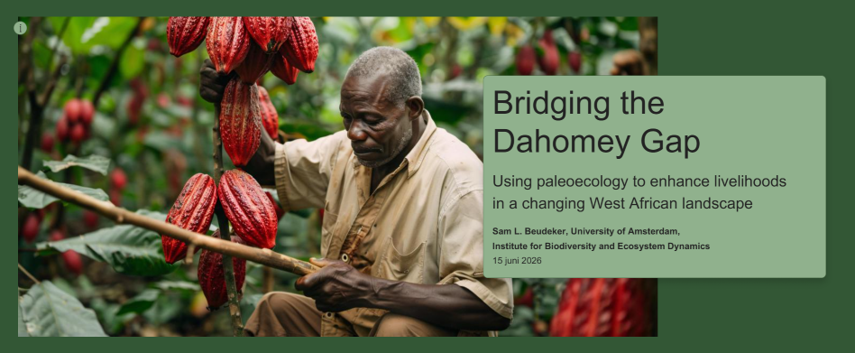
As a case study, I focused on the Dahomey Gap in West Africa, a forest–savanna transition zone that interrupts the continuous Guineo-Congolese rainforest belt. This region is not a fixed ecological boundary, but a shifting mosaic shaped over time by climate variability, fire, and human land use.
ArcGIS Storymap
To explore this system, I combined palaeoecological understanding with spatial environmental data in an ArcGIS StoryMap. The StoryMap links past, present, and future perspectives. It introduces the ecological diversity of West Africa and places the Dahomey Gap within this broader regional setting, before showing how the landscape has changed through time as forests and savannas expanded and contracted in response to long-term climate variability.
It then moves to present-day environmental conditions using remote sensing and spatial datasets, including land use, population density, nighttime lights, climate seasonality, and elevation. Together, these layers show how strongly the modern landscape is shaped by human activity and how natural ecosystems are increasingly fragmented within agricultural and settlement mosaics.
The final part of the StoryMap connects these long-term and present-day insights to future environmental change. Increasing land-use pressure and climate variability are expected to place further stress on ecosystems in the region. However, the long-term record also shows that this landscape has historically maintained ecological functionality under changing conditions, suggesting that resilience depends on diversity and flexibility rather than a single stable state.
This leads to a focus on sustainable land management that works with ecological processes rather than against them. Strengthening ecosystem services such as soil fertility, water regulation, biomass production, and climate buffering is essential for both ecological stability and human well-being. Nature-based systems such as agroforestry and diversified landscape mosaics can play an important role in maintaining productivity while increasing resilience under future climate change.
Importantly, the transition toward more nature-based systems has different implications across regions. In many parts of Europe, such changes may be perceived as a reduction in agricultural productivity. In contrast, in many parts of Africa, where livelihoods are more directly dependent on climate-sensitive and low-input farming systems, nature-based approaches can strengthen rather than reduce productivity by improving soil quality, water availability, and ecosystem stability. This makes such strategies not a downgrade, but a potential pathway for climate adaptation and livelihood improvement.
Visually Attractive and Easy to Understand Storytelling
Scientific research often remains within specialist audiences, while visual storytelling can make complex environmental systems more accessible and engaging. Importantly, visually attractive and intuitive ways of presenting science are essential for communicating environmental change: they help translate complex and often abstract scientific knowledge into something that is easier to understand. Particularly in less educated parts of the world and in cases where the local people should be mobilized, it is highly important to clearly transfer scientific knowledge.
The Future
Looking ahead, I hope to continue working at the intersection of ecology, Earth system science, and society. My aim is to contribute to approaches that strengthen ecosystem services while improving human livelihoods, particularly in regions where people are most directly dependent on natural resources and most vulnerable to environmental change. Ultimately, I hope to work in ways that help align ecological understanding with practical solutions that improve both environmental resilience and human well-being.
The StoryMap associated with this project will be sent over into the annual held ArcGIS Storymap student competition by ESRI. It can be accessed via the following https://arcg.is/0HSn480. Find out more about the BSc Future Planet Studies program at the University of Amsterdam here.
 Ecology of the past