In the coming weeks lots of pollen can be collected. Due to the nice, sunny weather birch trees are in full flower and release their pollen into the air. This is of course not so good news for the individuals sensitized to the pollen of birch because they can suffer from hay fever symptoms.
Next to birch also the ash trees are flowering. The black buds of the ash branches have bursted, releasing the purple anthers (first figure). Among those anthers you can see some that release their yellow pollen (second figure).
For more about our project on pollen and pollution in the Netherlands see other posts:
An African Pollen Database data steward training event was held at the Institute for Biodiversity & Ecosystem Dyanmics (University of Amsterdam, 27-29 January 2020) where training in the use of the Neotoma database was provided by Eric Grimm. The participants are now enabled curate and archive data within Neotoma. If you have a palaeoecological data set that you would like to contribute to Neotoma, or if you would like training as well, these people can now help you. Contact details below:
The three part guest blog posts “Can you go back?” by Prof. Mark Bush (Florida Institute of Technology) contained images collated by Mark over his career, here they are all together for you to enjoy.
By Rachel Sales (Florida Institute of Technology, USA)
My bike is angry at me.
I’m rattling down an unpaved road in the Ecuadorian Amazon. The brakes screech at every turn, and the chain is close to falling off. Unsurprisingly, the rain is pouring, turning the road into a maze of puddles and mud. The road follows the Anzu River, and I can hear its roar off to my right.
I’m forcing a perfectly innocent bike to brave the Amazon because this road leads to the Herbario Amazónico of the Universidad Estatal Amazónica (ECUAMZ). ECUAMZ (an acronym for “Ecuador Amazon”) is the only herbarium in the Amazon, and contains a repository of plant specimens for preservation and help with field identifications. It was established by Dr. David Neill, a specialist in the Fabaceae (legume) family and world-renowned expert in tropical botany, and Dr. Mercedes Asanza, the coordinator of the herbarium. They have agreed to mentor me over the summer and teach me about tropical plants. The Herbario Amazónico, which contains over 17,000 vascular plant species, is the perfect place to learn.
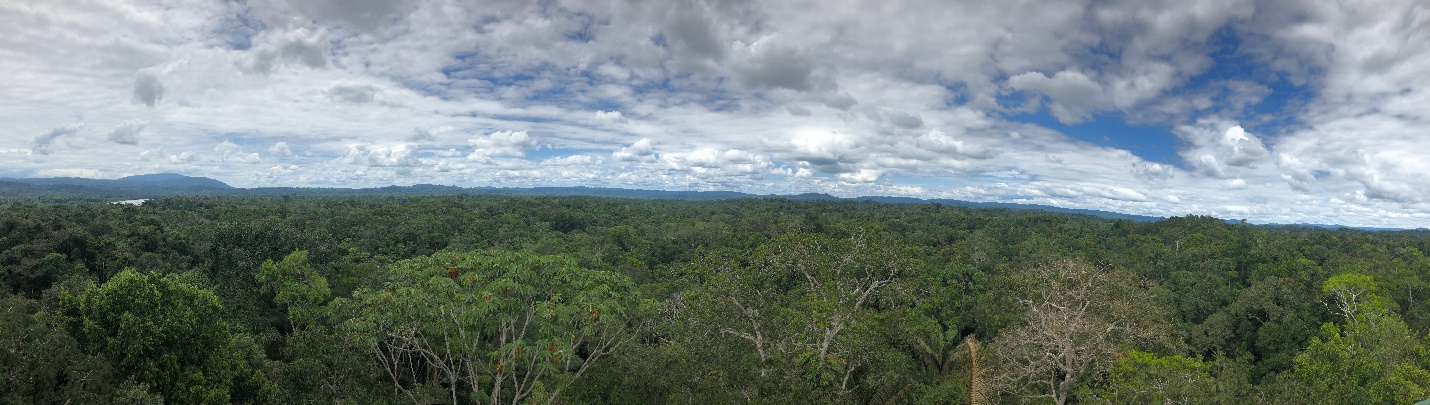
The view from the top of the tower at Jatun Sacha.
Rachel Sales, Bryan Valencia, and Majoi de Novaes Nascimento coring a different lake. In this picture, we have just pulled a core of mud up from the bottom of the lake. Photo credit: Seringe Huisman
I am sitting on the shore of Lago Condorcillo in Southern Ecuador, after a long day of travel, trying to control my shivering. At roughly 10,500 ft. above sea level, the lake is very cold, with wind that howls over the barren hills dotted with giant boulders. The lake is also almost always blanketed by thick fog and pelted by driving rain. When you’re surrounded by the thick fog punctuated by lightning bolts, it’s easy to believe that some lost civilization lurks just out of sight. Tonight we are experiencing lightning storms, which is adding to the feeling that some angry, ancient life form must live at Lago Condorcillo.
Tomorrow, I will be out in the cold and rain, balancing on an inflatable boat and fighting frostbite. Mark Bush, who is my Ph.D. advisor, Courtney Shadik, who is my lab partner and tent buddy, and I will be collecting cores of mud from the bottom of Condorcillo. We will create our rig for coring by tying two inflatable boats together, and placing a wooden platform between them. Mark, Courtney, and I will then collect our mud cores from this platform.
As I’m contemplating the hazards of camping in a lightning storm, Mark says, “Tell me everything that went wrong today.” Courtney pulls a sleeping bag closer to her. I begin to describe how Google Maps can’t seem to understand distance in the Andes, and so traveling to Lago Condorcillo took much longer than we anticipated. Courtney laughs beside me and adds, “We don’t have any matches to start a fire.” Despite our troubles, I am grinning from ear to ear, no doubt spoiling the grim mood Mark is attempting to cultivate and Lago Condorcillo is doing its best to enforce.
The International Conference on Past Plant Diversity, Climate Change, and Mountain Conservation was aimed to address this question, with a focus on mountain (montane) species. As climate warms, there are several outcomes for montane species. They can migrate upslope, go extinct, or adapt to the warming conditions. Given these options, we got together to discuss our most recent datasets, and the best strategies for the conservation of montane species. Effective conservation strategies are crucial for the survival of many rare and endemic montane species, because climate is indeed warming, regardless of what Trump or Fox News tries to tell people.
The Netherlands Annual Ecology Meeting (NAEM) 2019 takes place in the 12 and 13 February. This annual showcase of predominantly Dutch based ecological research will take place, as usual, at Conference Centre “De Werelt” (Lunteren). I am particularly excited this year as, along with Marielos Pena Carlos and Patrick Jansen, I am co-convening a session on “Tropical Ecology”. The first time I have contributed to the program in this way. Our session will be on the second day of the conference and contain the following exciting presentations:
15:00 Predator avoidance and prey tracking in a Neotropical forest (Constant Swinkels, Wageningen University & Research)
15:20 The role of fig volatiles in pollinator specificity and fig diversity (Aafke Oldenbeuving, Naturalis Biodiversity Center)
15:40 Mangrove Atlantis: Can mangroves keep up with extreme land-subsidence? (Celine van Bijsterveldt, Royal Netherlands Institute for Sea Research)
16:00 Break
16:10 The fate of forests in agro-forest frontier landscapes, implications for conservation (Madelon Lohbeck, Wageningen University & Research)
16:30 Trends in the variability of Specific Leaf Area of paramo vegetation during succession (Marian Cabrera, University of Amsterdam)
16:50 Succession dynamics of tree and soil fungal communities in regenerating tropical rainforests are strongly influenced by regional species pool and abiotic factors (Irene Adamo, Naturalis Biodiversity Center)