Mapping Ancient Africa: Seminar 14

February 28, 2024
WDG

The first Mapping Ancient Africa online seminar of 2024 will take place on 28 February (17:00 CET). 

  • Speaker:  Mathias Vinnepand (Leibniz-Institute for Applied Geophysics Hannover, Germany)
  • Title: An age-depth model for Lake Bosumtwi (Ghana) to reconstruct one million years of West African climate and environmental change
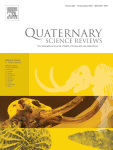
  • Related publication: Vinnepand, M., Zeeden, C., Wonik, T., Gosling, W., Noren, A., Kück, J., Pierdominici, S., Voigt, S., Abadi, M.S., Ulfers, A., Danour, S., Afrifa, K. & Kaboth-Bahr, S. (2024) An age-depth model for Lake Bosumtwi (Ghana) to reconstruct one million years of West African climate and environmental change. Quaternary Science Reviews 325, 108478. DOI: 10.1016/j.quascirev.2023.108478

The seminar will be delivered via Zoom. The link for the seminar can be obtained from the MAA Slack channel or by contacting the chair of this seminar (Stefanie Kaboth-Bahr). If you want to know more about the Mapping Ancient Africa project visit our web pages and please do not hesitate to get in contact if you want to get involved.

INQUAlogo

An age-depth model for Lake Bosumtwi (Ghana) to reconstruct one million years of West African climate and environmental change

January 8, 2024
WDG

Vinnepand, M., Zeeden, C., Wonik, T., Gosling, W.D., Noren, A., Kück, J., Pierdominici, S., Voigt, S., Abadi, M.S., Ulfers, A., Danour, S., Afrifa, K. & Kaboth-Bahr, S. (2024) An age-depth model for Lake Bosumtwi (Ghana) to reconstruct one million years of West African climate and environmental change. Quaternary Science Reviews 325, 108478. DOI: 10.1016/j.quascirev.2023.108478

AFQUA 2018 – day 6

July 20, 2018
WDG

AFQUA: The African Quaternary environments, ecology and humans
2ndInternational Conference and Workshops
14-22 July 2018-07-15 National Museum, Nairobi, Kenya

Day 6

The final day of talks at AFQUA 2018 took a more applied approach in the first session “Applying the Quaternary: The role of the past in supporting the future”. This session focused on how we can focus Quaternary science to produce outputs that directly meet concerns and needs of society. Examples included the quantification of the fossil charcoal record to provide insights into the nature and impact of fires in the past (C. Adolf), how we can use information on past vegetation change and disturbance factors to anticipate how ecosystems on Madagascar might respond to future changes (E. Razanatsoa), and how climate histories can be extended through tree ring data (D. Colombaroli).

This slideshow requires JavaScript.

Continue Reading

Blog at WordPress.com.