Nick and Will with Carman (director of the Pindo Mirador biological station)
Three members of the PCRG (William Gosling, Encarni Montoya and Nick Loughlin) visited Ecuador (November-December 2013) to develop collaborations with Ecuadorian institutions, recover more lake sediments, and find new potential sites for projects. Below are some photos from:
Lake Pindo,
Lake Huila, and
Lake Erazo.
Full reports on specific aspects of the fieldwork to follow.
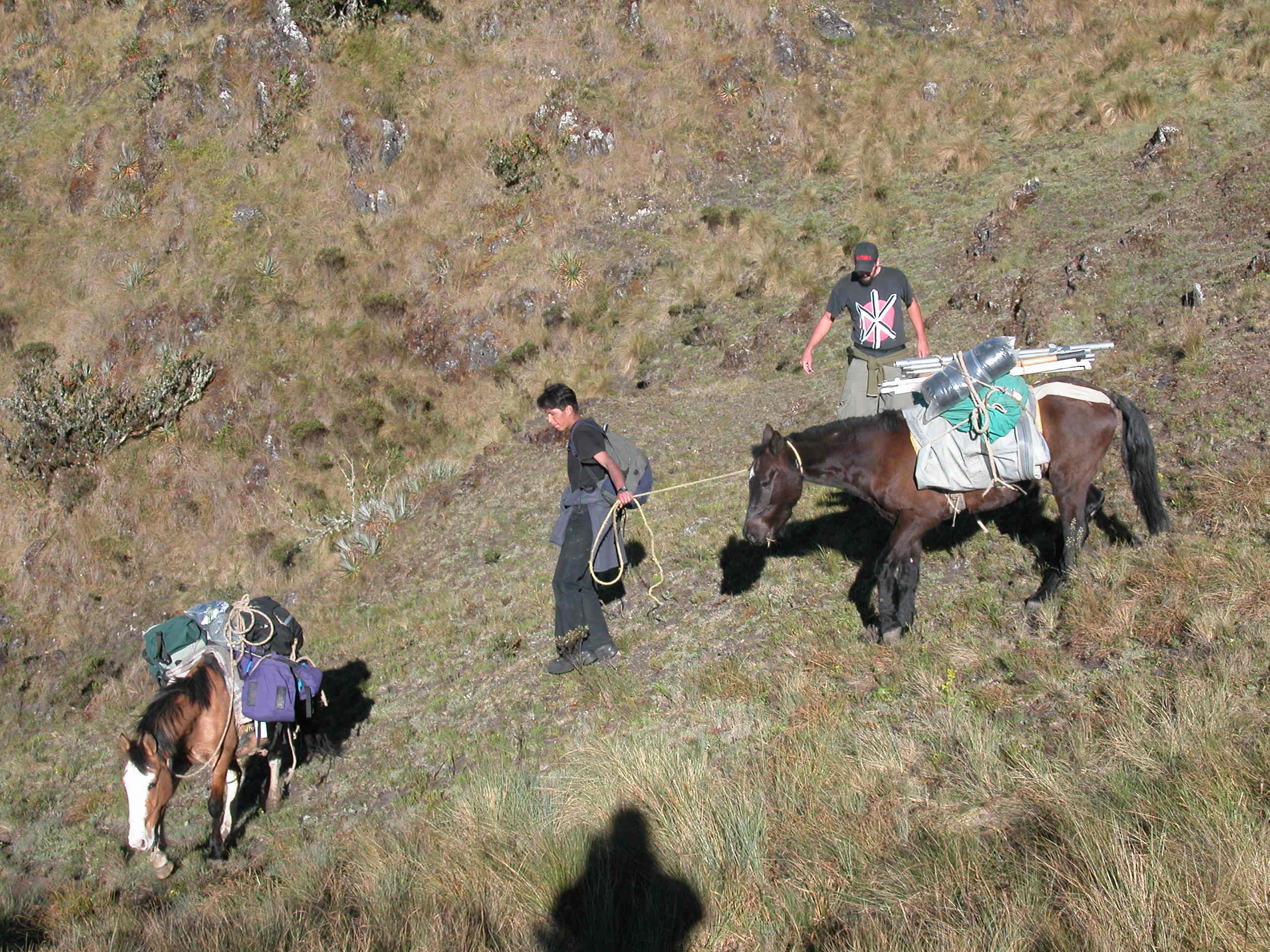
Trecking with sediment corer in the high Andes of Peru
When it comes to collecting sediments from lakes its all about having the right tools for the job. Working in remote areas of the tropics we tend to favour the Colinvaux-Vohnout corer; supplied by Vince Vohnout at Geo-core). The advantages of this system are:
its light-weight nature (can be backpacked or donkeyed into field sites), and
the cam system (which allows hammering to penetrate tough sediments).
Eric Martinez carrying an Avon Redstart back out from Laguna Khomer Kotcha (Williams et al., 2011a)
With the right platform (two banana boats and an A-frame) we have manged to retrive c. 20 m of sediment from 20 m of water (c. 40 m of drill rod extended); Lake Pacucha, Peru (Hillyer et al., 2009). More typically we use two Avon Redstart inflatables and a platform following the design of Colinvaux et al. (1999).


 Ecology of the past