
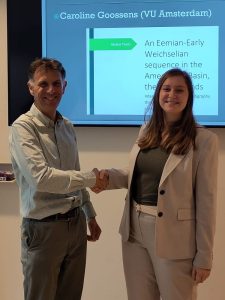
On Friday 24 May 2024 the Palynologische Kring (Dutch palynological society) held a seminar series and laboratory workshop at the Institute for Biodiversity & Ecosystem Dynamics (University of Amsterdam). During the afternoon we had the annual meeting of the society, the presentation of our MSc Thesis prize, four seminars and two laboratory demonstrations. The MSc thesis prize “Florschütz Award” was won by Caroline Goossens (VU Amsterdam) for her thesis entitle: “An Eemian-Early Weichselian sequence in the Amersfoort Basin, the Netherlands”; the project was supervised by Natalie Van der Putten, Cees Kasse and Jeroen Schokker. We hope that Caroline will present her thesis at a future Palynologishe Kring meeting.
The talk series was kicked off by Nina Witteveen (University of Amsterdam) who presented part of her PhD thesis (currently awaiting defense), entitled: “Long-term forest recovery in Amazonia insights from phytolith analysis”. Nina discussed the impact of past peoples on the vegetation of Suriname based on her work identifying phytoliths in soil samples collected at varying distances from an archaeological site. The second talk was given my Amanda Henry (Leiden University) who demonstrated how the analysis of starch grains extracted from archaeological context can provide insights in to past diets. She used these evidences to suggest that early humans and Neanderthals had a similar diversity of plants in their diets. The third talk was given by University of Amsterdam MSc researcher Teye Aukes and focused upon his identification of diatoms from an swampy lagoon environment near Ostia (Italy). He drew conclusions from these data about the antiquity of salt production in ancient Rome. The final talk was given online by Welmoed Out (Moesgaard Museum) who presented a detailed analysis of inter- and intra-analyst variability in phytolith morphometric analysis.
After the seminars we moved upstairs to the microscope laboratory where Nina Witteveen and Ana Smuk (University of Groningen) showed off phytoliths from their study site in South America and the Netherlands.


 Ecology of the past