An interview with Phil Jardine

July 1, 2014
philjardine

Well, we’ve heard from Wes and Adele, and now it’s my turn (Phil Jardine) for a bit of a chat on the “Ecology of the past” YouTube channel. Similar to the previous interview videos, I’m talking about my role on the Bosumtwi pollen chemistry project, and what I’ve done (academically speaking) prior to coming to the Open University. Enjoy!

For more videos check out the “Ecology of the past” YouTube channel.

An interview with Adele Julier

May 26, 2014
philjardine

Following on from Wes Fraser’s insightful and revealing interview, cactus-hugger Adele Julier tells us about her academic background and her role on the Lake Bosumtwi pollen chemistry project.


For more videos check out the “Ecology of the past” YouTube channel.

One short story and five scientific papers thinking about different aspects of ecological change through time.
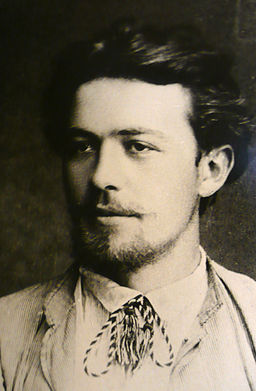
Chekhov in 1889

Chekhov in 1889 (http://tinyurl.com/ny2msd9)

Short story:

Checkhov, A. (1889) The Pipe

SUMMARY (Will): People have long been concerned about environmental change. Observations of phenological shifts, degradation of ecosystem services and climate change are clearly presented in Checkhov’s “The Pipe” (1889).The key difference is today we have a better idea of why these things are happening!?

Scientific papers:

Garcia, R.A., Cabeza, M., Rahbek, C. & Araújo, M.B. (2014) Multiple dimensions of climate change and their implications for biodiversity. Science 344 1247579
SUMMARY (Phil): This review highlights the alternative metrics used to quantify climate change at different spatial scales, each with its own set of threats and opportunities for biodiversity. It’s a very relevant paper for palaeoecologists, with implications for how we think about climatic estimates we generate, how we interpret ecological shifts in the assemblages we study, and for demonstrating the importance thinking spatially as well as temporally. It also shows how important palaeoecological data is for setting baselines and putting projected climatic change into context.

Garzón-Orduña, I.J., Benetti-Longhini, J.E. & Brower, A.V.Z. (2014) Timing the diversification of the Amazonian biota: butterfly divergences are consistent with Pleistocene refugia. Journal of Biogeography, early online.
SUMMARY (Will): Butterfly species diverged in the Neotropics during the Pleistocene (probably).

Mitchard, E.T.A. et al. (2014) Markedly divergent estimates of Amazon forest carbon density from ground plots and satellites. Global Ecology and Biogeography, early online.
SUMMARY (Will): It is difficult to work out how much carbon is in a tropical forest.

Stansell, N.D., Polissar, P.J., Abbott, M.B., Bezada, M., Steinmann, B.A. and Braun, C. (2014) Proglacial lake sediment records reveal Holocene climate changes in the Venezuelan Andes. Quaternary Science Reviews. 89, 44 – 55.
SUMMARY (Hayley): A study of three lake sediment records in the Venezuelan Andes to look at patterns of glacial variability, and how glaciers might have responded to changing climatic conditions during the last c. 12,000 years.

Still, C.J., Foster, P.N. & Schneider, S.H. (1999) Simulating the effects of climate change on tropical montane cloud forests. Nature, 398, 608–610.
SUMMARY (Nick): The paper attempts to model the impact of climate change on a number of cloud forests around the world by simulating atmospheric parameters at the last glacial maximum (LGM) and at twice today’s CO2 level. The models agrees with palaeoecological data of a downslope migration of the cloud forest at the LGM, while the 2xCO2 model shows reduced cloud cover and increased evapotranspiration, which results in a significant reduction in cloud forest supporting land area.
An interview with Wes Fraser

May 6, 2014
philjardine

Our next video to be uploaded to the ‘Ecology of the past’ Youtube channel is a short interview with Wes Fraser, Co-Investigator on the Bosumtwi project and developer of the pollen chemistry ultraviolet-B proxy. Wes talks about his role on the project, his background, and what excites him most about this current research. Similar ‘talking heads’ style interviews will follow over the coming weeks for each of the key researchers on the project.

For more videos check out the “Ecology of the past” YouTube channel.

A sociometabolic reading of the Anthropocene

March 28, 2014
philjardine


Human impacts on environments

Human impact on environments takes many forms and varies in space and time

Phil Jardine on:

Fischer-Kowalski, M., Krausmann, F. & Pallua, I. (2014) A sociometabolic reading of the Anthropocene: Modes of subsistence, population size and human impact on Earth. The Anthropocene Review, 1(1), 8 – 33.

Regardless of whether it’s worthwhile designating the “Anthropocene” as a new geological epoch (I have my doubts), determining the trajectory of human impact upon the Earth system is important. It provides context for how people see their relationship with natural systems and resources, and can help shape environmental policy and its acceptance by the public. But where to put the onset of this impact – where does the Anthropocene start? The authors of this paper belong to the Institute of Social Ecology at Klagenfurt University, Austria, and take a social sciences approach to the problem. Rather than focusing on physical evidence in the environment, as a geologist might do to delimit a geological epoch, Fischer-Kowalski et al. use a model where human impact is measured as the product of population size, affluence (= energy available per person) and technology, summed over three modes of subsistence: hunter-gatherers, agrarian and industrial. This avoids problems of time lags between human activity and the signature it leaves, and allows the authors to pull apart different driving factors across different societal types.

Using this approach shows a definite shift at around AD 1500: human impact was gradually increasing prior to this, but there is a sharp upturn at ~AD 1500, energy use becomes more important for amplifying the impact of population growth, and a shift from biomass to fossil fuel driven energies enhances this further. While there are problems with this approach – determining energy throughput for long-dead societies will always involve a lot of extrapolation from modern patterns – the authors are careful in stating their assumptions, and going through possible issues with the model itself. It would have been nice to see a comparison between the model output and the empirical evidence though, to help bridge the gap between these two different takes on the same question.

The Anthropocene Review – reviewed

March 26, 2014
WDG

AnthropoceneReviewThe Anthropocene Review is a new journal focusing on the impact of humans on planet Earth through time; information on the latest publications can be found on the associated blog.

Given that much of the research we are interested in relates human-environment interactions in the past we decided to take a closer look at the range of articles being covered by this journal. Our thoughts on seven articles published in the first issue of The Anthropocene Review will appear in a series of blog posts soon. To get started here are a list of the papers we will be covering:

Full Anthropocene Review table of contents here.


“Ecology of the past” YouTube channel

March 19, 2014
philjardine

"Ecology of the past" YouTube channel launched

“Ecology of the past” YouTube channel launched

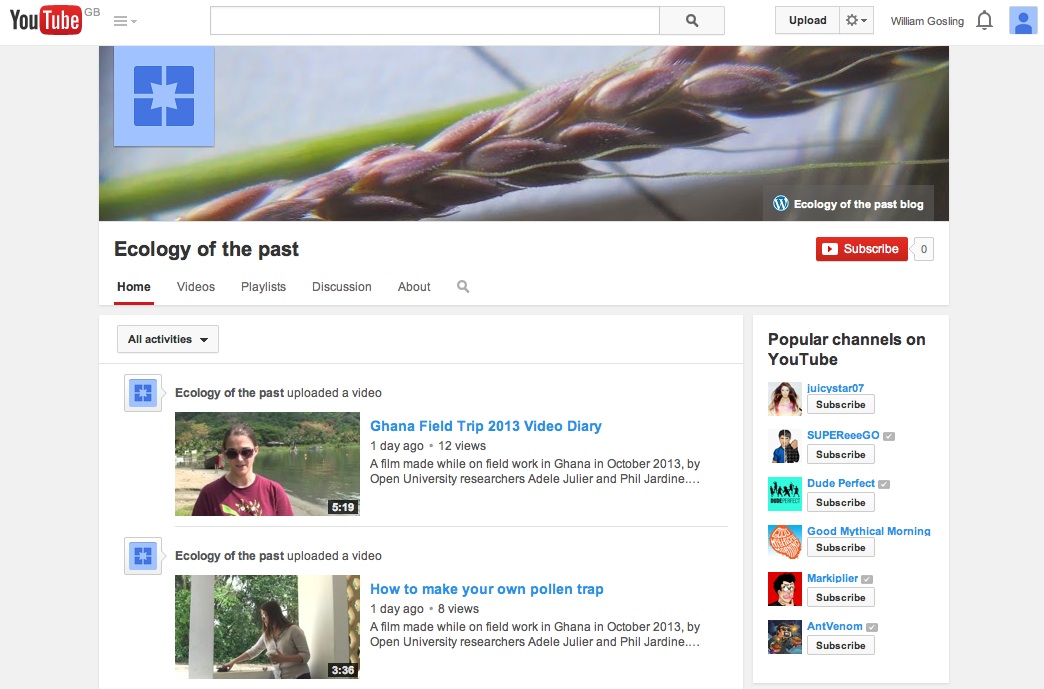
With the redesign and refocusing of the blog underway, I’m delighted to announce the launch of our very own “Ecology of the past” YouTube channel. Initially this will host videos produced as part of the Lake Bosumtwi pollen chemistry project, which includes a strong emphasis on impact and outreach activities. The videos are being targeted to a secondary school/sixth form audience, and will demonstrate both how we are doing the research and who we are as academics, highlighting the different roles and career pathways within the team. As time goes on this channel will be a platform for videos from other members of the research group, again showing who we are, what we do and how we do it.

For now, here are the first two videos: a diary of the field trip to Ghana that Adele and I went on last Autumn, and an accompanying piece showing how you too can make your own pollen trap. Enjoy!

A new addition to the Palaeoenvironmental Change Research Group

August 30, 2013
philjardine

Phil Jardine

Phil Jardine

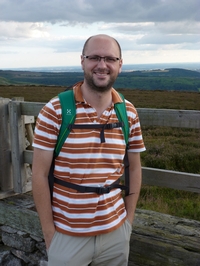
My name’s Phil Jardine, and I’ve recently joined the Palaeoenvironmental Change Research Group as a post-doc, on the NERC-funded ‘500,000 years of solar irradiance, climate and vegetation changes’. For this project I’ll be analysing the chemistry of pollen grains from a 500,000 year long sediment record from Lake Bosumtwi in Ghana, with the aim of generating a long-term historical record of solar irradiance.

Before coming to the Open University I was based at the University of Birmingham, where I did PhD and post-doc research on North American pollen records from the early Palaeogene (~65 – 45 million years ago). For this work I was particularly interested in the role of climate in driving changes in plant communities, especially during a rapid global warming event 55 million years called the Paleocene-Eocene Thermal Maximum (PETM). Having worked for some time now on pretty old material, I’m looking forward to researching something a bit more recent – if you can call the last 500,000 years recent – and going out to Ghana and looking at real, live, tropical plants.

If you would like to get in touch about the Lake Bosumtwi project, or something else pollen related, please feel free to get in touch.

BES Macroecology meeting

August 5, 2013
philjardine

BES Macroecology SIG

BES Macroecology SIG

Last week I attended the annual meeting of the British Ecological Society Macroecology Special Interest Group (or BES Macroecology SIG for something a bit more manageable) at the University of Sheffield. Macroecology deals with ecological patterns and processes that occur over large spatial and temporal scales, and so is a natural fit for a lot of palaeoecological data.

The organisers deliberately moved away from the standard conference format of back-to-back talks, and instead built in lots of time for discussions around several themes (‘provacations’) that addressed the current status of macroecology and possible future directions for it. Several areas for progress were identified here, including finding more efficient ways of generating, curating and accessing large (global scale) datasets, increasing dialogue between numerical modellers and empirical ecologists, and more statistical and computational training for undergraduate ecologists and biologists.

Sessions of presentations were also formulated to encourage discussion and debate, with either rapid, five-minute presentations or longer methodological talks forming the starting point for further discourse. I struggled enormously with the five-minute time limit during my talk (conference talks are often built around a 15 minute slot) but hopefully interested a few people in the uses of 60 million year old pollen for addressing macroecological questions.

 A workshop on ‘Spatial analysis in R’ followed the two-day meeting. This was taught by Barry Rowlingson, and was co-organised by the Macroecology and Computational Ecology SIGs. Barry started by introducing the programme R and then went on to demonstrate its uses for handling, mapping and analysing spatial data. This type of analysis was largely new to me, and this workshop was a brilliant introduction to what R can do with geographical data.

To join these British Ecological Society SIGs and find out about other groups visit the BES SIG pages by clicking here.

Blog at WordPress.com.