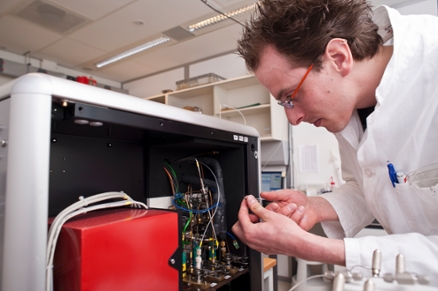
Vacancy: Physical-chemical research technician with management skills (salary scale 10)
Institute for Biodiversity & Ecosystem Dynamics
University of Amsterdam
Closing date: 22 October 2017
This position will link strongly with the IBED Department of Ecosystem & Landscape Dynamics which aims to improve our understanding of the functioning and dynamics of abiotic and biotic components of (geo-)ecosystems across landscapes through time. To achieve this aim we make use of a wide range of state-of-the-art research facilities provided by IBED (for more information on facilities click here).
For full details of the vacancy and how to apply click here, or visit Academic Transfer.
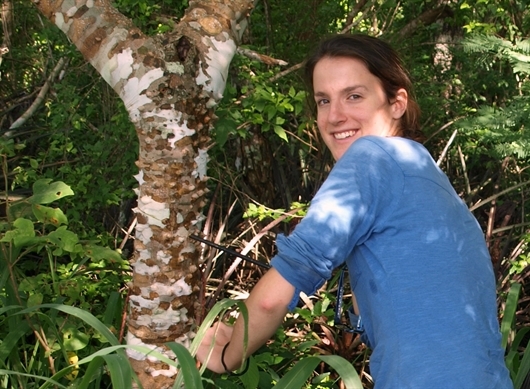
Natasha Barbolini getting a free mud treatment after some heavy rain.
Recent findings of monsoonal activity in Asia as old as 45 million years raises the fascinating possibility that these Monsoons may have triggered a global shift from the warm ice-free Greenhouse world, to the bi-polar Icehouse conditions the Earth still experiences today. Increased erosion and weathering of the uplifted Tibetan Plateau and Himalayas is currently advocated as the primary trigger for the enigmatic pCO2 drawdown that led to global cooling and rapid growth of the Antarctic ice sheet.
IBEDs Crystal McMichael hard at work sampling sediments in the Andes
Insights into recent field work in Ecuador by a team lead by Crystal McMichael can be found in a recent blog from our collaborators at the Instituto Geofisico, Escuela Politecnica Nacional, Quito (Ecuador).
This time you are reading a message from a non-expert in paleoecology. My name is Masha and I will spend the next two years on a very exciting postdoctoral fellowship funded by NWO (Dutch National Science Foundation) under their Rubicon scheme in close collaboration with William Gosling (University of Amsterdam).
BSc student Henk Cornelissen presents his thesis work on identifying charcoal characteristics that represent specific fire parameters, such as burn temperature. Photo: C. McMichael
Wimbledon tennis fortnight is on its way, but we’ve had our own palaeoecology fortnight here at the Institute for Biodiversity & Ecosystem Dynamics at the University of Amsterdam. We’ve seen seminars on reconstructing past landscapes and climates on timescales of decades to millions of years, and on spatial scales ranging from single sites to the entire Earth. Our presenters included our BSc students, MSc students, PhD candidates, faculty members, guest researchers, and even an internationally known palaeoclimatologist and contributor to the IPCC (Intergovernmental Panel on Climate Change) reports!
BSc student Isa Mulder presents her thesis on reconstructing glacial-aged fire histories from the Andes. Photo: C. McMichael
We began with a three-day series of presentations from our BSc students in the Future Planet studies program. William Gosling and I had four students that presented their final theses. We continued with a seminar series organized by the Palynologische Kring (the Dutch palynology society). Eric Grimm, a guest researcher at UvA, presented a high resolution record of hydrological variability, vegetation, and fire from the Great Plains of the United States. Guest researcher Carina Hoorn showed us how the Amazon River formed, and the associated plant turnover that occurred during the Neogene. PhD student Keith Richards explained to us why the Arctic seal became land-locked in the Caspian Sea over 2.6 million years ago. PhD student Suzette Flantua presented a multi-proxy approach to exploring the biogeographic history of the Andes Mountains. She came back the following day to present her PhD thesis entitled, “Ecosystems in Pleistocene Latin America”. And we are happy to report that Suzette is now Dr. Flantua!!
Suzette Flantua highlights the work in her PhD thesis. Congratulations Suzette! Photo: C. McMichael
Dr. William Gosling and Prof. Jonathan Overpeck discuss the future of palaeoecology and upcoming collaborations. Photo: C. McMichael
Our presenters included males and females from multiple countries at an array of career stages. I am glad to have been a part of this fortnight, and I am glad that our current students got to see such a diverse integration of people and palaeoecology. My hope is at least one of these students has been inspired by these seminars, and will develop the same passion for palaeoecology as what we’ve seen here over the last two weeks.
Eric Grimm: A high-resolution record of hydrologic variability, vegetation, and fire from the Northern Great Plains, North America
Suzette Flantua: Assembling the biogeographic history of the Northern Andes – A multi-proxy approach
Carina Hoorn: The Amazon at sea: Onset and stages of the Amazon River from a marine record, with special reference to Neogene plant turnover in the drainage basin
Keith Richards: Why did the Arctic seal, Phoca hispida, become land-locked in the Caspian Sea 2.6 million years ago? : Palynology and foraminifera explain how
New paleoclimatic perspectives on the future of terrestrial systems: bigger change, higher confidence? Jonathan Overpeck
The University of Arizona
Numerous assessments of future freshwater and terrestrial system change have highlighted the potential for unprecedented change in the 21st century given continued emissions of greenhouse gases (GHGs) to the atmosphere; the risk to biodiversity is also believed to be high. The basis for these assertions are strengthened by recent observed ecosystem change, as well as by a new global compilation of climate and vegetation change over the last deglaciation indicating that most, if not all, dominantly natural landscapes on the planet are at high risk of significant transformation given the projected magnitude of warming that is likely in the future absent major reductions in global GHG emissions. At the same time, new paleoclimatic results indicate that the Amazon forests may be more resilient to future change than previously thought, whereas the risk of human deforestation associated with multi-year “megadrought” might be higher than previously believed. A growing body of literature highlight that drought and megadrought risk around the globe is going to be a bigger problem than widely thought. We know with great confidence that warming will continue as long as GHG emissions continue, and this means more drying of terrestrial systems is likely over much of the planet. As a result, droughts will become more severe, longer and frequent as long as GHG emissions are not reduced significantly. The ability of precipitation increases to mitigate the ecological and hydrological impacts of continued warming is especially diminished in the many regions of the globe where multi-decadal megadrought is likely, an assessment made more challenging by the growing realization that that state-of-the-art climate models may underestimate the risk of future megadrought. Existing global climate change assessments may thus be underestimating the challenges to terrestrial water and ecoystems under continued climate change.
My second pair articles from Vegetation History & Archaeobotany that I would like to highlight look at the impacts of volcanoes and climate on vegetation change. Specifically these explore:
I am delighted to report that I have recently been appointed as an Associate Editor for the journal Vegetation History & Archaeobotany (VHA). The journals scope is global and covers Quaternary environmental and climatic change, with a specific focus on the Holocene and pre-historic human impacts on landscapes; often linking palaeoecological and archaeological research. My remit with VHA is to provide expertise on tropical, and in particular South American, studies. Recent articles in VHA with a South American focus include:
Assessing the influence of glacial-interglacial climate changes on the dry forest vegetation along the southern edge of Amazonia (Whitney et al., 2014),
Modern pollen-vegetation relationships in Brazil and Argentina (Rodrigues et al., 2016).
I hope that over the next few years we can publish some more exciting articles on the tropics in VHA and I would therefore like to encourage you to submit interesting high quality original research, reviews, or short articles for our consideration.
To find out more about the journal and submit an article click here.

 Vacancy: Physical-chemical research technician with management skills (salary scale 10)







 Ecology of the past