Mapping Ancient Africa: INQUA Rome session (updated)

July 16, 2023
WDG

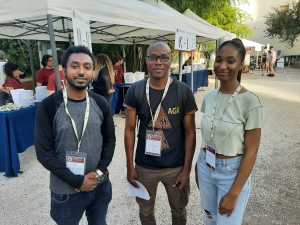
Mapping Ancient Africa participants at the INQUA Rome ice breaker event ready for action! Left to right: Bahru Zinaye Asegahegn, Alfred Houngnon, Busisiwe Hlophe.

The Mapping Ancient Africa (MAA) project has a double session of talks and a poster session at the INQUA congress in Rome 2023. Our session will be on Wednesday 19 July. Unfortunately a number of the originally planned speakers could not make it to Rome due to a combination of not obtaining visas, logistical challenges and ill health. We wish them all well and hope that they will continue to be involved in the project. Further, many thanks to all those who have agreed to step up and give a presentation at a late notice. Below is an updated schedule correct as of Sunday 16 July based on the information contained on the INQUA Rome App; if you are aware of any further problems or changes please let me know ASAP!

If you are at the INQUA Rome congress please come along to our talks and posters in Session 64: Mapping Ancient Africa: Climate, Vegetation & Humans.

Part 1: 08:30-11:00

  • Giosan et al. When the desert was a lake: Providing context for Homo sapiens development in the northern Kalahari
  • Chase et al. Paleolakes and socioecological implications of glacial “greening” of the South African interior
  • Blinkhorn et al. Evaluating refugia in recent human evolution in Africa
  • Aureli et al. Homo sapiens behaviour and adaptation in East Africa. New evidence from an open-air site in a modern Ethiopian savannah environment: the GOT10 site
  • Effiom et al. Late Holocene palaeoecological studies at Lake St Lucia, KwaZulu-Natal
  • Tallavaara et al. Pan-African Climate and Vegetation over the Quaternary and Implications for Human Distribution
  • Quick et al. Palaeoenvironments of the Cape Floristic Region: New research & current developments

Part 2: 11:00-13:00

Continue Reading

PoA35: Perspectives

December 24, 2021
WDG

The festive period blog post related to the recent volume of Palaeoecology of Africa (published entirely open access online) picks out the four Perspective articles. We included Perspective articles within the volume to place the volume in context and showcase some topical ideas, with the overall objective of stimulating further debate on past environmental change in Africa.

The opening two papers of the volume are both Perspectives. Louis Scott opens the volume with a short history of the Palaeoecology of Africa series. He sketches out the rich and varied history of the publication which, commenced in 1966 as a collection of eight reports (van Zinerden Bakker 1966), includes seven conference proceedings, and has been edited at various times by Eduard Meine van Zinerden Bakker, Joey Coetzee, Klaus Heine and currently Jürgen Runge. The second article, Lézine et al., tracks the rise and revival of the “African Pollen Database” (APD) from its formation in 1996, through to its decline in 2007, and up to its re-initiation in 2019 from which this volume of PoA has sprung. Personally, I think the huge enthusiasm shown to participate in this volume and to contributing to collaborative initiatives like the APD, demonstrate the strength of the field and can only bode well for future research.

The other two Perspective papers showcase nicely some of the motivation behind the enthusiasm for palaeoecological research. Lynne Quick focuses in on the hyper-diverse Cape Floristic Region of southern Africa and what records of past vegetation and climate change can tell us to reveal these origins and assist in the conservation and management of this ecological wonder today. The final perspective, by Lindsey Gillson, rounds off the volume by thinking more broadly about how palaeoecological research can be utilised in the development of conservation policy in Africa. She focuses particularly on how these records can provide insights into drivers of change in the past (climate, fire, and herbivory) and how this can then be used to guide conservation and enrich our understanding how the landscape we see in Africa today came to be.

To find out more download all the articles for free:

Continue Reading
Blog at WordPress.com.