
The International Continental Scientific Drilling Program (ICDP) Deep Chew Bahir (DeepCBH) drilling workshop took place in Addis Ababa (Ethiopia) between the 30 June and 3 July 2026. The workshop brought around 50 scientists to Ethiopia, with a further 30, or so, in a satellite meeting in Potsdam (Germany) and online. The workshop was lead by Asfawossen Asrat, Verena Foerster, Daniel Gebregiorgis and Stefanie Kaboth-Bahr, and included scientist from 18 different countries (including 5 African countries).
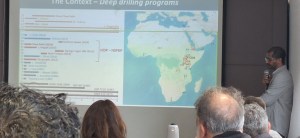
The purpose of the meeting was to, build upon the previous successful drilling of the Chew Bahir basin which raised sediments spanning the last c. 600,000 years (Foerster et al., 2026), and to discuss the opportunities, logistics and requirements to make the recovery of sediments spanning the whole of the Quaternary (last 2.6 million years) from the Chew Bahir basin possible. Obtaining such a record would provide an unprecedented insight into the environmental and climatic change that was the backdrop for the evolution of our genus, Homo.
The skill sets of those attending was as diverse as the challenges and opportunities that undertaking such an epic coring expedition would require. These included the fundamentals of what equipment would be required to recover a sediment core down to depths of 1.2 kms below the Earths surface and what to do with 1.2 kms of sediment once it was recovered; as well as the scientific motivations for doing so from perspectives of hydrology, human-environment interactions and extreme microbial ecosystems.
Over the three days, discussion of the feasibility, ambition and funding was intense, and many steps forward were made in aligning the practical and scientific considerations. It was great to meet everyone and to have a chance to chat about the potential of this exciting project. The next step is to collate the workshop outputs and submit a full proposal to the ICDP in January 2027.
To find out more about the DeepCBH project visit the ICDP web site here.





 Ecology of the past