Chevalier, M., Gosling, W.D., Hooghiemstra, H., Cartapanis, O., Chase, B.M. & Kaboth-Bahr, S. (2025) Eccentricity-driven glacial climate variability and its influence on speciation in the tropical Andes. Quaternary Science Advances 100278. DOI: 10.1016/j.qsa.2025.100278
To study the palaeo-environmental record of the Andean cloud forest, sediment cores were taken from the recently discovered Erazo lake. In mixed conditions of blazing sun and pouring rain, 14 researchers, one bus driver and several Ecuadorian guides hauled what felt like a ton of equipment up to the lake 2,300 m asl. In the centre of the lake, a wooden coring platform was mounted between two boats securely anchored at three positions. Using a modified Livingston corer with a drop hammer, five cores were successfully recovered from the lake up to a maximum depth of two metres. The main challenge encountered was the stability of the platform which resulted in several complications limiting the number of cores…
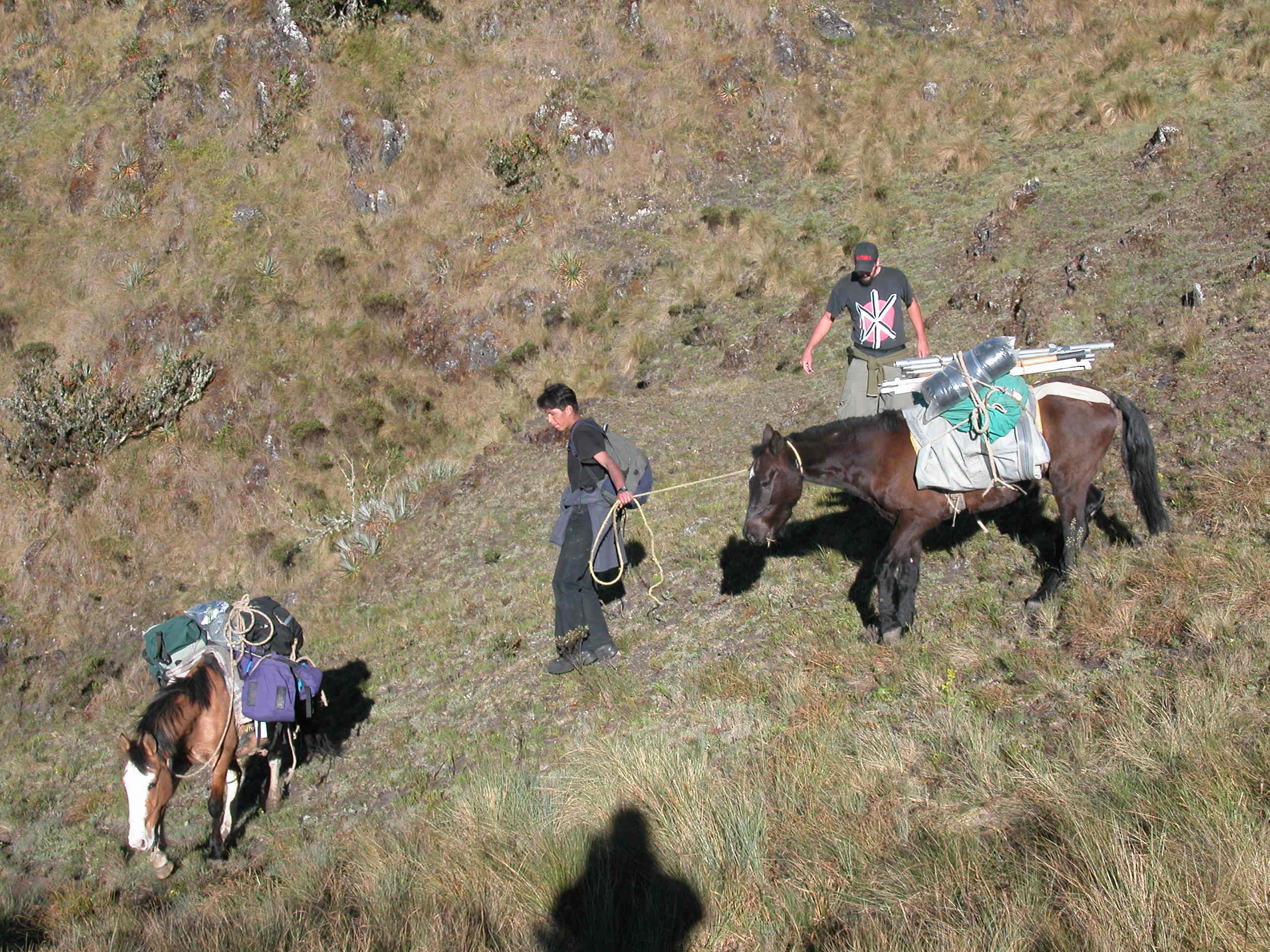
Trecking with sediment corer in the high Andes of Peru
When it comes to collecting sediments from lakes its all about having the right tools for the job. Working in remote areas of the tropics we tend to favour the Colinvaux-Vohnout corer; supplied by Vince Vohnout at Geo-core). The advantages of this system are:
its light-weight nature (can be backpacked or donkeyed into field sites), and
the cam system (which allows hammering to penetrate tough sediments).
Eric Martinez carrying an Avon Redstart back out from Laguna Khomer Kotcha (Williams et al., 2011a)
With the right platform (two banana boats and an A-frame) we have manged to retrive c. 20 m of sediment from 20 m of water (c. 40 m of drill rod extended); Lake Pacucha, Peru (Hillyer et al., 2009). More typically we use two Avon Redstart inflatables and a platform following the design of Colinvaux et al. (1999).



 Ecology of the past