Bison of the Maashorst (Netherlands)

May 17, 2023
WDG

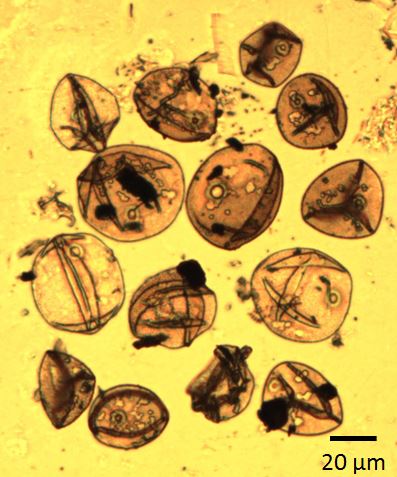
On Tuesday 16 May 2023 a small team of researchers from the Institute for Biodiversity & Ecosystem Dynamics (University of Amsterdam) visited the Maashorst (Netherlands) to visited an area “re-wilded” with European Bison (Bison bonasus). In addition to the bison the area is also now home to Tauros and Exmoor Ponies The purpose of the trip was to collect soil surface samples to examine for dung fungal spores. Certain fungi grow only on the dung of herbivores and the spores of these fungi can be preserved in the sedimentary record (for more information see Lee et al., 2022). Analysis of dung fungal spore diversity through the sedimentary record can therefore provide insights into the changes in the amount of dung (animals) in the landscape in the past. The purpose of this sampling effort was to see if we can quantify how many, and what type, of spores are representative of this group of bison. This information will help us to be able to interpret ancient records of fungal spores in more detail.

Special thanks to Maurice van Doorn (Gemeente Maashorst) for showing us around.

Netherlands Annual Ecology Meeting 2019

February 11, 2019
WDG

The Netherlands Annual Ecology Meeting (NAEM) 2019 takes place in the 12 and 13 February. This annual showcase of predominantly Dutch based ecological research will take place, as usual, at Conference Centre “De Werelt” (Lunteren). I am particularly excited this year as, along with Marielos Pena Carlos and Patrick Jansen, I am co-convening a session on “Tropical Ecology”. The first time I have contributed to the program in this way. Our session will be on the second day of the conference and contain the following exciting presentations:

  • 15:00 Predator avoidance and prey tracking in a Neotropical forest (Constant Swinkels, Wageningen University & Research)
  • 15:20 The role of fig volatiles in pollinator specificity and fig diversity (Aafke Oldenbeuving, Naturalis Biodiversity Center)
  • 15:40 Mangrove Atlantis: Can mangroves keep up with extreme land-subsidence? (Celine van Bijsterveldt, Royal Netherlands Institute for Sea Research)
  • 16:00 Break
  • 16:10 The fate of forests in agro-forest frontier landscapes, implications for conservation (Madelon Lohbeck, Wageningen University & Research)
  • 16:30 Trends in the variability of Specific Leaf Area of paramo vegetation during succession (Marian Cabrera, University of Amsterdam)
  • 16:50 Succession dynamics of tree and soil fungal communities in regenerating tropical rainforests are strongly influenced by regional species pool and abiotic factors (Irene Adamo, Naturalis Biodiversity Center)


Organisms and environments: Frontiers in palaeoecological technique development

October 16, 2014
WDG

inquaXIX INQUA Congress
NAGOYA, JAPAN 27 July-2 August, 2015

Grass pollen from Lake Bosumwti picked for individual chemical analysis

Grass pollen from Lake Bosumwti picked for individual chemical analysis

Abstract submission is now open for the XIX International Union for Quaternary Research (INQUA) Congress. “Ecology of the past” researchers will be there and are hosting a special session, entitled Organisms and environments: Frontiers in palaeoecological technique development, at which we hope to bring together a wide range of palaeoecologists working on novel proxy development. Members of the “Ecology of the past” group will be showcasing recent findings on the environmental significance of pollen chemistry change through time; linked to the 500,000 years of solar irradiance, climate and vegetation change in tropical West Africa project (Fraser et al., 2014). Please take a look at our session and consider submitting YOUR abstract today!

For information on abstract submission click here. Closing date for abstract submission 20 December 2014.

For further information on our session click here, or “Continue reading” below…

Continue Reading

Blog at WordPress.com.