Mapping Ancient Africa: INQUA Rome session (updated)

July 16, 2023
WDG

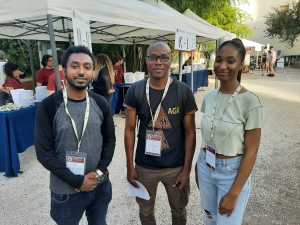
Mapping Ancient Africa participants at the INQUA Rome ice breaker event ready for action! Left to right: Bahru Zinaye Asegahegn, Alfred Houngnon, Busisiwe Hlophe.

The Mapping Ancient Africa (MAA) project has a double session of talks and a poster session at the INQUA congress in Rome 2023. Our session will be on Wednesday 19 July. Unfortunately a number of the originally planned speakers could not make it to Rome due to a combination of not obtaining visas, logistical challenges and ill health. We wish them all well and hope that they will continue to be involved in the project. Further, many thanks to all those who have agreed to step up and give a presentation at a late notice. Below is an updated schedule correct as of Sunday 16 July based on the information contained on the INQUA Rome App; if you are aware of any further problems or changes please let me know ASAP!

If you are at the INQUA Rome congress please come along to our talks and posters in Session 64: Mapping Ancient Africa: Climate, Vegetation & Humans.

Part 1: 08:30-11:00

  • Giosan et al. When the desert was a lake: Providing context for Homo sapiens development in the northern Kalahari
  • Chase et al. Paleolakes and socioecological implications of glacial “greening” of the South African interior
  • Blinkhorn et al. Evaluating refugia in recent human evolution in Africa
  • Aureli et al. Homo sapiens behaviour and adaptation in East Africa. New evidence from an open-air site in a modern Ethiopian savannah environment: the GOT10 site
  • Effiom et al. Late Holocene palaeoecological studies at Lake St Lucia, KwaZulu-Natal
  • Tallavaara et al. Pan-African Climate and Vegetation over the Quaternary and Implications for Human Distribution
  • Quick et al. Palaeoenvironments of the Cape Floristic Region: New research & current developments

Part 2: 11:00-13:00

Continue Reading

British Ecological Society annual meeting 2016

December 15, 2016
WDG

bes_new_logo_2016The British Ecological Society (BES) annual meeting for 2016 has come to an end. It has seemed like a long week (and it is only Thursday) because it has been so action packed. For me it commenced on Sunday when I helped out with the introduction session for early career researchers (MSc, PhD and post-docs), and the marathon council meeting. I think the length, and intensity, of the council meeting highlighted the need for the structural review that our president, Sue Hartley, has just initiated. The main program commenced on Monday and has been mainly a mix of workshops, posters and talks, with a side order of special interest group meetings, carol singers, and a gala dinner.
I would like to highlight two of the scientific talks that stuck in my head in particular:

  1. Steven Sylvester “Shifting perspectives on natural ecosystems in the high Andes”; showed how remote regions of the high Andes may still contain the vestigaes of ‘pristine’ ecosystems dating from before human arrival, and
  2. Stefano Allesina “Higher-order interactions stabilize dynamics in a generalized rock-paper-scissors game”; showed (theoretically) how ecosystem complexity plays a role in ecosystem stability.

Nick-thumbAn excellent and exciting meeting was capped for me by my PhD student Nick Loughlin for being awarded the BES Public Engagement award! Well done Nick (@PalaeoNick).

REFERENCES

Sylvester, S.P., Sylvester, M.D.P.V. & Kessler, M. (2014) Inaccessible ledges as refuges for the natural vegetation of the high Andes. Journal of Vegetation Science 25, 1225-1234. DOI: 10.1111/jvs.12176


Blog at WordPress.com.