Climate frameworks for the Middle Stone Age and Later Stone Age in Northwest Africa

December 15, 2024
WDG

Mapping Ancient Africa Quaternary International special issue article #4

#openaccess

Boisard, S., Wren, C.D., Timbrell, L. & Burke, A. (2025) Climate frameworks for the Middle Stone Age and Later Stone Age in Northwest Africa. Quaternary International 716, 109593. DOI: 10.1016/j.quaint.2024.109593

To find the complete list of articles in the Mapping Ancient Africa special issue of Quaternary International click here.

Mapping Ancient Africa: INQUA Rome – session 1

August 18, 2023
WDG

On Wednesday 19 July 2023 the Mapping Ancient Africa session of the INQUA Rome congress took place. We were delighted to have an full program of speakers despite some late cancellations. The first session featured seven speakers.

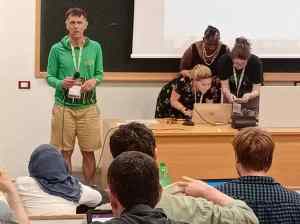
No panic as we set up for session 1…

The first two talks focused on southern Africa. The first talk by Liviu Giosan (Woodshole Oceanographic Institute) focused on new sediment cores extracted from the Okavango – Makgadikgadi region and new efforts to obtain sediment cores that can provide information on the dispersal of hominins. Brian Chase (CNRS) then looks us to the Karoo highlighting recent findings that suggest that this currently arid region was more habitable in the past and that a proliferation of stone tools suggests past peoples utilised the region extensively (Carr et al., 2023).

Continue Reading

Mapping Ancient Africa: INQUA Rome session (updated)

July 16, 2023
WDG

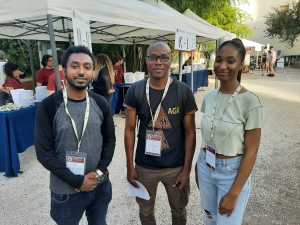
Mapping Ancient Africa participants at the INQUA Rome ice breaker event ready for action! Left to right: Bahru Zinaye Asegahegn, Alfred Houngnon, Busisiwe Hlophe.

The Mapping Ancient Africa (MAA) project has a double session of talks and a poster session at the INQUA congress in Rome 2023. Our session will be on Wednesday 19 July. Unfortunately a number of the originally planned speakers could not make it to Rome due to a combination of not obtaining visas, logistical challenges and ill health. We wish them all well and hope that they will continue to be involved in the project. Further, many thanks to all those who have agreed to step up and give a presentation at a late notice. Below is an updated schedule correct as of Sunday 16 July based on the information contained on the INQUA Rome App; if you are aware of any further problems or changes please let me know ASAP!

If you are at the INQUA Rome congress please come along to our talks and posters in Session 64: Mapping Ancient Africa: Climate, Vegetation & Humans.

Part 1: 08:30-11:00

  • Giosan et al. When the desert was a lake: Providing context for Homo sapiens development in the northern Kalahari
  • Chase et al. Paleolakes and socioecological implications of glacial “greening” of the South African interior
  • Blinkhorn et al. Evaluating refugia in recent human evolution in Africa
  • Aureli et al. Homo sapiens behaviour and adaptation in East Africa. New evidence from an open-air site in a modern Ethiopian savannah environment: the GOT10 site
  • Effiom et al. Late Holocene palaeoecological studies at Lake St Lucia, KwaZulu-Natal
  • Tallavaara et al. Pan-African Climate and Vegetation over the Quaternary and Implications for Human Distribution
  • Quick et al. Palaeoenvironments of the Cape Floristic Region: New research & current developments

Part 2: 11:00-13:00

Continue Reading

Haffer, J. (1969) Speciation in Amazonian forest birds. Science 165, 131-137. DOI: 10.1126/science.165.3889.131

Mackenzie, G., Boa, A.N., Taboada, A.D., Atkin, S.L. & Sathyapalan, T. (2015) Sporopollenin, the least known yet toughest natural biopolymer. Frontiers in Materials  2DOI: 10.3389/fmats.2015.00066

Nelson, B.W., Ferreira, C.A.C., da Silva, M.F. & Kawasaki, M.L. (1990) Endemism centers, refugia and botanial collection density in Brazilian Amazonia. Nature 345, 714-716. DOI: 10.1038/345714a0

Souto, C.P., Kitzberger, T., Arbetman, M.P. & Premoli, A.C. (2015) How do cold-sensitive species endure ice ages? Phylogeographic and paleodistribution models of postglacial range expansion of the mesothermic drought-tolerant conifer Austrocedrus chilensis. New Phytologist 208, 960-972. DOI: 10.1111/nph.13508
COMMENT: Variation in genetic diversity used to infer the location of glacial refugia.

One short story and five scientific papers thinking about different aspects of ecological change through time.

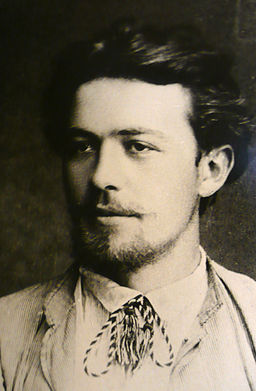
Chekhov in 1889

Chekhov in 1889 (http://tinyurl.com/ny2msd9)

Short story:

Checkhov, A. (1889) The Pipe

SUMMARY (Will): People have long been concerned about environmental change. Observations of phenological shifts, degradation of ecosystem services and climate change are clearly presented in Checkhov’s “The Pipe” (1889).The key difference is today we have a better idea of why these things are happening!?

Scientific papers:

Garcia, R.A., Cabeza, M., Rahbek, C. & Araújo, M.B. (2014) Multiple dimensions of climate change and their implications for biodiversity. Science 344 1247579
SUMMARY (Phil): This review highlights the alternative metrics used to quantify climate change at different spatial scales, each with its own set of threats and opportunities for biodiversity. It’s a very relevant paper for palaeoecologists, with implications for how we think about climatic estimates we generate, how we interpret ecological shifts in the assemblages we study, and for demonstrating the importance thinking spatially as well as temporally. It also shows how important palaeoecological data is for setting baselines and putting projected climatic change into context.

Garzón-Orduña, I.J., Benetti-Longhini, J.E. & Brower, A.V.Z. (2014) Timing the diversification of the Amazonian biota: butterfly divergences are consistent with Pleistocene refugia. Journal of Biogeography, early online.
SUMMARY (Will): Butterfly species diverged in the Neotropics during the Pleistocene (probably).

Mitchard, E.T.A. et al. (2014) Markedly divergent estimates of Amazon forest carbon density from ground plots and satellites. Global Ecology and Biogeography, early online.
SUMMARY (Will): It is difficult to work out how much carbon is in a tropical forest.

Stansell, N.D., Polissar, P.J., Abbott, M.B., Bezada, M., Steinmann, B.A. and Braun, C. (2014) Proglacial lake sediment records reveal Holocene climate changes in the Venezuelan Andes. Quaternary Science Reviews. 89, 44 – 55.
SUMMARY (Hayley): A study of three lake sediment records in the Venezuelan Andes to look at patterns of glacial variability, and how glaciers might have responded to changing climatic conditions during the last c. 12,000 years.

Still, C.J., Foster, P.N. & Schneider, S.H. (1999) Simulating the effects of climate change on tropical montane cloud forests. Nature, 398, 608–610.
SUMMARY (Nick): The paper attempts to model the impact of climate change on a number of cloud forests around the world by simulating atmospheric parameters at the last glacial maximum (LGM) and at twice today’s CO2 level. The models agrees with palaeoecological data of a downslope migration of the cloud forest at the LGM, while the 2xCO2 model shows reduced cloud cover and increased evapotranspiration, which results in a significant reduction in cloud forest supporting land area.


Blog at WordPress.com.