Wei, C., Li, M., Mao, L., Mander, L., Jardine, P.E., Gosling, W.D. & Hoorn, C. (2024) A 23-million-year record of morphological evolution within Neotropical grass pollen. New Phytologist. DOI: 10.1111/nph.20214
This paper is the latest to come from the PhD thesis of Caixia Wei who defended at the University of Amsterdam earlier in 2024. To find out more about Caixia’s work click here.
Zuccarelli Freire, V.N., Ziegler, M.J., Caetano-Andrade, V., Iminjili, V., Lellau, R., Rudd, R., Stokes, F., Viegas, D.H., Antonosyan, M. & Jha, D.K. Addressing the Anthropocene from the Global South: Integrating Paleoecology, Archaeology and Traditional Knowledge for COP Engagement. Frontiers in Earth Science 12, 1470577. DOI: 10.3389/feart.2024.1470577
Bremond, L., Aleman, J.C., Favier, C., Blarquez, O., Colombaroli, D., Connor, S.E., Cordova, C.E., Courtney-Mustaphi, C., Dabengwa, A.N., Gil-Romera, G., Gosling, W.D., Hamilton, T., Montade, V., Razafimanantsoa, A.H.I., Power, M.J., Razanatsoa, E., Yabi, I. & Vannière, B. (2024) Past fire dynamics in sub-Saharan Africa during the last 25,000 years: Climate change and increasing human impacts. Quaternary International.DOI: 10.1016/j.quaint.2024.07.012
Heijink, B.M., Zwarts, A., Witteveen, N.H., Watson, J., Ebbenhorst, A., Veenman, F., Kessel, M., León-Yánez, S., Guevara-Andino, J., Endara, M., Rivas-Torres, G., Bush, M.B. & McMichael, C.N.H. (2024) Past fire and vegetation change in the hyperdiverse forests of the Ecuadorian Amazon. Plants 13. DOI: 10.3390/plants13152048
In this article I summarize and describe the scientific research that was performed near Botopasi in Suriname, which was published in Ecology as ‘Pre-contact and post-colonial ecological legacies shape Surinamese rainforests’ (https://doi.org/10.1002/ecy.4272).
Figure 1: Our research team in the field
Background
In October 2021, between COVID-19 restrictions, I joined archaeologist dr. Cheryl White and her team to excavate the remnants of a ‘lost village’ of Saamaka Maroons in the Surinamese rainforest. Maroons are the descendants of enslaved Africans, who, in the late 1600s, fled plantations to live in freedom in the Surinamese rainforests. Dr. White has been investigating the first villages and the movements of Suriname’s Maroon communities for decades and is an expert in this topic.
Our wonderful research team consisted of Farisha Kartosemito B.Sc., Sushmeeta Ganesh B.Sc., Jõvan Samson B.Sc., Agir Axwijk B.Sc., Santosh Singh M.A., Thanya Fonkel MPA, Harrold Sijlbing, Dombi Lö, Gerno Eduards & Farik Eduards. We were welcomed in the village Botopasi, and after a day of hard work in the field, we enjoyed delicious Surinamese food and played troefcall!
As an ecologist, I was interested in the ecological effects of past human activities on the forest ecosystem. In these rainforests, Maroon and Indigenous communities often burn and remove trees near their homes to grow a variety of crops like cassava, tayer, maize and banana. After some years, the cultivation site is abandoned and forests can grow back. But do those forests recover back to their original state?
What did the forest look like before people arrived and settled in the landscape of Boven Suriname?
To study how Maroon communities have shaped Surinamese forests over time, I made a reconstruction of the landscape of the past (going back thousands of years). The landscape was near an archaeological sites called ‘Beng Tau’, where Maroons lived in the 17th century. We used plant fossils and charcoal remains to reconstruct the forest from the past, to research if people were using fire and growing crops, and how the forests recovered from that.
Results and implications
Figure 2: Phytoliths from the banana plant
The charcoal remains and plant fossils, particularly from maize and banana, confirmed Saamaka Maroons settled in the area since ca. 1700 and practiced slash-and-burn agriculture was near the archaeological site called ‘Beng Tapu’ (Figure 2). The site may have been a cooking area, because remnants of pottery with maize, rice and banana were found. Within 1 km of Beng Tapu, we found large fragments of charcoal, and plant fossils from maize and banana. Smaller charcoal fragments and banana were found within 5 km of the archaeological site. Nowadays, agriculture is practiced within 8 km of the archaeological site and Suriname river. The area used for agriculture likely expanded over time.
How did the forest recover from these activities?
Within 1 km of the archaeological site, forests were burnt and used multiple times. Here, forests have a lower biomass than further away from Beng Tapu, meaning fewer or smaller trees have grown back. Also, Attalea and Oenocarpus palm trees increased. Still today, the Saamaka Maroon community uses the maripa palm to make oil. Therefore, the number of maripa palms may have increased due to human activities like cooking and oil production! Attalea and Oenocarpus palms are also adapted to open conditions and fire, showing the influence people had on the environment and how the forest responded to fires.
Further (2-7 km) away from the archaeological site, where disturbances were fewer, the forests recovered much better but Astrocaryum palms grew back in higher numbers in the understory of the forests. What makes these palms so resilient? We are still uncertain. The forests furthest away (>8km) from Beng Tapu showed little signs of disturbances.
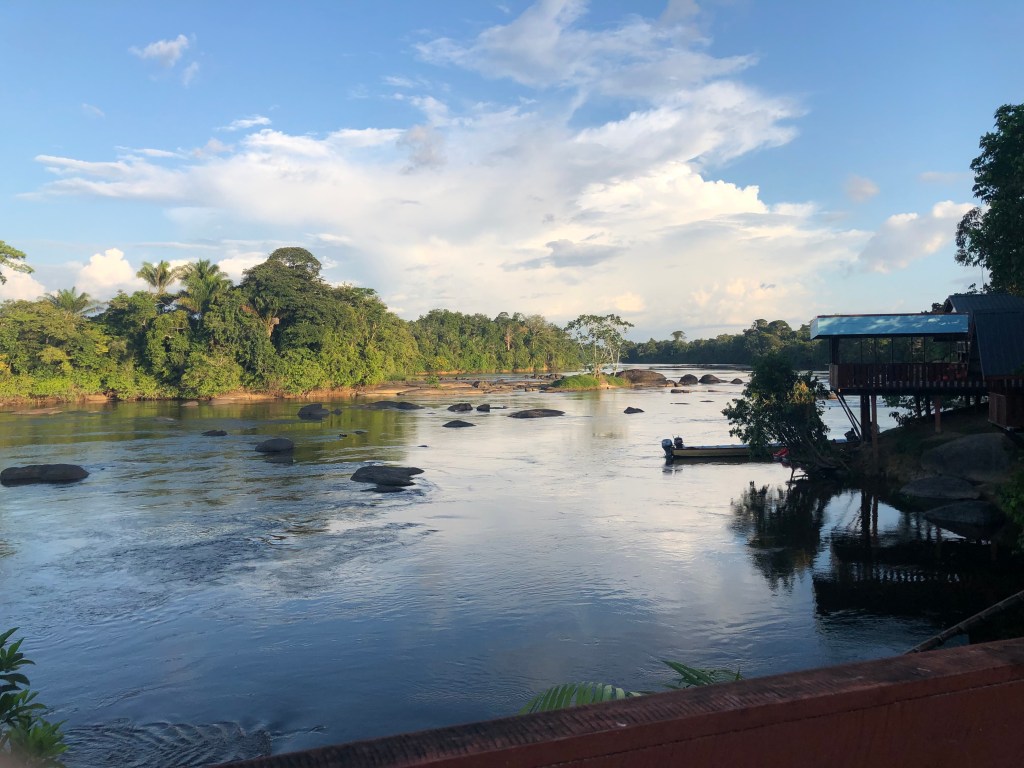
Figure 3: View from the Suriname River
A long human history, and an Indigenous archaeological site?
The Saamaka Maroons were not the first people to have inhabited the forests near Botopasi. Charcoal fragments show that people were in region (the ca. 20 km radius we studied) already 2000 years ago, and fire events occurred ca. 2000, 1700,1500, 1300, 1200 and 800 years ago. We don’t know which Indigenous Cultures may have inhabited this region, because of limited archaeological and historical research here. Large charcoal fragments were found ca. 7 km away from Beng Tapu, across the Suriname River. Could this be an Indigenous archaeological site?
Conclusion
Our results show the timing, intensity and frequency of past disturbances are very important for good forest recovery and some disturbances from the past can still impact the modern vegetation.
Unravelling the past not only tells us about the ancestors of Maroons and the lives of Indigenous communities before the 1500s. The past also helps us to understand how forests respond to human impacts. To better guide conservation strategies, we need to do more archaeological and ecological research in Surinamese rainforests.
Next to the Suriname River, past human activities shaped the forest andincreased local palm abundances. The broader forested region showed a healthy recovery. These results indicate that the Saamaka Maroon community preserved most of the forests they inhabited since the 1700s. We can learn from traditional knowledge about which management practices are sustainable to keep forests healthy.
If you want to know more about the “hows” of this research…dive with me into the methodology!
de Weger, L.A., Verbeek, C., Markey, E., O’Connor, D.J. & Gosling, W.D. (2024) Greater difference between airborne and flower pollen chemistry, than between pollen collected across a pollution gradient in the Netherlands. Science of The Total Environment 172963. DOI: 10.1016/j.scitotenv.2024.172963
Amazonian rainforests are incredibly biodiverse and provide global ecosystem services, but are threatened by fires, which completely alter ecosystem function and structure. Fires, especially in western Amazonia, almost always have an anthropogenic origin. However, much is unknown about the long-term recovery and multi-generational successional processes following fire events. Due to the long lifespan of tropical trees, past fires may have left ecological legacies in modern forest composition in Amazonia. The goal of this thesis is to investigate how past fire events impact successional trajectories of past vegetation change and whether these fire events and related human impacts have left ecological legacies in modern Amazonian forests. I specifically focus on western Amazon and changes in palm abundances and composition through time, as palms were an economically important plant family to past peoples. I compared lake charcoal records across the Amazon Basin and found fire was least prevalent in western Amazonia. On a local scale, very limited evidence of past disturbances was present in forest plots in northwestern Amazonia. Palm abundances have been increasing since the mid-Holocene, but this increase is not related to past fire events. Past fire likely have left low to none ecological legacies in these forest plots. Modern trait composition across western Amazonia is associated with past fire events, but more research is necessary to disentangle relationships between past fire, soils, and modern vegetation. Overall, western Amazonia likely contains the least intense ecological legacies in comparison with the rest of Amazonia.
Poaceae (the grass family) is one of the most diverse angiosperm families on Earth, comprising close to 12,000 species. The history of grass-dominated biomes extends back over 20 million years, yet the spatial and temporal development of these biomes and the underlying drivers remains unresolved. This thesis addresses these questions in South America, focusing on modern grass pollen and ancient samples dating from the early Miocene to the present. The thesis reveals several key points: (i) Grass pollen size varies significantly both among genera and species and within species. Pollen size shows no correlation with (a)biotic factors, indicating its limited utility as a generally applicable proxy for reconstructing past vegetation and climate; (ii) Grass pollen exhibits high diverse on surface ornamentation. The morphotypes identified by descriptive terminology are well-supported by a combination of SEM images of pollen surface patterns and computational image analysis. The findings reveal that pollen sculpture is unrelated to (a)biotic variables but is diverse across the phylogeny; (iii) Tropical grass pollen morphology suggests a gradual rather than punctuated evolution, based on the trend toward a less dense ornamentation of the exine since c. 23 Ma. The changes in the exine of grass pollen since the early Miocene might be driven by evolutionary processes (evolutionary drift and/or directional selection), and potentially immigration at the continental scale. In summary, the thesis reveals the trajectory of grass pollen morphological changes over time and examining the drivers that have contributed to their evolution and geographical expansion at the continental scale.
Developing new applications for plant wax n-alkane biomarkers can deepen our understanding of ecosystem history. In this thesis I study modern and sedimentary n-alkane signals, sourced along the tropical Andes, to better understand how they can be used as a proxy for past environmental change. The overarching question addressed in this thesis is: what do n-alkane patterns extracted from sedimentary records reflect? Specifically, I address:• Do environmental or taxonomic factors dominate the n-alkane signal?• Does the n-alkane signal alter as the plant material degrades?• How much of the n-alkane variability can be explained by our analytical protocols?I find that the taxonomic and environmental signals of n-alkane patterns are entangled, especially in leaf n-alkanes. Soil n-alkane patterns reflect environmental conditions at the site, but the results cannot rule out a taxonomic signal in soil n-alkane patterns. I also find that, as the source material degrades (leaves), the n-alkane patterns are altered. Although the n-alkane signal is recognizable as having plant origin, there is a reduction in n-alkane pattern variability and the metric for degradation becomes an increasingly important descriptor of the n-alkane pattern shifts observed in soils and sediments. I find evidence that the metric for degradation can be used as proxy for past environmental change, but the application of this n-alkane signal proxy is not straightforward. Finally, I find there is little understanding of how much extraction and measurement protocols contribute to the n-alkane pattern variability and what implications this has on interpretations of the n-alkane signal.










 Ecology of the past