The Llanos de Moxos in Bolivia is an area the size of England that has one of the highest densities of archaeological sites in the Amazon basin. I travelled there for the first time earlier this month for the fourth International Meeting of Amazonian Archaeology. As the airplane crossed from the Andes into the Amazon plains, I could tell this was a very different ‘Amazonia’ compared with the forests that I know from Peru, Ecuador, and western Brazil. The Llanos de Moxos is a seasonally flooded savanna and it was so…open! I immediately realized that the perception of ‘Amazonia’ varies widely among individuals, and I think that is one of the reasons why those of us who study the human history of Amazonia tend to disagree so frequently.
BSc student Henk Cornelissen presents his thesis work on identifying charcoal characteristics that represent specific fire parameters, such as burn temperature. Photo: C. McMichael
Wimbledon tennis fortnight is on its way, but we’ve had our own palaeoecology fortnight here at the Institute for Biodiversity & Ecosystem Dynamics at the University of Amsterdam. We’ve seen seminars on reconstructing past landscapes and climates on timescales of decades to millions of years, and on spatial scales ranging from single sites to the entire Earth. Our presenters included our BSc students, MSc students, PhD candidates, faculty members, guest researchers, and even an internationally known palaeoclimatologist and contributor to the IPCC (Intergovernmental Panel on Climate Change) reports!
BSc student Isa Mulder presents her thesis on reconstructing glacial-aged fire histories from the Andes. Photo: C. McMichael
We began with a three-day series of presentations from our BSc students in the Future Planet studies program. William Gosling and I had four students that presented their final theses. We continued with a seminar series organized by the Palynologische Kring (the Dutch palynology society). Eric Grimm, a guest researcher at UvA, presented a high resolution record of hydrological variability, vegetation, and fire from the Great Plains of the United States. Guest researcher Carina Hoorn showed us how the Amazon River formed, and the associated plant turnover that occurred during the Neogene. PhD student Keith Richards explained to us why the Arctic seal became land-locked in the Caspian Sea over 2.6 million years ago. PhD student Suzette Flantua presented a multi-proxy approach to exploring the biogeographic history of the Andes Mountains. She came back the following day to present her PhD thesis entitled, “Ecosystems in Pleistocene Latin America”. And we are happy to report that Suzette is now Dr. Flantua!!
Suzette Flantua highlights the work in her PhD thesis. Congratulations Suzette! Photo: C. McMichael
Dr. William Gosling and Prof. Jonathan Overpeck discuss the future of palaeoecology and upcoming collaborations. Photo: C. McMichael
Our presenters included males and females from multiple countries at an array of career stages. I am glad to have been a part of this fortnight, and I am glad that our current students got to see such a diverse integration of people and palaeoecology. My hope is at least one of these students has been inspired by these seminars, and will develop the same passion for palaeoecology as what we’ve seen here over the last two weeks.
The British Ecological Society (BES) annual meeting for 2016 has come to an end. It has seemed like a long week (and it is only Thursday) because it has been so action packed. For me it commenced on Sunday when I helped out with the introduction session for early career researchers (MSc, PhD and post-docs), and the marathon council meeting. I think the length, and intensity, of the council meeting highlighted the need for the structural review that our president, Sue Hartley, has just initiated. The main program commenced on Monday and has been mainly a mix of workshops, posters and talks, with a side order of special interest group meetings, carol singers, and a gala dinner.
I would like to highlight two of the scientific talks that stuck in my head in particular:
Steven Sylvester“Shifting perspectives on natural ecosystems in the high Andes”; showed how remote regions of the high Andes may still contain the vestigaes of ‘pristine’ ecosystems dating from before human arrival, and
Stefano Allesina“Higher-order interactions stabilize dynamics in a generalized rock-paper-scissors game”; showed (theoretically) how ecosystem complexity plays a role in ecosystem stability.
An excellent and exciting meeting was capped for me by my PhD student Nick Loughlin for being awarded the BES Public Engagement award! Well done Nick (@PalaeoNick).
REFERENCES
Sylvester, S.P., Sylvester, M.D.P.V. & Kessler, M. (2014) Inaccessible ledges as refuges for the natural vegetation of the high Andes. Journal of Vegetation Science 25, 1225-1234. DOI: 10.1111/jvs.12176
This is my first time attending the European Conference of Tropical Ecology and my second visit to Germany. The conference attracted c. 350 delegates; big enough to have plenty of interesting science, and yet small enough to find everyone you wanted to. The keynote speakers chosen to head the days provided some exciting insights into various new developments across the tropics, including: the importance of biogeography (Richard Corlett), metabolism and carbon cycles (Yadvinder Malhi), diversity and resilience (Lourens Poorter), tropical peatlands (Sue Page), agricultural landscapes (Ravi Prabhu), and mutualism of figs and fig wasps (Martine Hossaert-McKay).
From the many other interesting talks five in particular grabbed my attention, these were:
Day 2 of the NAEM breakfast 07:30, first lectures at 08:30… Two keynotes today thinking about ecological stoichiometry the first by Stan Harpole (Martin-Luther-Universitat-Halle-Wittenberg) focused on resource ratio theory, and then Martin Wassen (Utrecht University) thinking about N and P limitations. I also attended, parts of, three sessions today “Linkages between fire, vegetation, soil and ecosystem services”, “Novel ecosystems”, and “Scaling from trait to environment and back”. My top talks for today were:
Elmar Veenendaal (Wageningen University) Fire effects on tropical woody vegetation structure have been exaggerated? Working on long-term fire study plots (Kokondekro since 1932) suggest that for forest-savannah transition zones fire alone is insufficient to mediate a change between states; human manipulation of ecosystems is required as well to trigger the change.
Frank van Langevelde (Wageningen University) Feedbacks between fire and patches of woody vegetation in tropical grassland savannah Examination of tree distributions and fire within the Kruger National Park shows that landscapes contain more clustered tree populations when fire frequency is higher.
Plus today I have done lots of talking and made many new contacts. I have lots of follow up emails to write and promised papers to send around! Overall this has been a super meeting for meeting people – perfect for expanding my network of Dutch based ecologists – in a nice location, with good food and beer. Looking forward to next year already.
The annual Dutch ecology conference is being held over two days at the in “remote” Lunteren and I am pleased to be able to attend all of the conference this year. The conference was kicked off this morning with a recognition that this year is 150 years since the birth of ecology as a science (Haeckel, 1866). The opening two keynotes focused on aspects of ecology which have sometimes been overlooked firstly, parasitism (Peter Hudson, Penn State University) and secondly, immunology (Irene Tieleman, University of Groningen). Following these I focused on just two sessions in the morning “linking diversity to function”, and in the afternoon “ecosystem cascades”. From the range of excellent talks in the sessions I have picked one from each as my favourite:
Masha van der Sande (Wageningen University) The role of biodiversity and environment on productivity in tropical forests; evidence across scales By examining long-term tropical forest monitoring data van der Sande demonstrated that through time ecosystem traits changed significantly. She hypothesised that the lack of stability in ecosystem traits was due to past disturbance; although it is unclear what caused this disturbance (climate or humans), or when it occurred.
Dries Kuijper (Mammal Research Institute, Poland) Landscapes of fear in Europe: Wolves and humans shaping ungulate top-down effects By tracking Wolf pack distributions in the Bialowieza forest (Poland) Kuijpershowed that ungulates avoided Wolf pack “core areas” for fear of predation, that the exclusion of ungulates lead to reduced browsing of the vegetation, and so consequently forests regenerated faster in Wolf pack core areas.
The evening lecture was given by Bart Knols (in2care) who gave an impassioned talk on the importance of communicating science beyond the academic sphere. Arguing that now is the time for ecologists to have an influence on policy making, politics and business, as well as showing us how he has done this.
Last week I took part in my first “palynologendagen” (pollen days) with the Palynologische Kring (Dutch palynology society). Unfortunately, due to a prior commitment (Chairing a British Ecological Society careers webinar) I was only able to take part on the second day.
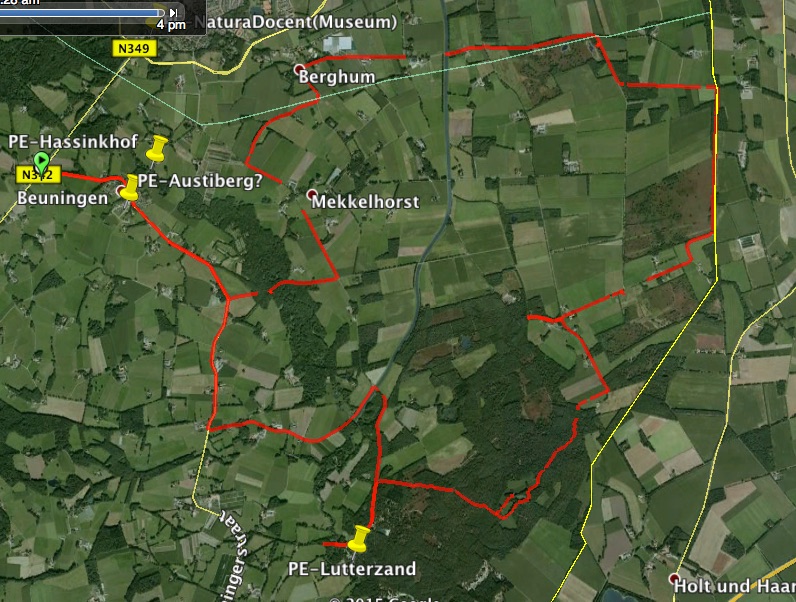
Day two of the pollen days was “op de fiets” (on bikes) in true Dutch style. We met at Twente Fiets to pick up 36 bicycles and one tandem and headed out into the countryside!
Figure 1: Route of the bicycle tour (max speed 21.8 kmph, distance 23.24 km)
Our route (Fig. 1) took in around 14 point of interest. At each point Harm provided interesting insights into the landscape history and how humans had interacted and shaped it. The presentations were in Dutch so I had to concentrate hard to get 50% of the information.
Two particularly nice sites (which I think I understood) were:
the site of an old toll house at the split in the old road to Germany (east) and Scandinavia (north), and
a sedimentary cross section, revealed by river down cutting, which showed the impact of cart wheels on the sediment along the site of an old road.
In addition to the tour it was also fantastic to meet many other fellow palynologists based in the Netherlands. I looking forward to being able to participate in many future Palynologische Kring events, and I am also pleased to say attending this years event has inspired me again to try and push on with learning Dutch again!
On Wednesday I attended my first Netherlands Annual Ecology Meeting (NAEM) unfortunately, due to prior commitments, I was not able to attend the whole event, but I still managed to get a nice insight into the vibrant Dutch Ecological research community. Particularly exciting for me was the “Biodiversity in Space and Time” theme. Plenary sessions by Alexandre Anotonelli (University of Gothenburg) and Hans ter Steege (Naturalis Biodiversity Center, Leiden) focused on the Amazon ecology past and present. The subsequent session on the same theme, organized by Daniel Kissling (University of Amsterdam) and Niels Raes (Naturalis Biodiversity Center), was also excellent and ranged from species richness patterns past and present in Gabon (Andre van Proosdij, Naturalis Biodiversity Center), through soil microbes (Kelly Ramirez, Netherlands Institute of Ecology) to the role of sea level change on island biodiversity (Kenneth Rijsdijk, University of Amsterdam). I am looking forward to attending more of these meetings in the future and getting involved with the NERN community.
Two weeks ago I attended the biannual International Biogeography Society (IBS) conference in Bayreuth, together with 600+ other people from more than 50 different countries. This IBS conference, my first IBS meeting, proved to be an exciting event during which I met scientists from many different disciplines and heard talks on cutting-edge biogeographical research.
The IBS conference was held in the Bavarian city of Bayreuth, in the middle of the biodiverse landscape of Upper Franconia. This landscape provided the training ground for Alexander von Humboldt, the founder of the field of biogeography. The 4-day conference included a wide variety of symposia and many, many posters. The conference dinner in the German Steam Train Museum was highly memorable. The conference was closed by a lecture from Daniel Simberloff, once a doctorate student of Edward O. Wilson, who received the Wallace Award for his outstanding contributions to invasion ecology.
I had a talk in the plenary symposium of ‘Ecosystem response to past climate change’, organized by David Nogués-Bravo and Francisco Rodríguez-Sánchez. The symposium covered the dangers of climate change to biodiversity and tried to assess if the range and rate of adaptation, migration, persistence, or extirpation, that are registered in deep-time records, palaeorecords, and the recent past, are adequate responses for predicted climate change in the future. I addressed this issue from the point of view of a small remote island, where migration is obviously a limiting factor. I showed how I reconstructed climate and its effect on island biota during the last 40,000 years using long-term palaeoecological records from Mauritius (de Boer et al, 2013 & 2014). These records show that different climate regimes result in different ecosystem response to climate change in the past. Local extirpation or population collapse of larger vertebrates was a natural phenomenon in the lowlands of Mauritius due to frequent climate extremes (I will discuss this in more detail in my next blog; de Boer, 2015). Despite these population collapses, island biota have always (in the timeframe of my records) survived natural climate change. Therefore, my take home message was not to focus on the effects of (future) climate change alone. Other key components of global change, such as invasive species and habitat destruction, are more imminent threats to the biodiversity of many islands. For more information on my research, including publications, click here.
More information on the IBS read on (below) or visit the IBS website or blog. All abstracts and other details of the IBS conference in Bayreuth can be found here. The next IBS meeting will take place in Salvador, Bahia (Brazil) in March 2017.






 Ecology of the past