6th Workshop on Non-Pollen Palynomorphs

July 9, 2014
encarnimontoya

POSTER: Non-Pollen Palynomorphs in Ecuador: Starting from scratch

OUR POSTER: Non-Pollen Palynomorphs in Ecuador: Starting from scratch

Tallinn University
18-20 June 2014

Last month I had the opportunity of attending the 3-days non-pollen palynomorphs (NPP) workshop that was held at the Tallinn University, Estonia. It was perfectly organised by Tiiu Koff and Egle Avi among other members of the university, as it was a join workshop of Cladocera remains (XII Subfossil Cladocera workshop; 16-18th June) and NPP (18-20th June). Unfortunately, I was just present in the NPP workshop, so my comments will be focus on it.

With around 40 participants, we greatly enjoyed the discussions that came up about the state-of-the-art of this broad and interesting proxy and its implications for archaeology, palaeolimnology, and different aspects of ecology like human landscape management, biodiversity and conservation, or community assemblages. Current methodological problems like taxonomy, standardisation of lab techniques, etc., were also debated.

Opening and key lectures were from Bas van Geel and Emilie Gauthier, showing the development of this discipline over the last 40 years, and a great example of multi-proxy project aimed to study the human arrival and impact in Greenland respectively. Besides oral and poster presentations, last day there was a microscope session, very useful for sharing knowledge and uncertainties! In our specific case, Will, Hayley and I contributed with a poster titled “Non-pollen palynomorphs in Ecuador: starting from scratch”.

Personally, among the things I most like from the NPP meetings is the friendly and close environment, where everyone is more than glad to help others, regardless the experience. Following this feeling of small and scattered group of people dealing with the same issues, we used to do a final remark session every workshop raising the advances and inconveniences found so far, updating our NPP papers repository (managed by Antonella Miola), and addressing future directions as a group (for instance, we have now our own project in ResearchGate, thanks to Lyudmila Shumilovskikh!). In this particular workshop, I was very happy when I found out that Tallinn University has a green policy (paper free), and they replaced book abstracts etc., by iPads to follow the workshop schedule.

Although these meetings are normally biannual, next conference location and date is yet to be decided, but we hope to have the chance to join this very friendly and supporting community again. In addition, there will be a NPP session in the next European Palaeobotany and Palynology congress, tobe held in University of Padova (Italy), next August 2014. We encourage people with all kind of experience (or lack of) to attend further events.

Macroecology workshop

April 9, 2014
encarnimontoya

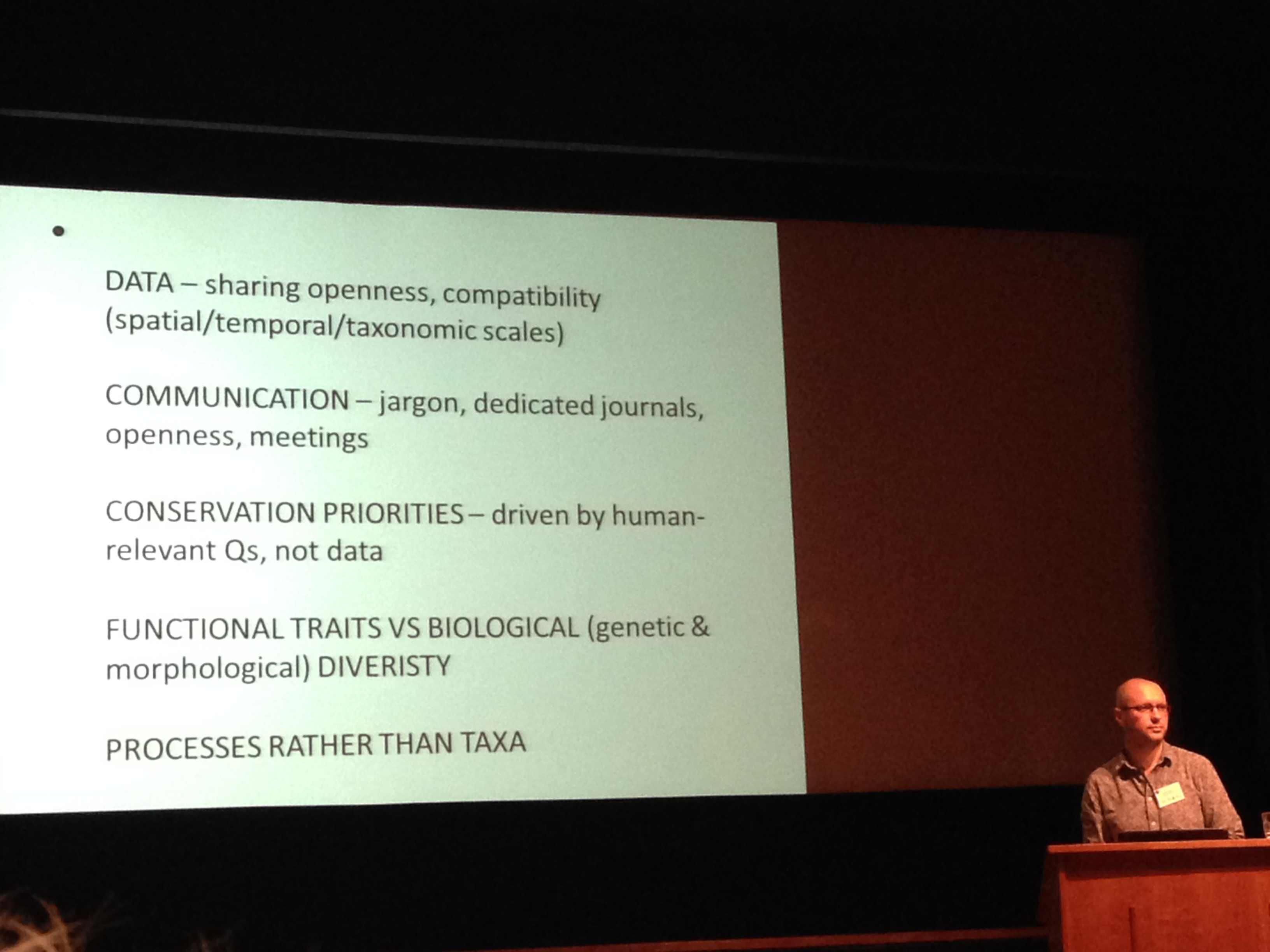
Phil Jardine taking charge at the macro-ecology meeting

Phil Jardine taking charge at the macro-ecology meeting

On 1st April, Alice, Encarni, Hayley and Nick attended the joint British Ecological Society Macroecology Special Interest Group and Palaeontological Association workshop held in the Natural History Museum, called Challenges in Macroecology – Scaling the Time Barrier. The workshop was co-organised by our member Phil Jardine (jointly with Victoria Herridge, Adriana de Palma and Isabel Fenton), and it was a mix between deep and shallow time, neoecologists and other researchers interested in any kind of macroecology topics.

We enjoyed so much how this one-day meeting was scheduled, with some formal approach including four plenary and lighting talks, and other informal initiatives such as speed dating and discussion groups. This way, all participants could interact with other non-directly related researchers.

The focuses of the plenary talks were related to different fields within macroecology. In this sense:

  1. Andy Purvis opened the session with the definition of macroecology, the trends and shifts of study topics it has carried out since the discipline began and ended with what macroecology is not any longer.
  2. David Jablonski explored through examples of bivalves studies how climate in time and space affects the studies of diversity dynamics, mainly addressed to three key questions: a) Extinctions, b) Latitudinal Diversity Gradients, and c) Geographical ranges.
  3. Lee Hsiang Liow encouraged us to evaluate both processes and observations, and highlighted the importance of modelling both to take into account the “unobservable” or latent truth including examples of capture-recapture and occupancy methods.
  4. Kathy Willis gave a review of the trends followed for conservation strategies since 1980s, until the development of the “ecosystems services” idea of given an economic value to biodiversity. Her main statement was focused on how palaeo-data can help in providing information to some “knowledge gaps” related to human resources including: a) trends in biomass, b) trends in nutrient cycling, c) trends in in final ecosystems services, and d) sustainability of ecosystems services.

Lighting talks were related to more specific study cases of macroecology, including specific researches about turtles, fungi, beetles, crocodiles, foraminifera or dinosaurs, in several spatial and temporal scales .

We would like to thank again Phil, Victoria, Adriana and Isabel for the great day that finished with a nice and warm wine reception sponsored by BMC Ecology. We hope to attend further events like this soon.

For more on this meeting see blog post by @protohedgehog “Macroecology – scaling the time barrier”  and storify of the twitter feed, click here.

Royal Geographical Society (with IBG) annual international conference – 2013

August 30, 2013
HayleyKeen

Palaeo-people at the RGS-IBG meeting plotting future papers and grants.

Palaeo-people at the RGS-IBG meeting plotting future papers and grants. Left-right: Encarni Montoya, Joe Williams, Hayley Keen and Frazer Bird.

RGS – IBG Annul International Conference 2013
27th – 30th August, London

Yesterday (29th August) four members of the Palaeoenvironmental Change Research Group (PCRG) went down to London for the third day of the Royal Geographical Society with IBG (RGS – IBG) international conference for a day of informative talks. Two of the morning sessions were of particular interest to us with the sessions entitled ‘Human – environment interactions in the Neotropics: historical impact to current challenges’ organised by John Carson, Lizzy Rushton and Sarah Metcalfe.

Continue Reading

Into the next 100 years

August 28, 2013
Bryan

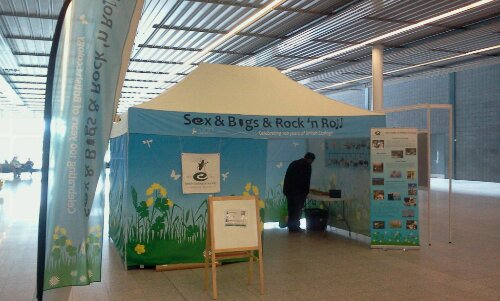
Sex & Bugs & Rock n Roll at INTECOL

Sex & Bugs & Rock n Roll at INTECOL: The BES sponsored tour of music festivals (http://www.besfest.org) landed at INTECOL. David Price from Science made Simple (http://www.sciencemadesimple.co.uk/) arrived on the Wednesday day afternoon to show what can be achived with professional science busking.

INTECOL 2013
18-23 August
ExCeL London

As a palaeoecologist when I came back to the UK from my post doc in Florida I started to get involved with the British Ecological Society (BES) so I could meet neoecologists. Eight years later I am still involved in the society and delighted that the theme of the society’s centenary celebration meeting focuses on change through time: Into the next 100 years. With 11 plenary lectures, dozens of parallel session, hundreds of posters and other activities including Pecha Kucha talks, workshops, field trips and trade stalls I will restrict my post to my thinking about the theme of timescales and the broader messages I got from the meeting.

Continue Reading

BES Macroecology meeting

August 5, 2013
philjardine

BES Macroecology SIG

BES Macroecology SIG

Last week I attended the annual meeting of the British Ecological Society Macroecology Special Interest Group (or BES Macroecology SIG for something a bit more manageable) at the University of Sheffield. Macroecology deals with ecological patterns and processes that occur over large spatial and temporal scales, and so is a natural fit for a lot of palaeoecological data.

The organisers deliberately moved away from the standard conference format of back-to-back talks, and instead built in lots of time for discussions around several themes (‘provacations’) that addressed the current status of macroecology and possible future directions for it. Several areas for progress were identified here, including finding more efficient ways of generating, curating and accessing large (global scale) datasets, increasing dialogue between numerical modellers and empirical ecologists, and more statistical and computational training for undergraduate ecologists and biologists.

Sessions of presentations were also formulated to encourage discussion and debate, with either rapid, five-minute presentations or longer methodological talks forming the starting point for further discourse. I struggled enormously with the five-minute time limit during my talk (conference talks are often built around a 15 minute slot) but hopefully interested a few people in the uses of 60 million year old pollen for addressing macroecological questions.

 A workshop on ‘Spatial analysis in R’ followed the two-day meeting. This was taught by Barry Rowlingson, and was co-organised by the Macroecology and Computational Ecology SIGs. Barry started by introducing the programme R and then went on to demonstrate its uses for handling, mapping and analysing spatial data. This type of analysis was largely new to me, and this workshop was a brilliant introduction to what R can do with geographical data.

To join these British Ecological Society SIGs and find out about other groups visit the BES SIG pages by clicking here.

Dead heads

July 30, 2013
encarnimontoya

DeadHeads12th International Workshop on Subfossils Chironomids
10-13th June, New Forest, UK

Last month Frazer and Encarni attended the 3-days “dead heads” workshop that was held at the Beaulieu Hotel , in the New Forest National Park (UK). It was perfectly organised by Pete Langdon and Steve Brooks,  and was a great opportunity for both of us who are relatively new to the midges’ community. With around 40 participants from Europe, America and Asia, we greatly enjoyed the discussions that came up about the state-of-the-art for this interesting proxy and the implications for palaeoclimatology, palaeolimnology, and different aspects of ecology like conservation, restoration or community assemblages. In addition, useful topics such as current methodological problems with age-depth model uncertainties, the usefulness and limitations of transfer functions, and taxonomy were also debated.

Besides oral and poster presentations, the workshop offered several tutorials during the afternoons, key amoung these were an introduction to R carried out by Richard Telford and Steve Juggins, and taxonomic support for head capsules ID leaded by Steve Brooks and Oliver Heiri.

In our specific case, Frazer contributed with an oral presentation titled Understanding the modern distributions and ecological tolerances of the Neotropical Chironomidae fauna: The potential as a palaeoecological proxy” base on his PhD research. We were both so glad to make contact with other people working in South America, in particular Julieta Massaferro and Alberto Araneda presented very interesting data from Argentina and Chile.

Although these meetings are normally biannual, next conference location and date is yet to be decided, but we hope to have the chance to join this very friendly and supporting community again. We encourage people with all kind of experience (or lack of) to attend any further events.

American tour: Biogeography meeting & Ecuador field work

February 26, 2013
Fray

PCRG COMPLETE AGAIN

Image

I am glad to say that after almost two months out of the office running around with 8 bags of equipment, Frazer and I have finished our tour of the Americas. As the work has been so diverse, we would like to split our comments and impressions into two different posts, we hope you enjoy them!

Continue Reading

Palynologishe Kring

January 9, 2013
WDG

Prof. H. Hoogiemstra Chair of Palaeoecology & Landscape ecology

Prof. H. Hoogiemstra Chair of Palaeoecology & Landscape ecology at IBED

Dutch and Belgian Palynology meeting
University of Amsterdam
13/12/2012

Many thanks to Henry Hooghiemstra for the invitation to present at the recent palynology meeting in Amsterdam hosted by the Institute of Biodiversity and Ecosystems Dynamics (IBED). The program of talks was broad and interesting ranging from the deep time geological history of the Amazon basin (Carina Hoorn) to the use of video game technology in visulizing landscapes (Bodo Schuetze); watch videos of his work, or read the thesis.

View Schuetze's work on recreating Mauritius in 3D on Vimeo

View Schuetze’s work on recreating Mauritius in 3D on Vimeo

 I contributed some new work on human-landscape interaction in the central Andes, entitled: Ecosystem service provision sets the pace for pre-Columbian Andean societal development”. It was very exciting to get feedback from such an esteemed audience on this new work. The days talks concluded with the IBED seminar given by Mark Bush (Florida Institute of Technology) which countinued the South American human-environment theme but we moved to the lowlands for “Amazonia in 1491: A paleoecological perspective”. Mark’s talk built on his recent work exmining the extent of human impact on Amazonia (references 1-3 below) which has cautioned against assuming widespread and intensive human impact within Amazonia prior to the arrival of Europeans.

Following the seminars we had drinks at the institute and an excellent meal in Amsterdam. Thanks again to Henry and all those at IBED who hosted a high class and scientifically stimulating meeting.

Continue Reading

Understanding pollen and spore diversity

November 2, 2012
WDG

Linnean Society Palynology Specialist Group meeting
Linnean Society of London
Burlington House
1st November 2012

Linnean Society (November 2012)

PCRG members at the Linnean Society 1st November
Left-Right: Hayley Keen, William Gosling, Alice Kennedy and Encarni Montoya

Yesterday four members of the Palaeoenvironmental Change Research Group (PCRG) visited the Linnean Society of London to attended the annual palynology meeting. The talks were excellent and covered a wide range of issues in palaynology  from the configuration of Late Triassic Cassopollis grains (Wolfram Kurschner, University of Oslo), through how pollen and spores are built (Stephen Blackmore, Royal Botanic Garderns, Edinburgh) to understanding global patterns of mass-extinctions with particular focus on the Cretaceous-Paleogene (Vivi Vajda, University of Lund). For further information on the days program click here to visit the meeting web site.

The PCRG contribution to the meeting was made by Hayley Keen who presented the first paper related to her doctoral research to an exteral audience entitled “Pollen counting for diverse tropical ecosystems”. The paper presented:  

  1. A statistical model (developed by co-author Felix Hanke) which simulaltes pollen counting in order to estimate the size of pollen count required to develop a robust ecological insight from the fossil pollen record, and
  2. compared model predictions with empirical data from a diverse tropopical ecosystem (Mera, Ecuador) to assess the reliablity of the model.

It is hoped the application of the model to fossil pollen counting will allow more efficient and effective use of palynologists time. The paper was very well recieved despite the audible intake of breath when Hayley recommened that to characterize pollen richness (diversity) in some settings pollen counts in excess of 2000 grains might be required!

UK ICDP

July 5, 2012
WDG

ICDP UK KICK OFF MEETING (3rd July 2012)

On Tuesday the UK participation in the International Continental scientific Drilling Program (ICDP) was officially launched at the British Geological Survey (Keyworth). The ICDP is designed to help scientists with the aquisition of samples to answer fundemental questions related to geological and enviornmental science. Now that the UK has membership to the ICDP, thanks to investment from the BGS, UK based scientists can take more of a lead in developing projects. Having worked on two projects based on ICDP sediments (Lake’s Titicaca and Bosumtwi) I am delighted by this development and hope over the next few years to be able to get involved in further exciting research.

Continue Reading

Blog at WordPress.com.