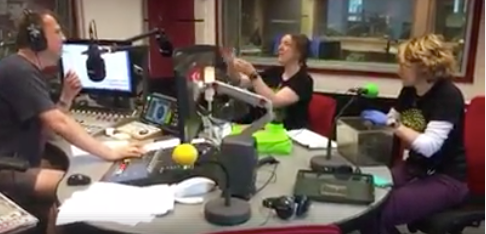
When Jennie Dennett of BBC Radio Cumbria heard that we were taking Cumbrian dung beetles to Glastonbury, she immediately got in touch to find out more and invited us to give an interview at their studios in Carlisle. Our activity “How Gross is Your Festival Kit” gave her an idea – drawing presenter Mike Zeller away from the studio under the pretence of a meeting, a member of the studio team took sneaky swabs of his kit and posted them to us at the Lancaster Environment Centre. We duly plated them out and incubated them to see what’s population the BBC Radio Cumbria studio.
On Friday, we arrived at the studio with some nasty-looking growths on agar plates, which we were able to produce on cue when Mike asked us about the activity.
BBC Radio Cumbria videoed the whole thing and have posted it on Facebook here.
Eric Grimm: A high-resolution record of hydrologic variability, vegetation, and fire from the Northern Great Plains, North America
Suzette Flantua: Assembling the biogeographic history of the Northern Andes – A multi-proxy approach
Carina Hoorn: The Amazon at sea: Onset and stages of the Amazon River from a marine record, with special reference to Neogene plant turnover in the drainage basin
Keith Richards: Why did the Arctic seal, Phoca hispida, become land-locked in the Caspian Sea 2.6 million years ago? : Palynology and foraminifera explain how
New paleoclimatic perspectives on the future of terrestrial systems: bigger change, higher confidence? Jonathan Overpeck
The University of Arizona
Numerous assessments of future freshwater and terrestrial system change have highlighted the potential for unprecedented change in the 21st century given continued emissions of greenhouse gases (GHGs) to the atmosphere; the risk to biodiversity is also believed to be high. The basis for these assertions are strengthened by recent observed ecosystem change, as well as by a new global compilation of climate and vegetation change over the last deglaciation indicating that most, if not all, dominantly natural landscapes on the planet are at high risk of significant transformation given the projected magnitude of warming that is likely in the future absent major reductions in global GHG emissions. At the same time, new paleoclimatic results indicate that the Amazon forests may be more resilient to future change than previously thought, whereas the risk of human deforestation associated with multi-year “megadrought” might be higher than previously believed. A growing body of literature highlight that drought and megadrought risk around the globe is going to be a bigger problem than widely thought. We know with great confidence that warming will continue as long as GHG emissions continue, and this means more drying of terrestrial systems is likely over much of the planet. As a result, droughts will become more severe, longer and frequent as long as GHG emissions are not reduced significantly. The ability of precipitation increases to mitigate the ecological and hydrological impacts of continued warming is especially diminished in the many regions of the globe where multi-decadal megadrought is likely, an assessment made more challenging by the growing realization that that state-of-the-art climate models may underestimate the risk of future megadrought. Existing global climate change assessments may thus be underestimating the challenges to terrestrial water and ecoystems under continued climate change.
My second pair articles from Vegetation History & Archaeobotany that I would like to highlight look at the impacts of volcanoes and climate on vegetation change. Specifically these explore:
Having recently become an Associate Editor for Vegetation History & Archaeobotany I have decided that I will try and highlight a couple papers from the journal each months which have caught my attention. My first selections are:
A study which demonstrated the close relationship between the fossil fungal spore record and historical accounts (Orbay-Cerrato et al., 2017).
An investigation of a human modification of ecosystems on the sub-tropical Pacific island of New Caledonia using fossil wood charcoal remains (Dotte-Sarout, 2017)
For more detailed thoughts on these papers read on…
I am delighted to report that I have recently been appointed as an Associate Editor for the journal Vegetation History & Archaeobotany (VHA). The journals scope is global and covers Quaternary environmental and climatic change, with a specific focus on the Holocene and pre-historic human impacts on landscapes; often linking palaeoecological and archaeological research. My remit with VHA is to provide expertise on tropical, and in particular South American, studies. Recent articles in VHA with a South American focus include:
Assessing the influence of glacial-interglacial climate changes on the dry forest vegetation along the southern edge of Amazonia (Whitney et al., 2014),
Modern pollen-vegetation relationships in Brazil and Argentina (Rodrigues et al., 2016).
I hope that over the next few years we can publish some more exciting articles on the tropics in VHA and I would therefore like to encourage you to submit interesting high quality original research, reviews, or short articles for our consideration.
To find out more about the journal and submit an article click here.
9TH EARLY CAREER RESEARCHER MEETING Integrating Tropical Ecology Across Biomes and Continents 29-31 March 2017 LANCASTER ENVIRONMENT CENTRE, LANCASTER UNIVERSITY Join us at Lancaster Environment Ce…





 Ecology of the past