After six successful meetings, the legendary BES-TEG Early Career Research Meeting returns. Day one will focus on Ecology and Ecosystem Processes, while day two will focus on Practical Applications and links to Policy such as conservation, livelihood, policy and development.
All early-career researchers, both PhD and Post-Docs, are welcome to present their tropical ecology related research with a poster and/or oral presentation. There shall be a competition for both with prizes. This event will take place at Derwent College (D/L//047) and the accommodation at Alcuin College (see map link below).
We enjoyed so much how this one-day meeting was scheduled, with some formal approach including four plenary and lighting talks, and other informal initiatives such as speed dating and discussion groups. This way, all participants could interact with other non-directly related researchers.
The focuses of the plenary talks were related to different fields within macroecology. In this sense:
Andy Purvis opened the session with the definition of macroecology, the trends and shifts of study topics it has carried out since the discipline began and ended with what macroecology is not any longer.
David Jablonski explored through examples of bivalves studies how climate in time and space affects the studies of diversity dynamics, mainly addressed to three key questions: a) Extinctions, b) Latitudinal Diversity Gradients, and c) Geographical ranges.
Lee Hsiang Liow encouraged us to evaluate both processes and observations, and highlighted the importance of modelling both to take into account the “unobservable” or latent truth including examples of capture-recapture and occupancy methods.
Kathy Willis gave a review of the trends followed for conservation strategies since 1980s, until the development of the “ecosystems services” idea of given an economic value to biodiversity. Her main statement was focused on how palaeo-data can help in providing information to some “knowledge gaps” related to human resources including: a) trends in biomass, b) trends in nutrient cycling, c) trends in in final ecosystems services, and d) sustainability of ecosystems services.
Lighting talks were related to more specific study cases of macroecology, including specific researches about turtles, fungi, beetles, crocodiles, foraminifera or dinosaurs, in several spatial and temporal scales .
We would like to thank again Phil, Victoria, Adriana and Isabel for the great day that finished with a nice and warm wine reception sponsored by BMC Ecology. We hope to attend further events like this soon.
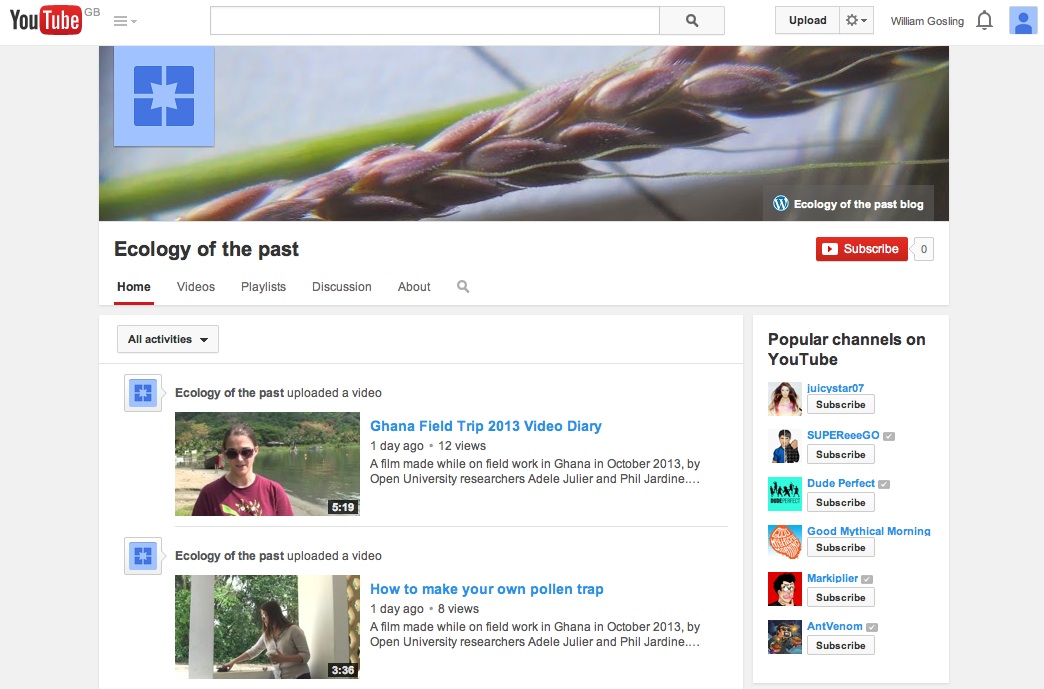
With the redesign and refocusing of the blog underway, I’m delighted to announce the launch of our very own “Ecology of the past”YouTube channel. Initially this will host videos produced as part of the Lake Bosumtwi pollen chemistry project, which includes a strong emphasis on impact and outreach activities. The videos are being targeted to a secondary school/sixth form audience, and will demonstrate both how we are doing the research and who we are as academics, highlighting the different roles and career pathways within the team. As time goes on this channel will be a platform for videos from other members of the research group, again showing who we are, what we do and how we do it.
For now, here are the first two videos: a diary of the field trip to Ghana that Adele and I went on last Autumn, and an accompanying piece showing how you too can make your own pollen trap. Enjoy!
Tardigrade egg found in Ghanaian pollen trap by Adele
Here is a summary of what other people have been up to:
Lottie Miller: submission and approval of thesis corrections (hooray), working on British Ecological Society grant application.
Hayley Keen: is finishing up lab work (macro charcoal – done, XRF – done, wood macrofossils – thin sectioned, awaiting identification, pollen – just 4 more samples!); and dealing with minor review revisions to first submitted paper (hooray).
Frazer Bird: finished the data collection for two Ecuadorian lakes (Banos and Pindo) and will hopefully begin to write up this data soon; attended the NERC stats course (very useful; would advise everyone to try and get on it).
Nick Loughlin: has split and logged the sediment cores recovered from Lake Huila (Ecuador) during recent fieldwork, and begun preparing the samples for pollen.
Adele Julier: has been preparing pollen trap samples from Ghana and learning tropical pollen.
Emily Sear: has mostly been on holiday and we are still waiting for the post card! She has also been working at getting results that make sense from the MS2.
Phil Jardine: has been oxidising spores to see what it does to the chemistry, generating FTIR data with the oxidised samples and starting the numerical analysis, and editing film footage from the 2013 Ghana trip.
Encarni Montoya: has been doing pollen lab and analysing pollen from Baños, and comparing the midges trends from Pindo and Baños with Frazer.
Wes Fraser: Reported back to Royal Society on finding from research grant – paper containing exciting results to follow in next couple of months.
Some pollen from Adele’s pollen traps in Ghana
We have also had 4 papers published with 2014 dates on them:
Cárdenas, M.L., Gosling, W.D., Pennington, R.T., Poole, I., Sherlock, S.C. & Mothes, P. (2014) Forests of the tropical eastern Andean flank during the middle Pleistocene. Palaeogeography, Palaeoclimatology, Palaeoecology, 393: 76-89. doi: 10.1016/j.palaeo.2013.10.009
Fraser, W.T., Watson, J.S., Sephton, M.A., Lomax, B.H., Harrington, G., Gosling, W.D. & Self, S. (2014) Changes in spore chemistry and appearance with increasing maturity. Review of Palaeobotany and Palynology, 201, 41-46. doi:10.1016/j.revpalbo.2013.11.001
Sayer, E.J., Featherstone, H.C. & Gosling, W.D. (2014) Sex & Bugs & Rock n Roll: getting creative about public engagement. Trends in Ecology & Evolution, 29, 65-67. doi: 10.1016/j.tree.2013.12.008
Last week I attended the annual meeting of the British Ecological Society Macroecology Special Interest Group (or BES Macroecology SIG for something a bit more manageable) at the University of Sheffield. Macroecology deals with ecological patterns and processes that occur over large spatial and temporal scales, and so is a natural fit for a lot of palaeoecological data.
The organisers deliberately moved away from the standard conference format of back-to-back talks, and instead built in lots of time for discussions around several themes (‘provacations’) that addressed the current status of macroecology and possible future directions for it. Several areas for progress were identified here, including finding more efficient ways of generating, curating and accessing large (global scale) datasets, increasing dialogue between numerical modellers and empirical ecologists, and more statistical and computational training for undergraduate ecologists and biologists.
Sessions of presentations were also formulated to encourage discussion and debate, with either rapid, five-minute presentations or longer methodological talks forming the starting point for further discourse. I struggled enormously with the five-minute time limit during my talk (conference talks are often built around a 15 minute slot) but hopefully interested a few people in the uses of 60 million year old pollen for addressing macroecological questions.
A workshop on ‘Spatial analysis in R’ followed the two-day meeting. This was taught by Barry Rowlingson, and was co-organised by the Macroecology and Computational Ecology SIGs. Barry started by introducing the programme R and then went on to demonstrate its uses for handling, mapping and analysing spatial data. This type of analysis was largely new to me, and this workshop was a brilliant introduction to what R can do with geographical data.
To join these British Ecological Society SIGs and find out about other groups visit the BES SIG pages by clicking here.
More regular type activities have also continued. Hayley is working on the protocol for thin sectioning wood here. Frazer is picking midges and becoming increasingly media savey. While Bryan, Lottie and Natalie are all writing theses!
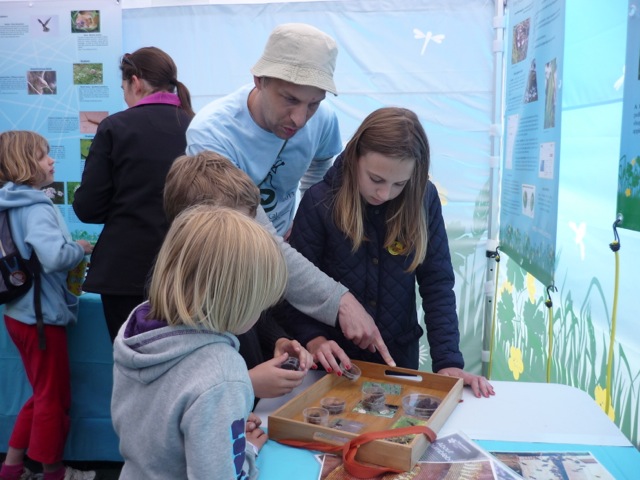
Playing the “Who’s poo” game at Wychwood Festival.
Group members William and Frazer took part in the first music festival outing of the British Ecological Society 100 year celebration “Sex & Bugs & Rock ‘n Roll” at Wychwood (31 May – 3 June). Early reports suggest that over 900 people were “stickered” and around 100 people “swabbed” during the weekend. For full details of this event, and future activity, check out the blog and follow the BES Roadies on twitter @BESRoadies.
Lots of excitement in the Palaeo group over the last couple of months including:
Co-I Wes Fraser checks out the FTIR in its new lab. The FTIR will be the main kit used for pollen chemical analysis in the project.
1) Recruitment. Interviews, and offers, for the PhD and PDRA posts related to our recent NERC standard grant award. Hot competition made our life very difficult but we are delighted to be adding two new people to our team. More information as soon as positions have been confirmed…
2) Student conference. On 16 May it was the annual CEPSAR student conference. The standard of talks from our 2nd and 3rd year PhD students was as excellent. With both Hayley and Frazer representing the PCGR well. Frazer recieved a highly commended award from the judges which means that he is on the right track having just had a paper accepted for INTECOL in August – well done Frazer.
3) Outreach preparation & activity. The British Ecological Society “Sex and Bugs and Rock ‘n’ Roll” got its first outing at Imperialfest (04/05/2013), further activities and equipment were tested at The OU (24/05/2013) and hopefully we are now set for our first major outing at Wychwood – exciting times!
4) Science outputs on track. The acceptance of two papers for publication (an African pollen atlas to be published in Review of Palaeobotany & Palynology, and palaeo-ecosystem services in the Andes paper for TheHolocene).
Throughout the year we hope to get more and more video content of events and activities online. Here is a quick compiliation of existing BES online video content to give you a taste of what we are building upon!
The first Festival of Ecology video was posted by the Sex & Bugs & Rock ‘n’ Roll team and was shot at the BES annual meeting 2012:
Ecologist workshop on creative public engagement at the BES annual meeting 2012
The BES Roadies (@BESRoadies) will be taking ecology to music festivals over the summer. So far we are confirmed at Wychwood and Greenman. More video from the BES Roadies will be posted on our YouTube page.
 Keynote speakers: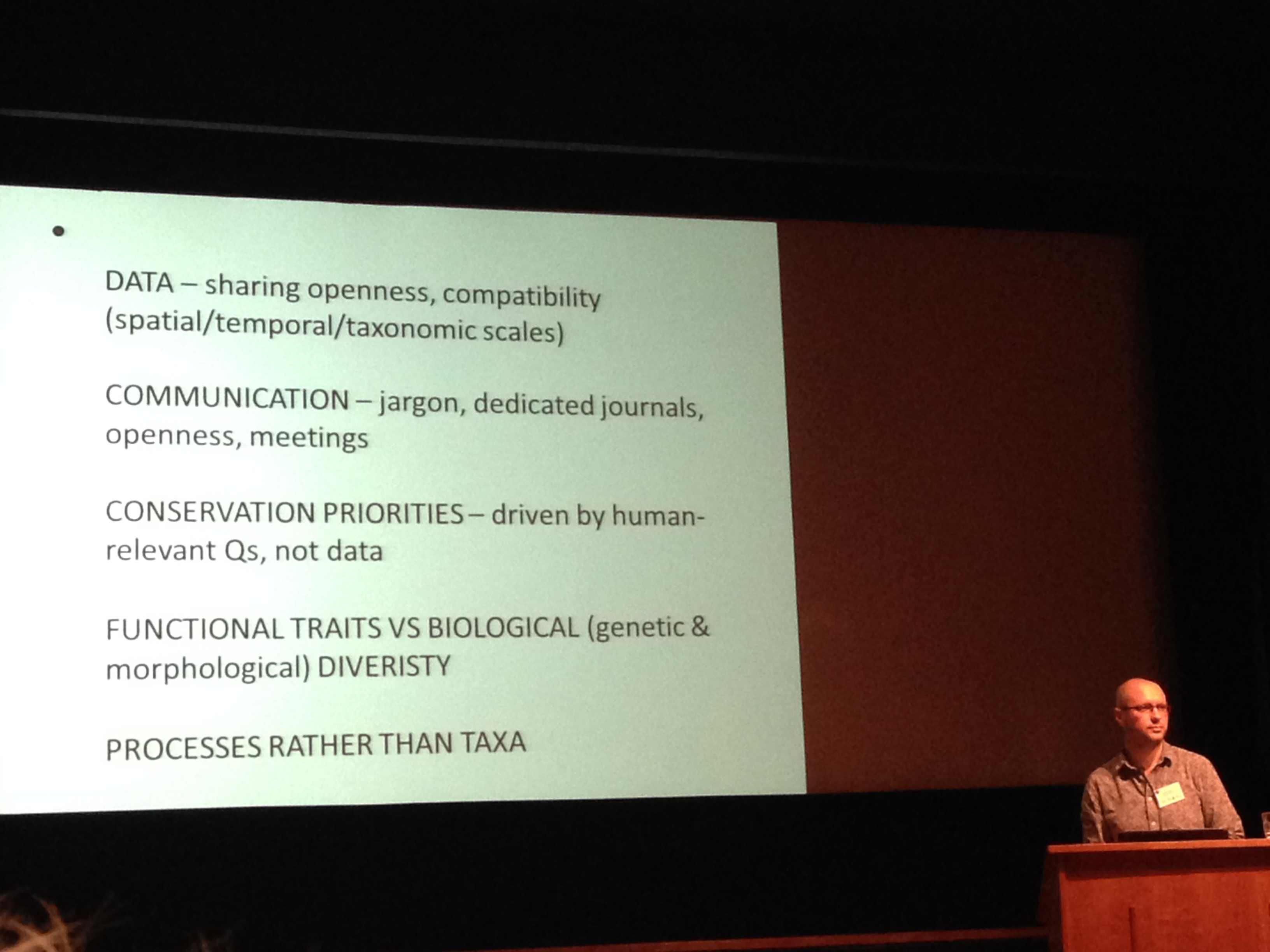




 Ecology of the past