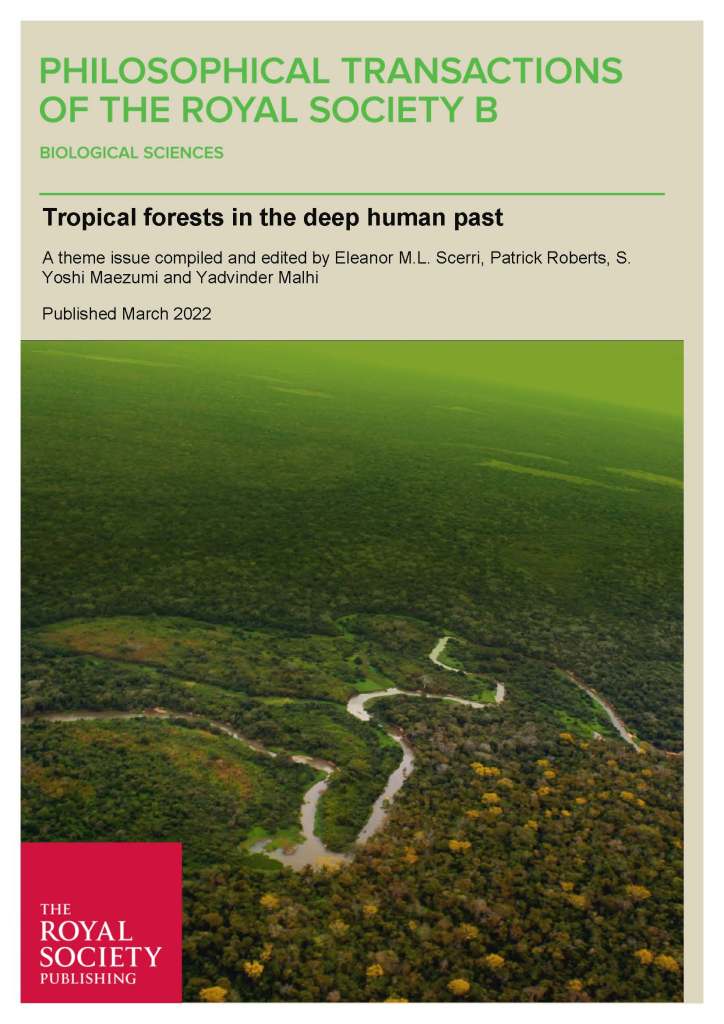
Hugo de Vries Prijs winner!

June 18, 2025
WDG

Ecology of the Past blog contributor Nina Witteveen was awarded the Hugo de Vries prize on 13 June 2025 at the Botanic Gardens in Nijmegen. The Hugo de Vries prize is awarded by the KNbv (Royal Dutch Botanical Society) and the Stichting Hugo de Vries fonds (Hugo de Vries foundation) for the best PhD thesis in Botany defended at a Dutch University. This years prize was awarded to Nina for her thesis “Long-term Forest Recovery in Amazonia: Insights from Phytolith Analysis” (University of Amsterdam) which was completed under the supervision of Crystal McMichael.

After much debate the jury decided to award two first prizes this year, with the other prize also going to a tropical PhD thesis. That of Tomonari Matsuo for his thesis “Drivers and mechanisms of tropical secondary forest succession” (Wageningen University & Research).

To find out more about the prize and how to submit a thesis for the award visit: https://www.knbv.eu/hugo-de-vries-prijs/

Follow Nina’s journey into tropical palaeoecology through her blog posts here: https://ecologyofthepast.info/?s=nina+witteveen
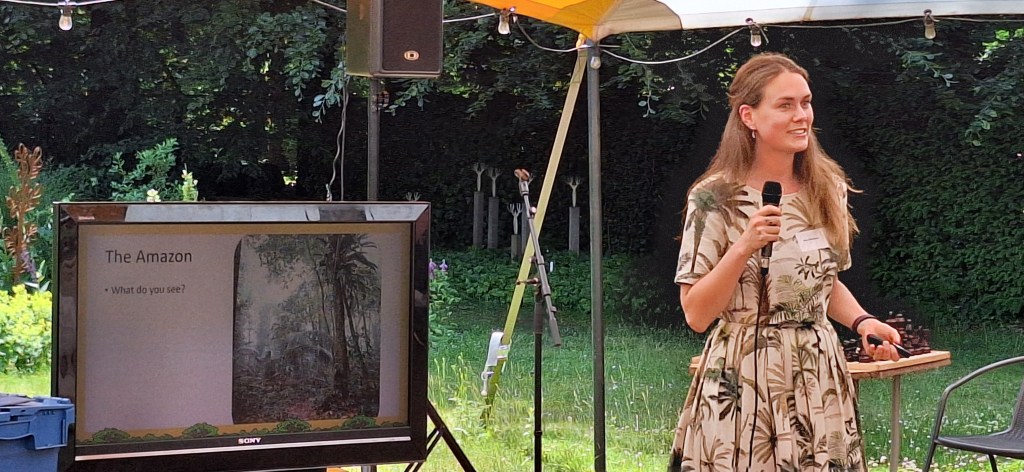

Nina presenting here PhD thesis at the prize giving of the Hugo de Vries award 2025!

Why palm fossils are important for the Amazon rainforest

March 14, 2022
ninahylkjewitteveen

With all the horror chaos in the world, science doesn’t seem like the most important thing. I forgot all about my paper, until I received an email, that… the first chapter of my PhD is published! Some positive news I would like to share with you.  

If you think about a stereotypical scientist, hidden in a lab, investigating every detail of a tiny thing…. that is great description of what I was doing! 

A snapshot of data analysis
Continue Reading

Netherlands Annual Ecology Meeting 2019

February 11, 2019
WDG

The Netherlands Annual Ecology Meeting (NAEM) 2019 takes place in the 12 and 13 February. This annual showcase of predominantly Dutch based ecological research will take place, as usual, at Conference Centre “De Werelt” (Lunteren). I am particularly excited this year as, along with Marielos Pena Carlos and Patrick Jansen, I am co-convening a session on “Tropical Ecology”. The first time I have contributed to the program in this way. Our session will be on the second day of the conference and contain the following exciting presentations:

  • 15:00 Predator avoidance and prey tracking in a Neotropical forest (Constant Swinkels, Wageningen University & Research)
  • 15:20 The role of fig volatiles in pollinator specificity and fig diversity (Aafke Oldenbeuving, Naturalis Biodiversity Center)
  • 15:40 Mangrove Atlantis: Can mangroves keep up with extreme land-subsidence? (Celine van Bijsterveldt, Royal Netherlands Institute for Sea Research)
  • 16:00 Break
  • 16:10 The fate of forests in agro-forest frontier landscapes, implications for conservation (Madelon Lohbeck, Wageningen University & Research)
  • 16:30 Trends in the variability of Specific Leaf Area of paramo vegetation during succession (Marian Cabrera, University of Amsterdam)
  • 16:50 Succession dynamics of tree and soil fungal communities in regenerating tropical rainforests are strongly influenced by regional species pool and abiotic factors (Irene Adamo, Naturalis Biodiversity Center)


AFQUA 2018 – day 6

July 20, 2018
WDG

AFQUA: The African Quaternary environments, ecology and humans
2ndInternational Conference and Workshops
14-22 July 2018-07-15 National Museum, Nairobi, Kenya

Day 6

The final day of talks at AFQUA 2018 took a more applied approach in the first session “Applying the Quaternary: The role of the past in supporting the future”. This session focused on how we can focus Quaternary science to produce outputs that directly meet concerns and needs of society. Examples included the quantification of the fossil charcoal record to provide insights into the nature and impact of fires in the past (C. Adolf), how we can use information on past vegetation change and disturbance factors to anticipate how ecosystems on Madagascar might respond to future changes (E. Razanatsoa), and how climate histories can be extended through tree ring data (D. Colombaroli).

This slideshow requires JavaScript.

Continue Reading

Kissling, W.D., Blach-Overgaard, A., Zwaan, R.E. & Wagner, P. (2016) Historical colonization and dispersal limitation supplement climate and topography in shaping species richness of African lizards (Reptilia: Agaminae). Scientific Reports 6, 34014. DOI: 10.1038/srep34014

Lutz, H.L., Weckstein, J.D., Patane, J.S.L., Bates, J.M. & Aleixo, A. (2013) Biogeography and spatio-temporal diversification of Selenidera and Andigena Toucans (Aves: Ramphastidae). Molecular Phylogenetics and Evolution 69, 873-883. DOI: 10.1016/j.ympev.2013.06.017

Malhi Y. , Gardner T.A., Goldsmith G.R., Silman M.R., Zelazowski P. (2014) Tropical forests in the Anthropocene. Annual Review of Environment and Resources 39, 125-159. DOI: 10.1146/annurev-environ-030713-155141

Morueta-Holme, N., Engemann, K., Sandoval-Acuña, P., Jonas, J.D., Segnitz, R.M. & Svenning, J. (2015) Strong upslope shifts in Chimborazo’s vegetation over two centuries since Humboldt. Proceedings of the National Academy of Sciences 112, 12741-12745. DOI: 10.1073/pnas.1509938112


Blog at WordPress.com.