From palaeoecological knowledge to sustainable environmental management

August 4, 2026
WDG

By Sam Beudeker

BSc Future Planet Studies, Future Earth track, University of Amsterdam

Check out the ArcGIS Storymap of this blog at: https://arcg.is/0HSn480

Climate change is one of the greatest challenges of our time. It reflects a growing imbalance between people and the natural systems that support life on Earth. Building a more sustainable future requires more than understanding present-day environmental problems. It requires a deeper perspective on how ecosystems function, how they have changed over time, and how humans have interacted with them over long periods.

As a third-year bachelor student in biological and Earth sciences, I have become increasingly interested in these long-term interactions between climate, ecosystems, and human land use. I have learned that ecosystems are not stable systems, but dynamic ones that continuously respond to changes in climate, fire, and land use. Palaeoecology provides a way to reconstruct these long-term dynamics and place modern environmental change in a much deeper temporal context.
Although environmental change has always been part of Earth’s history, the current situation is characterised by a particularly rapid combination of climate change and human pressure on land systems. This makes long-term knowledge especially important, as it helps us distinguish natural variability from human-driven change and understand whether current ecosystems are within historical ranges of behaviour or entering new states.

Honours Program Thesis Extension

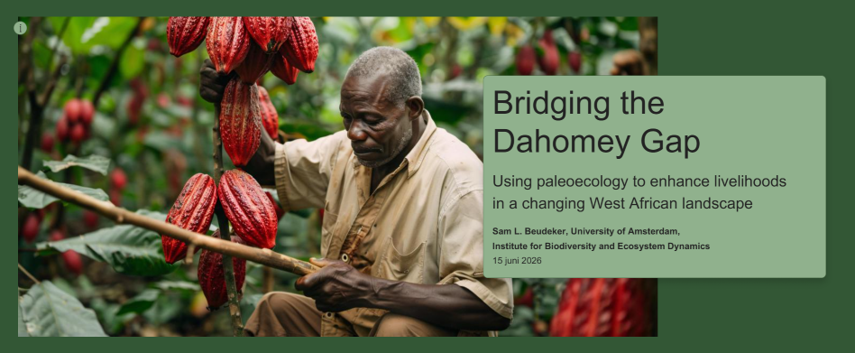
For the Honours Program alongside my bachelor’s degree, I extended my palaeoecology thesis with an interdisciplinary perspective focused on how long-term environmental knowledge can inform future land management. Rather than treating palaeoecology only as a reconstructive science, I explored its role as a bridge between past ecosystem dynamics and present-day sustainability challenges.

As a case study, I focused on the Dahomey Gap in West Africa, a forest–savanna transition zone that interrupts the continuous Guineo-Congolese rainforest belt. This region is not a fixed ecological boundary, but a shifting mosaic shaped over time by climate variability, fire, and human land use.

ArcGIS Storymap

Continue Reading

Hugo de Vries Prijs winner!

June 18, 2025
WDG

Ecology of the Past blog contributor Nina Witteveen was awarded the Hugo de Vries prize on 13 June 2025 at the Botanic Gardens in Nijmegen. The Hugo de Vries prize is awarded by the KNbv (Royal Dutch Botanical Society) and the Stichting Hugo de Vries fonds (Hugo de Vries foundation) for the best PhD thesis in Botany defended at a Dutch University. This years prize was awarded to Nina for her thesis “Long-term Forest Recovery in Amazonia: Insights from Phytolith Analysis” (University of Amsterdam) which was completed under the supervision of Crystal McMichael.

After much debate the jury decided to award two first prizes this year, with the other prize also going to a tropical PhD thesis. That of Tomonari Matsuo for his thesis “Drivers and mechanisms of tropical secondary forest succession” (Wageningen University & Research).

To find out more about the prize and how to submit a thesis for the award visit: https://www.knbv.eu/hugo-de-vries-prijs/

Follow Nina’s journey into tropical palaeoecology through her blog posts here: https://ecologyofthepast.info/?s=nina+witteveen

Nina presenting here PhD thesis at the prize giving of the Hugo de Vries award 2025!

New funding opportunity for African researchers

November 8, 2023
WDG

A new funding stream is about to open up (1 December 2023) to support African scientists to carry out PhD research at Dutch universities. The GROW research programme (Graduate Research on Worldwide Challenges) will fund 51 PhD positions to be based at one of five Dutch universities, including with the Institute for Biodiversity & Ecosystem Dynamics, at the University of Amsterdam.

To find out more click here.

Applications open 1 December 2023 and close 31 January 2024.

The geology of mankind

April 8, 2014
adelecmj

Adele Julier on:

Malm, A. & Hornborg, A. (2014) The geology of mankind? A critique of the Anthropocene narrative. The Anthropocene Review, 1, 62-69.

Malm and Hornborg’s paper ‘The geology of mankind? A critique of the Anthropocene narrative’ raises some important points about the terminology of climate science and how this not only affects perceptions of who or what is to blame, but also of what can be done to address  it and by who. The main thrust of their argument is that the use of the term Anthropocene distances people from the effects of man-made climate change through the argument that human nature inescapably led to large CO2 emissions and therefore the havoc being wreaked upon ecosystems is essentially inevitable. They go on to discuss that this ignores the fact that a tiny percentage of humanity actually set into motion the huge changes which we are only now beginning to address, that humanity as a whole at no point decided to take this path and that the use of the term Anthropocene is actually counter-productive, in that it removes the onus of solving environmental problems from the small group of humans that actually caused them, instead spreading it out so thinly that it loses its power.

The argument that Anthropocene is perhaps not the best term to use for the present situation is persuasive, but the idea that it apportions blame too widely does not take into consideration the fact that developing countries are now largely following in the footsteps of developed countries in terms of both habitat destruction and carbon emissions. Although all of humanity may not have started global change, the practices initiated by the few are now being endlessly replicated. The reasons behind this are economic; currently, and largely in the short term, it pays countries and large corporations to continue unsustainable practices. They ignore pressure to change if it undermines economic growth or affects profit margins, not because they do not think they are part of the problem. Academics could choose to call this the ‘Anthropocene’ the ‘OnePercentocene’ or the ‘ThisIsYourFault,Sir,Yes,YouInTheGreySuit,StopPlayingWithYour PhoneAndListen-ocene’, but it will not make the slightest difference until these basic problems are addressed.

PCRG publications 2013

December 20, 2013
WDG

Gosling, W.D., Miller, C.S. & Livingstone, D.A. (2013) Atlas of the tropical West African pollen flora. Review of Palaeobotany and Palynology, 199, 1-135

Gosling, W.D. & Williams, J.J. (2013) Ecosystem service provision sets the pace for pre-Hispanic societal development in the central Andes. The Holocene, 23, 1619-1624

Miller, C.S., Leroy, S.a.G., Izon, G., Lahijani, H.a.K., Marret, F., Cundy, A.B. & Teasdale, P.A. (2013) Palynology: A tool to identify abrupt events? An example from Chabahar Bay, southern Iran. Marine Geology, 337, 195-201

Roucoux, K.H., Lawson, I.T., Jones, T.D., Baker, T.R., Coronado, E.N.H., Gosling, W.D. & Lähteenoja, O. (2013) Vegetation development in an Amazonian peatland. Palaeogeography, Palaeoclimatology, Palaeoecology, 374, 242-255

Rull, V., Montoya, E., Nogué, S., Vegas-Vilarrúbia, T. & Safont, E. (2013) Ecological palaeoecology in the neotropical Gran Sabana region: Long-term records of vegetation dynamics as a basis for ecological hypothesis testing. Perspectives in Plant Ecology, Evolution and Systematics, 15, 338-359

Blog at WordPress.com.