From palaeoecological knowledge to sustainable environmental management

August 4, 2026
WDG

By Sam Beudeker

BSc Future Planet Studies, Future Earth track, University of Amsterdam

Check out the ArcGIS Storymap of this blog at: https://arcg.is/0HSn480

Climate change is one of the greatest challenges of our time. It reflects a growing imbalance between people and the natural systems that support life on Earth. Building a more sustainable future requires more than understanding present-day environmental problems. It requires a deeper perspective on how ecosystems function, how they have changed over time, and how humans have interacted with them over long periods.

As a third-year bachelor student in biological and Earth sciences, I have become increasingly interested in these long-term interactions between climate, ecosystems, and human land use. I have learned that ecosystems are not stable systems, but dynamic ones that continuously respond to changes in climate, fire, and land use. Palaeoecology provides a way to reconstruct these long-term dynamics and place modern environmental change in a much deeper temporal context.
Although environmental change has always been part of Earth’s history, the current situation is characterised by a particularly rapid combination of climate change and human pressure on land systems. This makes long-term knowledge especially important, as it helps us distinguish natural variability from human-driven change and understand whether current ecosystems are within historical ranges of behaviour or entering new states.

Honours Program Thesis Extension

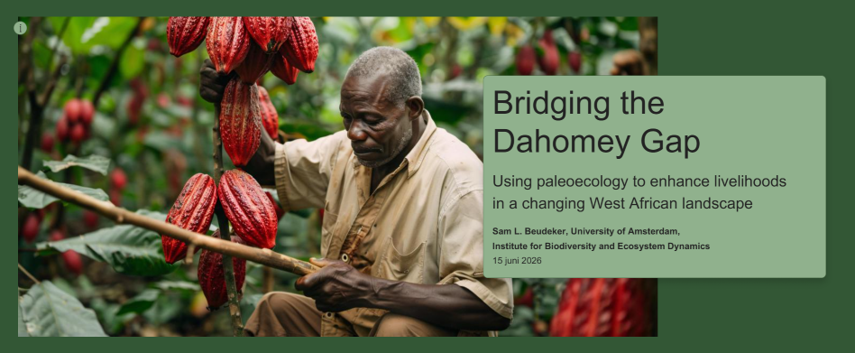
For the Honours Program alongside my bachelor’s degree, I extended my palaeoecology thesis with an interdisciplinary perspective focused on how long-term environmental knowledge can inform future land management. Rather than treating palaeoecology only as a reconstructive science, I explored its role as a bridge between past ecosystem dynamics and present-day sustainability challenges.

As a case study, I focused on the Dahomey Gap in West Africa, a forest–savanna transition zone that interrupts the continuous Guineo-Congolese rainforest belt. This region is not a fixed ecological boundary, but a shifting mosaic shaped over time by climate variability, fire, and human land use.
ArcGIS Storymap

Continue Reading

Big History

December 18, 2024
WDG

This week I will give a lecture on the University of Amsterdam, Institute for Interdisciplinary Studies, BSc Big History course. This course sets out with the large ambition of covering “How the histories of the cosmos, life, Earth and human societies influence each other and shape important aspects of the world together?” The small component of this that I am involved in relates to the understanding of past environmental change and how humans have shaped the landscapes we see around us today.

Related to the topic of past environmental change Prof. Henry Hooghiemstra (University of Amsterdam), and the Big History team, have produced a short video “How are civilizations influenced by climate change?”. In this video a introduction to how we can obtain information on past environmental change from the sedimentary record is given, and examples of changing landscapes and cultures in the Netherlands and Mexico are discussed.

You can find more Big History content in the University of Amsterdam Big History MOOC (Massive Online Open Content) by clicking here.

Introducing Milan Teunissen van Manen

February 9, 2016
WDG

Milan Teunissen van ManenMy name is Milan Teunissen van Manen and I just finished my first week as a Ph.D. researcher with the Palaeoecology & Landscape Ecology (P&L) group in the Institute for Biodiversity & Ecosystem Dynamics (IBED) at the University of Amsterdam (UvA)!

My undergraduate studies were interdisciplinary in nature: I did a BSc Beta-Gamma (Institute for Interdisciplinary Studies (IIS), UvA) where students are taught to collaborate between different disciplines. Ecology has always been an interest of mine, so I was quick to specialize in that field. In my final year of my bachelor I came in contact with paleoecology and did not hesitate to make sure my first master’s project (MSc Biological Science, IBED, UvA) would be with the P&L research group (IBED) – a worked on a project on tropical rainforest dynamics in Miocene Amazonia. After that I got the chance to test my skills outside research institutes: during the Tesla consultancy Minor (IIS) I got firsthand practical experience in developing urban green areas from start to finish for the municipality of Amsterdam. The focus of that project was to increase the ecologic, educational, scientific, and social value of the natural areas on Amsterdam Science Park. It was great to see my scientific background put to good use outside the research community. The project is still active today.

After a short period of working in education and sustainability consultancy I seized the opportunity to, once more, join the P&L research group – this time as a Ph.D. student under the watchful eyes of William Gosling and Boris Jansen. My project revolves around characterizing biomarker and modern pollen-rain signals across the altitude of the Ecuadorian Andes vegetation. A great opportunity at the frontier of tropical research!

If the first week is any indication, I foresee to a lot of collaboration, hard work, exploration and adventure in the coming years!

To find out more about me visit:

Blog at WordPress.com.