From palaeoecological knowledge to sustainable environmental management

August 4, 2026
WDG

By Sam Beudeker

BSc Future Planet Studies, Future Earth track, University of Amsterdam

Check out the ArcGIS Storymap of this blog at: https://arcg.is/0HSn480

Climate change is one of the greatest challenges of our time. It reflects a growing imbalance between people and the natural systems that support life on Earth. Building a more sustainable future requires more than understanding present-day environmental problems. It requires a deeper perspective on how ecosystems function, how they have changed over time, and how humans have interacted with them over long periods.

As a third-year bachelor student in biological and Earth sciences, I have become increasingly interested in these long-term interactions between climate, ecosystems, and human land use. I have learned that ecosystems are not stable systems, but dynamic ones that continuously respond to changes in climate, fire, and land use. Palaeoecology provides a way to reconstruct these long-term dynamics and place modern environmental change in a much deeper temporal context.
Although environmental change has always been part of Earth’s history, the current situation is characterised by a particularly rapid combination of climate change and human pressure on land systems. This makes long-term knowledge especially important, as it helps us distinguish natural variability from human-driven change and understand whether current ecosystems are within historical ranges of behaviour or entering new states.

Honours Program Thesis Extension

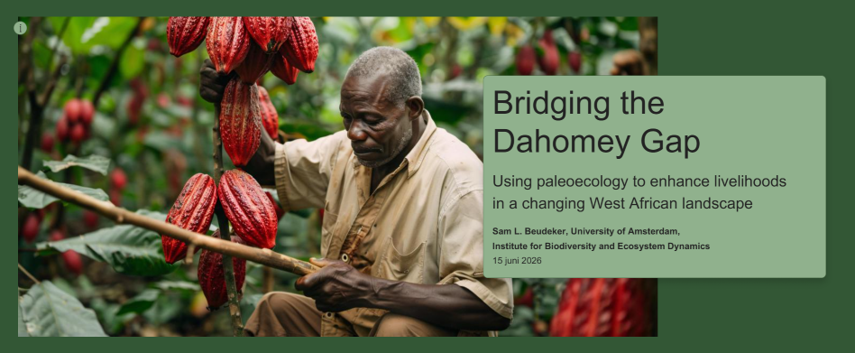
For the Honours Program alongside my bachelor’s degree, I extended my palaeoecology thesis with an interdisciplinary perspective focused on how long-term environmental knowledge can inform future land management. Rather than treating palaeoecology only as a reconstructive science, I explored its role as a bridge between past ecosystem dynamics and present-day sustainability challenges.

As a case study, I focused on the Dahomey Gap in West Africa, a forest–savanna transition zone that interrupts the continuous Guineo-Congolese rainforest belt. This region is not a fixed ecological boundary, but a shifting mosaic shaped over time by climate variability, fire, and human land use.
ArcGIS Storymap

Continue Reading

European Conference of Tropical Ecology: Registration Open

November 14, 2024
WDG

We are excited that more than 250 abstracts have been submitted for the 8th European Conference of Tropical Ecology “Time for Tropical Ecology” in Amsterdam. Furthermore, we are delighted to announce the NWO (the Dutch Science Foundation) as the main sponsors of the event. The conference is being organised by the Institute for Biodiversity & Ecosystem Dynamics (University of Amsterdam) on behalf of the European Society of Tropical Ecology. The conference will take place in February 2025 at a central location in the city (Hotel Casa).

We have an exciting program emerging including keynotes from three ‘rising star’ and three ‘senior’ scientists, a conference dinner (House of Watt), and a photo competition with prizes! Throughout the program we hope to create a vibrant atmosphere for the discussion of cutting edge research into the tropical regions of planet Earth.

You can be a part of this event by registering now. Early bird rate is valid until: 18 December 2024

European Conference of Tropical Ecology: Call for abstracts open

October 10, 2024
WDG

ABSTRACT DEADLINE: 23 October 2024. Click here to submit your abstract NOW.

The European Conference of Tropical Ecology will take place in Amsterdam between 24 and 28 February 2025. The event will be centered around thematic oral and poster sessions. There are twenty-three different thematic sessions organized into seven broad topics:

  • Freshwater and marine ecosystems
  • Human-environment interactions
  • Monitoring and modelling
  • Patterns and processes
  • Restoration and conservation
  • Spatial and temporal scales
  • General ecology

For full details on the thematic sessions click here to download our Thematic Session booklet.

Or click here to explore the conference webpages:

Click here to submit your abstract NOW.

MSc track Environmental Management

February 27, 2023
WDG

The “Environmental Management” track of the University of Amsterdam MSc Earth Sciences program is the more applied sister to the Earth System Science track. The Environmental Science track is focused on the solutions to societal challenges that can be gained from the Earth sciences. Drawing on linkages with social sciences you will gain a broad interdisciplinary training covering topics including: urban-ecological development, human-wildlife conflicts, and the climate crisis. During the degree you will work with researcher within the interdisciplinary Institute for Biodiversity & Ecosystem Dynamics (IBED), carry out an independent research project, and an internship at a societal facing organisation.

  • Energy and Climate Change: Investigate the relationship between climate change and energy systems, and confront the challenges of creating a decarbonised world.
  • GIS and Remote Sensing in Ecosystem Dynamics: Learn how to use large remotely sensed datasets to gain insights into geological, geomorphological and soil systems.
  • Integrated Coastal Dune Management: Explore the concept of “Resilience Thinking” in tacking the complex management task of protecting the Dutch coastline and its ecosystems.
  • Metropol Ecology: Focused on the part of the Earth system where people are, investigate biodiversity and ecosystems in urban systems and mega cities.
  • Science Based Geo-ecological Management: How can science guide environmental management, address key challenges of supporting society, includes field visit to Oostvardersplassen.
  • System Innovation and Transition Management: Climate, energy and agricultural systems are all changing discover how understanding their dynamics is important for governance and sustainability.
  • Click here for further details and a full list of courses.
Environmental management of high Andean ecosystems. During the field school in Peru MSc Earth Science students work with locals and NGOs to improve practices (click here to find out more)

The Environmental Management track can be taken in conjunction with the “Science for Sustainability” minor offered by the Faculty of Science, or other free elective courses to broaden your program.

During the course you will do an internship to get direct experience of working outside academia. Organisations hosting internships in recent years have included:

Sustaining Earth’s Biodiversity

August 31, 2017
WDG

Exciting new edition of the Past Global Changes (PAGES) magazine focused on the sustainability of Earth’s biodiversity. Includes articles by Ecology of the Past blog contributors Dr. Encarni Montoya and Dr. Macarena Cardenas.

To find out more check out the full issue (free):

  • Gillson, L., Gell, P. & von Gunten, L. (2017) Past Global Changes Magazine: Sustaining the Earth’s Biodiversity 25(2): 76-130. DOI: 10.22498/pages.25.2

Blog at WordPress.com.