

By Sam Beudeker
BSc Future Planet Studies, Future Earth track, University of Amsterdam
Check out the ArcGIS Storymap of this blog at: https://arcg.is/0HSn480
Climate change is one of the greatest challenges of our time. It reflects a growing imbalance between people and the natural systems that support life on Earth. Building a more sustainable future requires more than understanding present-day environmental problems. It requires a deeper perspective on how ecosystems function, how they have changed over time, and how humans have interacted with them over long periods.
As a third-year bachelor student in biological and Earth sciences, I have become increasingly interested in these long-term interactions between climate, ecosystems, and human land use. I have learned that ecosystems are not stable systems, but dynamic ones that continuously respond to changes in climate, fire, and land use. Palaeoecology provides a way to reconstruct these long-term dynamics and place modern environmental change in a much deeper temporal context.
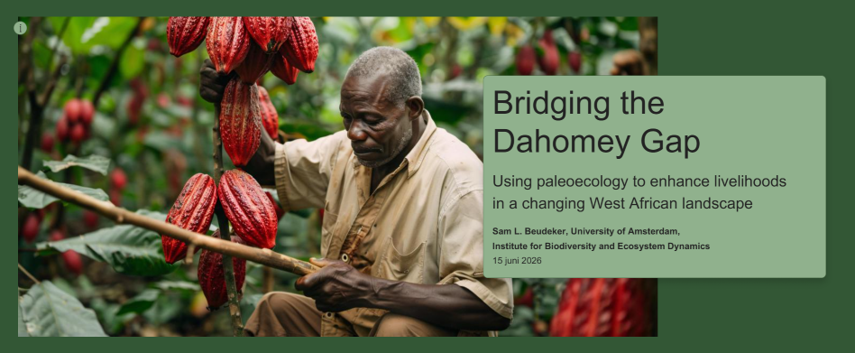
Although environmental change has always been part of Earth’s history, the current situation is characterised by a particularly rapid combination of climate change and human pressure on land systems. This makes long-term knowledge especially important, as it helps us distinguish natural variability from human-driven change and understand whether current ecosystems are within historical ranges of behaviour or entering new states.
Honours Program Thesis Extension
For the Honours Program alongside my bachelor’s degree, I extended my palaeoecology thesis with an interdisciplinary perspective focused on how long-term environmental knowledge can inform future land management. Rather than treating palaeoecology only as a reconstructive science, I explored its role as a bridge between past ecosystem dynamics and present-day sustainability challenges.
As a case study, I focused on the Dahomey Gap in West Africa, a forest–savanna transition zone that interrupts the continuous Guineo-Congolese rainforest belt. This region is not a fixed ecological boundary, but a shifting mosaic shaped over time by climate variability, fire, and human land use.
 Ecology of the past