Wei, C., Li, M., Mao, L., Mander, L., Jardine, P.E., Gosling, W.D. & Hoorn, C. (2024) A 23-million-year record of morphological evolution within Neotropical grass pollen. New Phytologist. DOI: 10.1111/nph.20214
This paper is the latest to come from the PhD thesis of Caixia Wei who defended at the University of Amsterdam earlier in 2024. To find out more about Caixia’s work click here.
The high tropical Andes harbours vital ecosystems that sustain biodiversity, carbon storage, and environmental service provision for millions of people. They are identified as one of the most vulnerable terrestrial ecosystems to global environmental changes, particularly to climate change and land use conversion. Despite their vulnerability and the importance of global biodiversity conservation and Andean societies, they are among the least studied ecosystems in the world. In this thesis, I studied the patterns of summit plant community’s across the tropical section of the Andes. Further, I studied what environmental factors influence plant community composition, species diversity, and thermal niche traits in high tropical alpine ecosystems. Based on the thermal niche traits, I assessed the potential vulnerability of species and communities to climate warming, considering the effect of the climate variability hypothesis on the species niche breadths. Further, I synthesised the current state of knowledge and assessed the current and projected landscape changes in the high Andes due to the combined effect of glacier retreat and climate warming. I reviewed documented glacier changes and landscape evolution over past decades to millennia and assessed projected future glacier shrinkage until 2100 for two case studies in the Andes of Ecuador and Peru. I also evaluated the capacity of high Andean ecosystems to recover from land use changes using the aptitude to store and take up carbon together with plant diversity. Lastly, I carried out an applied research analysis aimed at informing conservation policy formulation in continental Ecuador through defining critical areas for biodiversity conservation.
We invite you to join us on an incredible journey through the heart of Ecuador, where a group of adventurous students from Florida Institute of Technology embarked on a life-changing experience as part of the Neotropical Archaeoecology summer field course. Buckle up as we delve into the marvels of nature, indigenous cultures, and unforgettable experiences. Let’s dive right in!
Unveiling the Andes
Our adventure began with a breath-taking visit to the Paramo at Cayambe-Coca National Park. Paramos are high altitude (3000-4000 metres) wet grasslands above the tree line and below the snow line within the equatorial Andes. Our tour guides Patricio and Byron gave us information about the local vegetation, focusing on the Polylepis tree (locally known as “paper tree”), which is unique to this sort of habitat. They also told us about some of the fascinating wildlife that can be seen here, such as the Andean Bear (Tremarctos ornatus) and the Andean Puma (Puma concolor).
We then descended through the cloud forest (3,600–3,400 meters) and lower montane rainforest (3,400–2,500 meters). Across these various habitats, we documented changes in hummingbird abundance and recorded their behaviour at four different feeder points: Guango Lodge, La Brisa, San Isidro Lodge, and Cascada el Hollin. The sheer diversity of hummingbird species left us in awe, and we marvelled at their iridescent feathers and incredible agility.
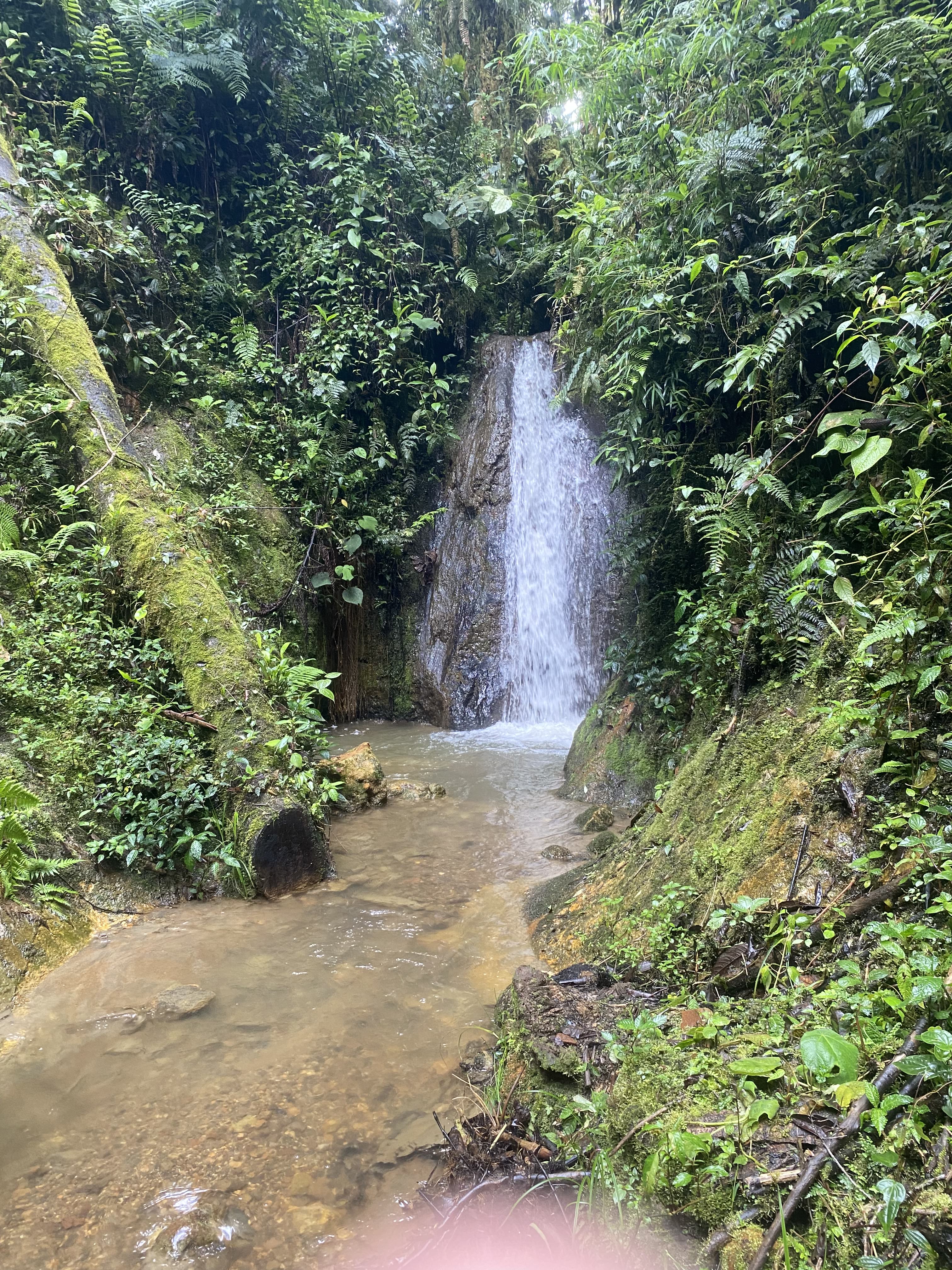
We explored a waterfall near San Isidro Lodge (https://cabanasanisidro.com), and we were able to observe pre-Inca pottery. At the lodge we also saw a diverse array of bird species, which was delightful! The forest’s nightlife brought us close encounters with a group of nocturnal monkeys, and to our surprise, we stumbled upon a very rare mountain tapir. The following morning we saw a small agouti (a small rodent) prowling around the lodge, and ended our adventures in the cloud forest on a high note.
San Isidro waterfall and some of the animal diversity we observed
McMichael, C.N.H., Vink, V., Heijink, B.M., Witteveen, N.H., Piperno, D.R., Gosling, W.D. & Bush, M.B. (2022) Ecological legacies of past fire and human activity in a Panamanian forest. Plants, People, Planet. DOI: 10.1002/ppp3.10344
Cuesta, F., Llambi, L.D., Huggel, C., Drenkhan, F., Gosling, W.D., Muriel, P., Jaramillo, R. & Tovar, C. (2019) New land in the Neotropics: a review of biotic community, ecosystem, and landscape transformations in the face of climate and glacier change. Regional Environmental Change. DOI: 10.1007/s10113-019-01499-3
The Netherlands Annual Ecology Meeting (NAEM) 2019 takes place in the 12 and 13 February. This annual showcase of predominantly Dutch based ecological research will take place, as usual, at Conference Centre “De Werelt” (Lunteren). I am particularly excited this year as, along with Marielos Pena Carlos and Patrick Jansen, I am co-convening a session on “Tropical Ecology”. The first time I have contributed to the program in this way. Our session will be on the second day of the conference and contain the following exciting presentations:
15:00 Predator avoidance and prey tracking in a Neotropical forest (Constant Swinkels, Wageningen University & Research)
15:20 The role of fig volatiles in pollinator specificity and fig diversity (Aafke Oldenbeuving, Naturalis Biodiversity Center)
15:40 Mangrove Atlantis: Can mangroves keep up with extreme land-subsidence? (Celine van Bijsterveldt, Royal Netherlands Institute for Sea Research)
16:00 Break
16:10 The fate of forests in agro-forest frontier landscapes, implications for conservation (Madelon Lohbeck, Wageningen University & Research)
16:30 Trends in the variability of Specific Leaf Area of paramo vegetation during succession (Marian Cabrera, University of Amsterdam)
16:50 Succession dynamics of tree and soil fungal communities in regenerating tropical rainforests are strongly influenced by regional species pool and abiotic factors (Irene Adamo, Naturalis Biodiversity Center)
The montane cloud forests of South America are some of the most biodiverse habitats in the world, whilst also being especially vulnerable to climate change and human disturbance.
Today much of this landscape has been transformed into a mosaic of secondary forest and agricultural fields. This thesis uses palaeoecological proxies (pollen, non-pollen palynomorphs, charcoal, organic content) to interpret ecosystem dynamics during the late Quaternary, unravelling the vegetation history of the landscape and the relationship between people and the montane cloud forest of the eastern Andean flank of Ecuador. Two new sedimentary records are examined from the montane forest adjacent to the Río Cosanga (Vinillos) and in the Quijos Valley (Huila). These sites characterise the natural dynamics of a pre-human arrival montane forest and reveal how vegetation responded during historical changes in local human populations.
Non-pollen palynomorphs (NPPs) are employed in a novel approach to analyse a forest cover gradient across these sites. The analysis identifies a distinctive NPP assemblage connected to low forest cover and increased regional burning. Investigation into the late Pleistocene Vinillos sediments show volcanic activity to be the primary landscape-scale driver of ecosystem dynamics prior to human arrival, influencing montane forest populations but having little effect on vegetation composition.
Lake sediments at Huila from the last 700 years indicate the presence of pre-Hispanic peoples, managing and cultivating an open landscape. The subsequent colonization of the region by Europeans in the late 1500’s decimated the indigenous population, leading to the abandonment of the region in conjunction with an expansion in forest cover ca. 1588 CE. After approximately 130 years of vegetation recovery, montane cloud forest reached a stage of structural maturity comparable to that seen in the pre-human arrival forest. The following 100 years (1718-1822 CE) of low human population and minimal human impact in the region is proposed as a shifted ecological baseline for future restoration and conservation goals. This ‘cultural ecological baseline’ features a landscape that retains many of the ecosystem service provided by a pristine montane forest, while retaining the cultural history of its indigenous people within the vegetation. Continue Reading
For those of you I have not had the pleasure of meeting yet, please allow me to introduce myself. My name is Yoshi Maezumi. I have recently been awarded a Marie Curie Fellowship for my research proposal FIRE: Fire Intensity in Rainforest Ecotones. I will have the honor of working with an extraordinary team of international, interdisciplinary researchers including Will Gosling, Crystal McMichael, Emiel van Loon, and Boris Jansen from the University of Amsterdam, Boris Vannière from the Université de Franche-Comté, Jose Iriarte from the University of Exeter, and Francisco Cruz from the University of São Paulo. Together we will examine the long-term role of fire in shaping Amazon Rainforest Ecotones.
My research is focused on paleofire (fire in the past) in Neotropical savanna and rainforest ecosystems. My current post-doctoral research at the University of Exeter is investigating the role indigenous fire management practices had on shaping the composition, structure, and flammability of modern Amazonian rainforests.
Recently introduced to a book by Bill Gammage entitled The Biggest Estate on Earth: How the Aborigines Made Australia. Gammage identifies five uses of indigenous fire: 1) to control wildfire fuel; 2) to maintain diversity; 3) to balance species; 4) to ensure abundance; 5) to locate resources conveniently and predictably. Gammage argues that our current regime is struggling with number one. These stages of fire management provide some really interesting food for thought for my Marie Curie Fellowship as I aim to develop new paleoecological techniques to analyze paleofire that will be used to model natural and anthropogenic drivers of paleofire activity.
I have been thinking a lot about what we do and do not know about paleofire. One of the ways we reconstruct past fire activity is through the use of charcoal preserved in lake sediments. Charcoal can tell us a lot about what past fires were like including what kind of plants were burning, how often fires occurred, and potentially how big a fire was. One of the more elusive components is paleofire intensity, or how hot a particular fire was. The temperature of a fire has important ecological implications, as hotter fires tend to cause more ecological damage. Lots of factors can contribute to fire intensity including droughts, fuel loads, vegetation composition and structure, fuel moisture, etc. All of this is to say that, fire intensity is complicated. Nevertheless, one of the main objectives of my Marie Curie research will be to compile what we currently know about the effect of modern fire intensity on the charcoal formation to figure out how that information can be used to interpret charcoal from the palaeorecord.
If you would like to join me on this ‘intense’ paleofire journey, (punny, I know, I just couldn’t resist), I am starting a weekly science blog called Her Science that will highlight the trials, tribulations, and triumphs of my Marie Curie research over the next few years.








 Ecology of the past