On Tuesday 16 May 2023 a small team of researchers from the Institute for Biodiversity & Ecosystem Dynamics (University of Amsterdam) visited the Maashorst (Netherlands) to visited an area “re-wilded” with European Bison (Bison bonasus). In addition to the bison the area is also now home to Tauros and Exmoor Ponies The purpose of the trip was to collect soil surface samples to examine for dung fungal spores. Certain fungi grow only on the dung of herbivores and the spores of these fungi can be preserved in the sedimentary record (for more information see Lee et al., 2022). Analysis of dung fungal spore diversity through the sedimentary record can therefore provide insights into the changes in the amount of dung (animals) in the landscape in the past. The purpose of this sampling effort was to see if we can quantify how many, and what type, of spores are representative of this group of bison. This information will help us to be able to interpret ancient records of fungal spores in more detail.
Special thanks to Maurice van Doorn (Gemeente Maashorst) for showing us around.
Bison statueTauros on the moveStudents collecting dataBison enjoying the sun
During the delivery of this years BSc Palaeoeclogy course at the University of Amsterdam (UvA) I discussed with a number of students about the nature and purpose of understanding the ecology of the past. This lead me to highlighting the research of Nick Loughlin (@PalaeoNick) from his PhD at The Open University and the subsequent work that he has done. I though it might be interesting to also share this here…
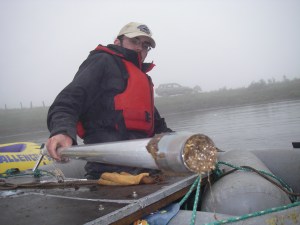
Nick Loughlin during his PhD field work in Ecuador
Nick’s study sought to understand better the ecological history of the biodiverse eastern Andean flank in Ecuador. To achieve this he went into the field and recovered sediments from a lake and a sedimentary section exposed by a road cutting. He analysed the sediments to reveal vegetation change (pollen analysis), fire histories (charcoal analysis), and past animals in the landscape (non-pollen palynomorphs, or NPPs). To extract extra ecological information from his samples he developed the methodological approach for examining NPPs in a tropical setting (Loughlin et al. 2018a). He then combined all the different palaeoecological approaches to reveal the drivers of vegetation change during the last glacial period (in the absence of humans; Loughlin et al. 2018b), and during the last 1000 years (when indigenous and European human populations radically altered the landscape; Loughlin et al. 2018c). The insights gained from Nicks research provided empirical evidence of how humans have been modifying this biodiversity hotspot on the timescales relevant to the lifecycles of tropical trees. These findings and ideas were collated in his PhD Thesis at The Open University which was supervised by Encarni Montoya, Angela Coe and myself (Loughlin, 2018a). Subsequently, Nick has been working to broaden the impact of his work and to communicate his findings to the broader scientific and conservation community. This has lead to two new publications focused on understanding baseline ecological function and conservation implications (Loughlin et al. 2022, Nogué et al. 2022).
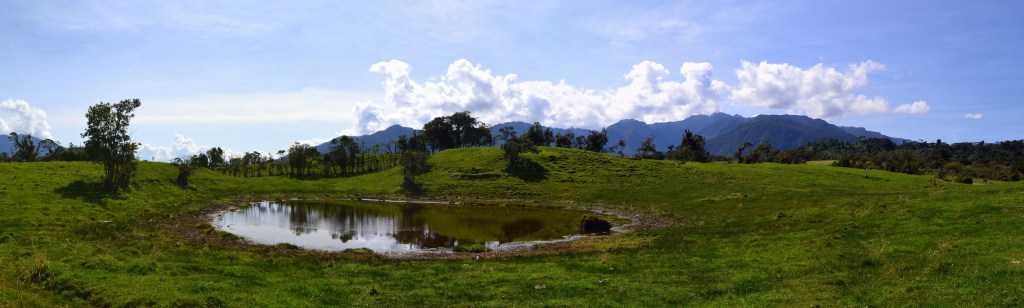
Evidence of past ecological change recovered from Lake Huila (Ecuador) revealed how past peoples had modified the landscape of the eastern Andean biodiversity hotspot.
The arch of research carried out by Nick, I think, really demonstrates the important of understanding the ecology of the past – without his detailed investigation of microfossils we could not have seen the impacts of indigenous communities on the past Andean landscape, or identify the consequences of the European depopulation; or been able to estimate the timescales of the ecological change!
Lee, C.M., van Geel, B. & Gosling, W.D. (2022) On the use of spores of coprophilous fungi preserved in sediments to indicate past herbivore presence. Quaternary 5, 30. DOI: 10.3390/quat5030030
This manuscript was developed from a literature review study by Clare Lee conducted as part of her MSc Earth Sciences degree at the University of Amsterdam under the supervision of Bas van Geel.
In June there will be a “European Pollen Database in Neotoma” meeting in Prague. For full details visit the European Pollen Database web site, click here.




 Ecology of the past