On Wednesday 19 July 2023 the Mapping Ancient Africa session of the INQUA Rome congress took place. We were delighted to have an full program of speakers despite some late cancellations. The first session featured seven speakers.
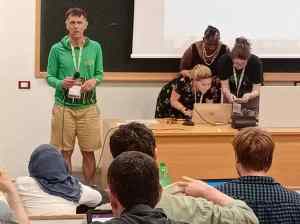
No panic as we set up for session 1…
The first two talks focused on southern Africa. The first talk by Liviu Giosan (Woodshole Oceanographic Institute) focused on new sediment cores extracted from the Okavango – Makgadikgadi region and new efforts to obtain sediment cores that can provide information on the dispersal of hominins. Brian Chase (CNRS) then looks us to the Karoo highlighting recent findings that suggest that this currently arid region was more habitable in the past and that a proliferation of stone tools suggests past peoples utilised the region extensively (Carr et al., 2023).
Yesterday (day 3) was excursion day of the AFQUA conference (photos to follow). Day 4 of the meeting was back in the National Museum Nairobi and kicked off with a session on “African archaeological landscapes”. The opening talk reviewed the career of Karl Butzer who coined the term ‘geoarchaeology’ back in the 1970’s when writing about his work integrating geological, archaeological and anthropological information (C.A. Cordova). Two talks then followed highlighting work on Lake Makagadikgadi from the perspective of archaeology and landscapes (D.S.G Thomas) and geochemical fingerprinting of stone tools to determine their source (D.J. Nash).
To take us up to lunch Boris Vanniere and Daniele Colombaroli gave a ‘double header’ plenary talk highlighting the exciting advances in the development of the Global Charcoal Database and how understanding past fire histories in Africa is key to interpreting environmental change. The after lunch session continued the palaeo-fire theme with records from Lake Botswana (C.E. Cordova), Lake Bosumtwi (W.D. Gosling – me), and Madagascar presented (A. Razafimanantsoa); as well as work on the usefulness of the morphometric’s of charcoal in determining the plant of origin (L.Bremond).
In the final session of the day we were back to “Southern Africa” as a theme. Under which banner we were “boggled” by sea-surface and sub-surface temperature reconstructions (M.A. Berke), shown how to extract climate records from Hyrax middens (B.M. Chase) and given insights into the past flora of the Cape Floristic region from fossil pollen records spanning 130,000 years (L.J. Quick).




 Ecology of the past