
Introducing: Seringe Huisman

July 3, 2017
WDG

Seringe Huisman

Hi all! My name is Seringe (Dutch for lilac flower), and unsurprisingly I am a biology student. I completed my BSc Biology at the VU University, specializing in ecology. Being fascinated by tropical rainforest since I was a kid, I attended a Tropical Ecology course at the University of Amsterdam (UvA), resulting in a research project with Crystal McMichael from the Palaeoecology & Landscape Ecology group on the late-Holocene fire history of western Amazonia. Besides performing this palaeoecological project, focusing on the aspect of ancient human activity, I followed courses of Latin America Studies to broaden my perspectives on the current socio-environmental complexity and conservation status of the area. This year, I have gotten the amazing opportunity to join Crystal McMichael on a fieldwork expedition to the Ecuadorian Amazon!

Seringe Huisman in the field...

Seringe Huisman in the field…

The fieldwork will be part of my Master’s thesis, elaborating on the regional patterns of vegetation composition changes in relation to human disturbance. I will be taking sediment cores from two lakes in the Sangay region of Ecuador, perform charcoal and phytolith analysis to reconstruct fire and vegetation assemblages over the late Holocene and compare the results to previously established records across western Amazonia. While I am currently attending the MSc Biological Sciences Limnology & Oceanography Master’s track at UvA, I could not help but directing my first project into Paleoecology again! My field trip is largely made possible by obtaining €1150 of grants through the Treub-Maatschappij and the Amsterdam University Fund, for which I am very grateful.

I am super excited to be heading to Ecuador soon, and will be back in a month with field stories, mosquito bites and hopefully some suitable sediments!
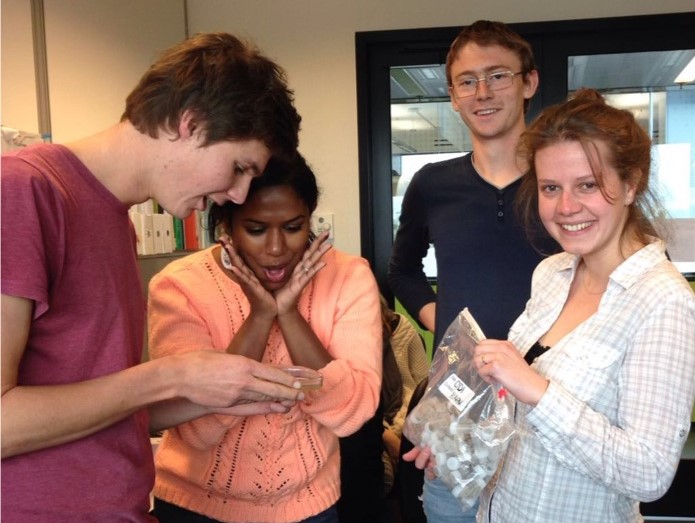
Seringe Huisman and palaeoecology friends

Seringe Huisman and palaeoecology friends

A fortnight of palaeoecology at the University of Amsterdam!

June 27, 2017
cmcmicha

BSc student Henk Cornelissen presents his thesis work on identifying charcoal characteristics that represent specific fire parameters, such as burn temperature. Photo: C. McMichael

BSc student Henk Cornelissen presents his thesis work on identifying charcoal characteristics that represent specific fire parameters, such as burn temperature. Photo: C. McMichael

by Crystal McMichael

Wimbledon tennis fortnight is on its way, but we’ve had our own palaeoecology fortnight here at the Institute for Biodiversity & Ecosystem Dynamics at the University of Amsterdam. We’ve seen seminars on reconstructing past landscapes and climates on timescales of decades to millions of years, and on spatial scales ranging from single sites to the entire Earth. Our presenters included our BSc students, MSc students, PhD candidates, faculty members, guest researchers, and even an internationally known palaeoclimatologist and contributor to the IPCC (Intergovernmental Panel on Climate Change) reports!

BSc student Isa Mulder presents her thesis on reconstructing glacial-aged fire histories from the Andes. Photo: C. McMichael

BSc student Isa Mulder presents her thesis on reconstructing glacial-aged fire histories from the Andes. Photo: C. McMichael

We began with a three-day series of presentations from our BSc students in the Future Planet studies program. William Gosling and I had four students that presented their final theses. We continued with a seminar series organized by the Palynologische Kring (the Dutch palynology society). Eric Grimm, a guest researcher at UvA, presented a high resolution record of hydrological variability, vegetation, and fire from the Great Plains of the United States. Guest researcher Carina Hoorn showed us how the Amazon River formed, and the associated plant turnover that occurred during the Neogene. PhD student Keith Richards explained to us why the Arctic seal became land-locked in the Caspian Sea over 2.6 million years ago. PhD student Suzette Flantua presented a multi-proxy approach to exploring the biogeographic history of the Andes Mountains. She came back the following day to present her PhD thesis entitled, “Ecosystems in Pleistocene Latin America”. And we are happy to report that Suzette is now Dr. Flantua!!

Suzette Flantua highlights the work in her PhD thesis. Congratulations Suzette! Photo: C. McMichael

Suzette Flantua highlights the work in her PhD thesis. Congratulations Suzette! Photo: C. McMichael

Dr. William Gosling and Prof. Jonathan Overpeck discuss the future of palaeoecology and upcoming collaborations. Photo: C. McMichael

Dr. William Gosling and Prof. Jonathan Overpeck discuss the future of palaeoecology and upcoming collaborations. Photo: C. McMichael

Professor Jonathan Overpeck from the University of Michigan also delivered a seminar entitled “New paleoclimatic perspectives on the future of terrestrial systems: bigger change, higher confidence?” Our society faces serious challenges involving current and future rates of climate change, and this seminar highlighted the importance of palaeoecology for assessing how the planet will respond to these changes.

Our presenters included males and females from multiple countries at an array of career stages. I am glad to have been a part of this fortnight, and I am glad that our current students got to see such a diverse integration of people and palaeoecology. My hope is at least one of these students has been inspired by these seminars, and will develop the same passion for palaeoecology as what we’ve seen here over the last two weeks.


Exploring ancient cesspits in Deventer (Netherlands)

June 26, 2017
WDG

Jippe Kreuning

University of Amsterdam MSc Biological Sciences student Jippe Kreuning investigated the contents of cesspits in the Dutch city of Deventer for his research project. Jippe investigated fossil pollen, seeds and other biological remains to discover what people in the ancient city were eating. In doing so Jippe gained new insights into ancient trade routes.

To find out more about Jippe’s project watch his video courtesy of FOLIA YouTube channel (in Dutch)

Jippe Kreunings zoektocht naar versteende poep

Past climate change seminars

June 15, 2017
WDG

Palynologische Kring presents four seminars focus on past climate change

Date: Thursday 22 June
Time: Starts 14:10
Location: University of Amsterdam, Institute for Biodiversity & Ecosystem Dynamics, Science Park

  • Eric Grimm: A high-resolution record of hydrologic variability, vegetation, and fire from the Northern Great Plains, North America
  • Suzette Flantua: Assembling the biogeographic history of the Northern Andes – A multi-proxy approach
  • Carina Hoorn: The Amazon at sea: Onset and stages of the Amazon River from a marine record, with special reference to Neogene plant turnover in the drainage basin
  • Keith Richards: Why did the Arctic seal, Phoca hispida, become land-locked in the Caspian Sea 2.6 million years ago? : Palynology and foraminifera explain how

For percise details of location and time please contact the organiser Prof. dr. Henry Hooghiemstra.

The meeting will be followed by the IBED seminar given by Prof. Jonathan Overpeck, click here for more details.

New paleoclimatic perspectives on the future of terrestrial systems: bigger change, higher confidence?

June 14, 2017
WDG

Institute for Biodiversity & Ecosystem Dynamics seminar
University of Amsterdam
22 June 2017 (for details click here)

New paleoclimatic perspectives on the future of terrestrial systems: bigger change, higher confidence?
Jonathan Overpeck
The University of Arizona

Numerous assessments of future freshwater and terrestrial system change have highlighted the potential for unprecedented change in the 21st century given continued emissions of greenhouse gases (GHGs) to the atmosphere; the risk to biodiversity is also believed to be high. The basis for these assertions are strengthened by recent observed ecosystem change, as well as by a new global compilation of climate and vegetation change over the last deglaciation indicating that most, if not all, dominantly natural landscapes on the planet are at high risk of significant transformation given the projected magnitude of warming that is likely in the future absent major reductions in global GHG emissions. At the same time, new paleoclimatic results indicate that the Amazon forests may be more resilient to future change than previously thought, whereas the risk of human deforestation associated with multi-year “megadrought” might be higher than previously believed.  A growing body of literature highlight that drought and megadrought risk around the globe is going to be a bigger problem than widely thought. We know with great confidence that warming will continue as long as GHG emissions continue, and this means more drying of terrestrial systems is likely over much of the planet. As a result, droughts will become more severe, longer and frequent as long as GHG emissions are not reduced significantly. The ability of precipitation increases to mitigate the ecological and hydrological impacts of continued warming is especially diminished in the many regions of the globe where multi-decadal megadrought is likely, an assessment made more challenging by the growing realization that that state-of-the-art climate models may underestimate the risk of future megadrought. Existing global climate change assessments may thus be underestimating the challenges to terrestrial water and ecoystems under continued climate change.

Hosted by: William Gosling

Volcanic, climatic and human ecosystem modification

May 8, 2017
WDG

My second pair articles from Vegetation History & Archaeobotany that I would like to highlight look at the impacts of volcanoes and climate on vegetation change. Specifically these explore:

For more detailed thoughts on these papers read on…

Continue Reading

Jardine, P.E., Abernethy, F.A.J., Lomax, B.H., Gosling, W.D. & Fraser, W.T. Shedding light on sporopollenin chemistry, with reference to UV reconstructions. Review of Palaeobotany and Palynology 238: 1-6. DOI: 10.1016/j.revpalbo.2016.11.014


Records of past animals and human ecosystem manipulation

February 28, 2017
WDG

vhaHaving recently become an Associate Editor for Vegetation History & Archaeobotany I have decided that I will try and highlight a couple  papers from the journal each months which have caught my attention. My first selections are:

  • A study which demonstrated the close relationship between the fossil fungal spore record and historical accounts (Orbay-Cerrato et al., 2017).
  • An investigation of a human modification of ecosystems on the sub-tropical Pacific island of New Caledonia using fossil wood charcoal remains (Dotte-Sarout, 2017)

For more detailed thoughts on these papers read on…

Continue Reading

Blog at WordPress.com.