Mapping Ancient Africa Quaternary International special issue article #7
Open access:
Gosling, W.D., Chevalier, M., Fischer, M.L., Holewijn, M., Finch, J., Gil-Romera, G., Hill, T., Houngnon, A., Leonardi, M., Manica, A., & Kaboth-Bahr, S. (2025). A multi-model approach to the spatial and temporal characterization of the African Humid Period. Quaternary International744, 109933. https://doi.org/10.1016/j.quaint.2025.109933
Gosling, W.D., Chevalier, M., Lothar Fischer, M., Holewijn, M., Finch, J. M., Gil-Romera, G., Hill, T. R., Houngnon, A., Leonardi, M., Manica, A., & Kaboth-Bahr, S. (2025). Code from: A multi-model approach to the spatial and temporal characterization of the African Humid Period. Figshare. https://doi.org/10.6084/M9.FIGSHARE.29608400.V1
To find the complete list of articles in the Mapping Ancient Africa special issue of Quaternary International click here.
Chevalier, M., Gosling, W.D., Hooghiemstra, H., Cartapanis, O., Chase, B.M. & Kaboth-Bahr, S. (2025) Eccentricity-driven glacial climate variability and its influence on speciation in the tropical Andes. Quaternary Science Advances 100278. DOI: 10.1016/j.qsa.2025.100278
A workshop will be held at the National Museums of Kenya (Nairobi, Kenya) in June 2024. The aim of the workshop is to help authors prepare articles for the Mapping Ancient Africa (MAA) special issue proposed for publication in Quaternary International and lead by Dr. Stefanie Kaboth-Bahr. The workshop will be associated with the “1st Joint International Scientific Conference” (3-6 June). The MAA workshop is being organized by Dr. Rahab Kinyanjui, and the congress organization is being lead by Dr. Emmanuel Ndiema (click here to watch his 2022 MAA seminar) and Dr. Esther Kioko (Acting Director National Repository and Research).
For further information on attending the MAA workshop please contact Rahab directly.
To find out more about the Mapping Ancient Africa project click here.
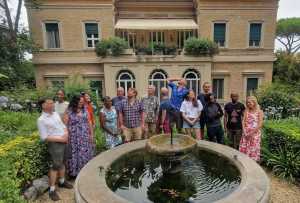
Mapping Ancient Africa participants on the Rome workshop (2023)
The Mapping Ancient Africa (MAA) project has an open call for contributions to a Special Issue of Quaternary International; the journal of our funder the International Union for Quaternary Research (INQUA). The concept for the special issue is agreed in principle with the journals editor-in-chief so now it is our task to collate a collection of manuscripts suitable to published in this international peer reviewed journal. The special issue will be based around papers discussed and presented at the MAA workshop in Rome and session at the INQUA congress in Rome in July 2023, but we are also happy to consider other manuscripts that fit within the MAA project area.
To find out if your manuscript idea might fit either explore the MAA web pages or contact a member of the editorial team:
I am delighted to announce that there our session “Mapping Ancient Africa: Climate, Vegetation & Humans” has been accepted for the INQUA congress in Rome (14-20 July 2023).
Abstract: Great uncertainty exists surrounding the link between climate change and hominin evolution, cultural development, and dispersal in and out of Africa. Several hypotheses have been proposed about how environmental conditions in Africa might have driven important developments in human origins over the last 4 million years. These findings link important evolutionary events with environmental change including cooling, drying, and wider climate fluctuations over time. However, key questions remain on the type, speed and driver of climate variability in Africa and how it affected evolution and development, e.g., did changing environment affect resources which consequently lead humans to develop new tools, why did so many early hominin species persist, evolve and/or go extinct, why did our species (Homo sapiens) emerge and survive, and how have we shaped our own environment either intentionally or unintentionally? In this session we look to bring together researchers focused on reconstructing past environments in Africa on the basis of empirical data (palaeoclimatic, palaeoecological, archaeological records) with researchers using modelling approaches (climate, vegetation, dispersal and cultural models). We hope to stimulate research and debate on how past change (climate, ecological, behavioral) shaped modern humans and the role of human niche construction on African environments. This session is linked to the INQUA “Mapping Ancient Africa” project, but we welcome all submissions.
I am pleased to announce the start of a new project “Mapping Ancient Africa” funded by the International Union for Quaternary Research (INQUA) with support from the Palaeoclimate commission (PALCOM) and the Human & Biospheres commission (HABCOM). This project will bring together Quaternary scientists focused on past climates and environments with those working on human evolution and development in Africa. Through the synthesising data and linking these with modelling approaches we hope to bring together a novel group of researchers to explore the climatic and environmental backdrop to hominin development.
Further information on the project can be found on a new “sub-site” within this blog dedicated to the “Mapping Ancient Africa” project. The project is designed to connect researchers working on these topics so if you are interested to be involved please do get in contact. The first meeting will be held in October 2021 online and at four locations: Nairobi (Kenya), Port Elizabeth (South Africa), Potsdam (Germany) and Portland (Oregon, USA) – for further details click here.





 Ecology of the past