PCRG members included in action with the British Ecological Society Roadies at Wychwood festival:
Video compiled by our very own Frazer Bird!
Check out the Roadies blog to find out which festivals we are coming to next!
June 29, 2013
PCRG members included in action with the British Ecological Society Roadies at Wychwood festival:
Video compiled by our very own Frazer Bird!
Check out the Roadies blog to find out which festivals we are coming to next!
June 7, 2013

Dr Phil Jardine joining us from the University of Birmingham
We are pleased to announce the imminent arrival of three new PCRG members Phil Jardine, Adele Julier and Nicholas Loughlin. Phil and Adele will be working on the African based, NERC funded, “500,000 years of solar irradiance, climate and vegetation changes” project as PDRA and PhD student respectively. While Nick will be working on South American palaeoenvironmental records looking at “Tropical forests response to past global climate change” as a NERC/CEPSAR funded PhD student. Phil will start in the department on Monday and the others will arrive with the October PhD student intake… exciting times.
June 5, 2013
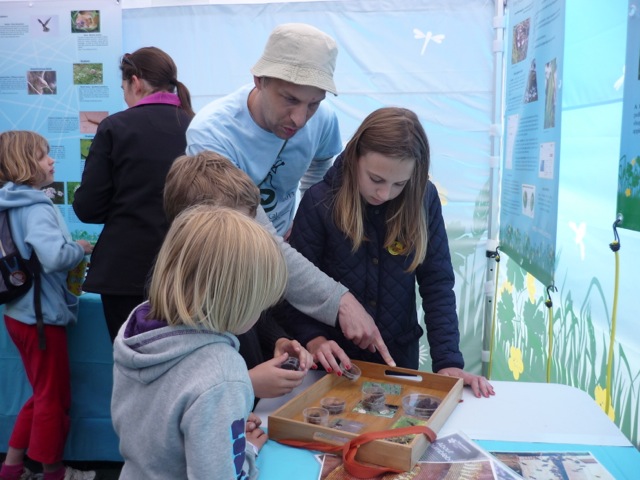
Playing the “Who’s poo” game at Wychwood Festival.
Group members William and Frazer took part in the first music festival outing of the British Ecological Society 100 year celebration “Sex & Bugs & Rock ‘n Roll” at Wychwood (31 May – 3 June). Early reports suggest that over 900 people were “stickered” and around 100 people “swabbed” during the weekend. For full details of this event, and future activity, check out the blog and follow the BES Roadies on twitter @BESRoadies.
May 20, 2013
Lots of excitement in the Palaeo group over the last couple of months including:

Co-I Wes Fraser checks out the FTIR in its new lab. The FTIR will be the main kit used for pollen chemical analysis in the project.
1) Recruitment. Interviews, and offers, for the PhD and PDRA posts related to our recent NERC standard grant award. Hot competition made our life very difficult but we are delighted to be adding two new people to our team. More information as soon as positions have been confirmed…
2) Student conference. On 16 May it was the annual CEPSAR student conference. The standard of talks from our 2nd and 3rd year PhD students was as excellent. With both Hayley and Frazer representing the PCGR well. Frazer recieved a highly commended award from the judges which means that he is on the right track having just had a paper accepted for INTECOL in August – well done Frazer.
3) Outreach preparation & activity. The British Ecological Society “Sex and Bugs and Rock ‘n’ Roll” got its first outing at Imperialfest (04/05/2013), further activities and equipment were tested at The OU (24/05/2013) and hopefully we are now set for our first major outing at Wychwood – exciting times!
4) Science outputs on track. The acceptance of two papers for publication (an African pollen atlas to be published in Review of Palaeobotany & Palynology, and palaeo-ecosystem services in the Andes paper for The Holocene).
April 12, 2013

Rachel Gill and Encarni Montoya with sediment cores from Jamaica.
Quick and belated update on activity in March! Not sure where the time is going at the moment…
Early in the month we were delighted to welcome Prof. Jonathan Holmes and Rachel Gill from UCL who came to use our core splitter to open new sediment cores from Wally Wash Pond in Jamaica! A visit from Steve Brooks (Natural History Museum) early in the month to discuss midgy progress with Frazer was great. We are getting ever closer to developing a training data set… Also popping by was ex-PhD student and now Aberystwyth lecturer Joe Williams who we will hopefully be developing some new collaborations with over the summer and fingers crossed mounting an expedition back to Bolivia!
March 29, 2013
Full time Post-Doctoral Research Associate, Temporary contract for 36 months, £27,854 – £36,298
Department of Environment, Earth & Ecosystems, Faculty of Science, The Open University
Closing date : 25/04/2013

The PDRA project will descover more about past vegetation and climate change in Lake Bosumtwi (Ghana)
We are seeking a PDRA to study past climate and vegetation change in tropical West Africa as part of the NERC-funded “500,000 years of solar irradiance, climate and vegetation changes” project. You will join a multidisciplinary collaborative research team and will work with an international network of project partners. The project will utilise cutting-edge organic geochemical techniques to generate the longest continuous record of fossil pollen chemistry change. The study will build upon previous research into the sediments recovered from Lake Bosumtwi (Ghana). The data generated will shed new light on the role of climate in driving vegetation change in the tropics.
You will already hold a PhD, or be near to completing your PhD, in a relevant scientific discipline with a background in the Earth or Environmental sciences. You must have substantial experience of organic geochemistry or tropical palynology, with well-developed self-management skills and the ability to prioritise effectively.

The PDRA will work with an associated PhD student looking at modern pollen-vegetation relationships in the same region.
Co-Investigators:
Dr Barry Lomax (University of Nottingham)
Dr Wesley Fraser (Oxford Brookes University)
Project partners:
Prof . Yadvinder Malhi (University of Oxford)
Prof. Mark Sephton (Imperial College London)
Dr Tim Shanahan (University of Texas, Austin)
Dr Stephen Abu-Bredu (Forestry Research Institute of Ghana)
For further particulars click here.
For information on how to apply click here visit The Open University jobs web site.

The PDRA will be part of an international team; partners based at University of Nottingham, Oxford Brooks University, Imperial College London, Oxford University, University of Texas at Austin and the Forestry Research Institute of Ghana
March 21, 2013
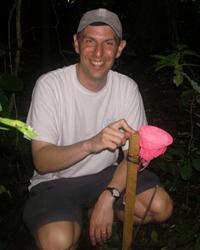
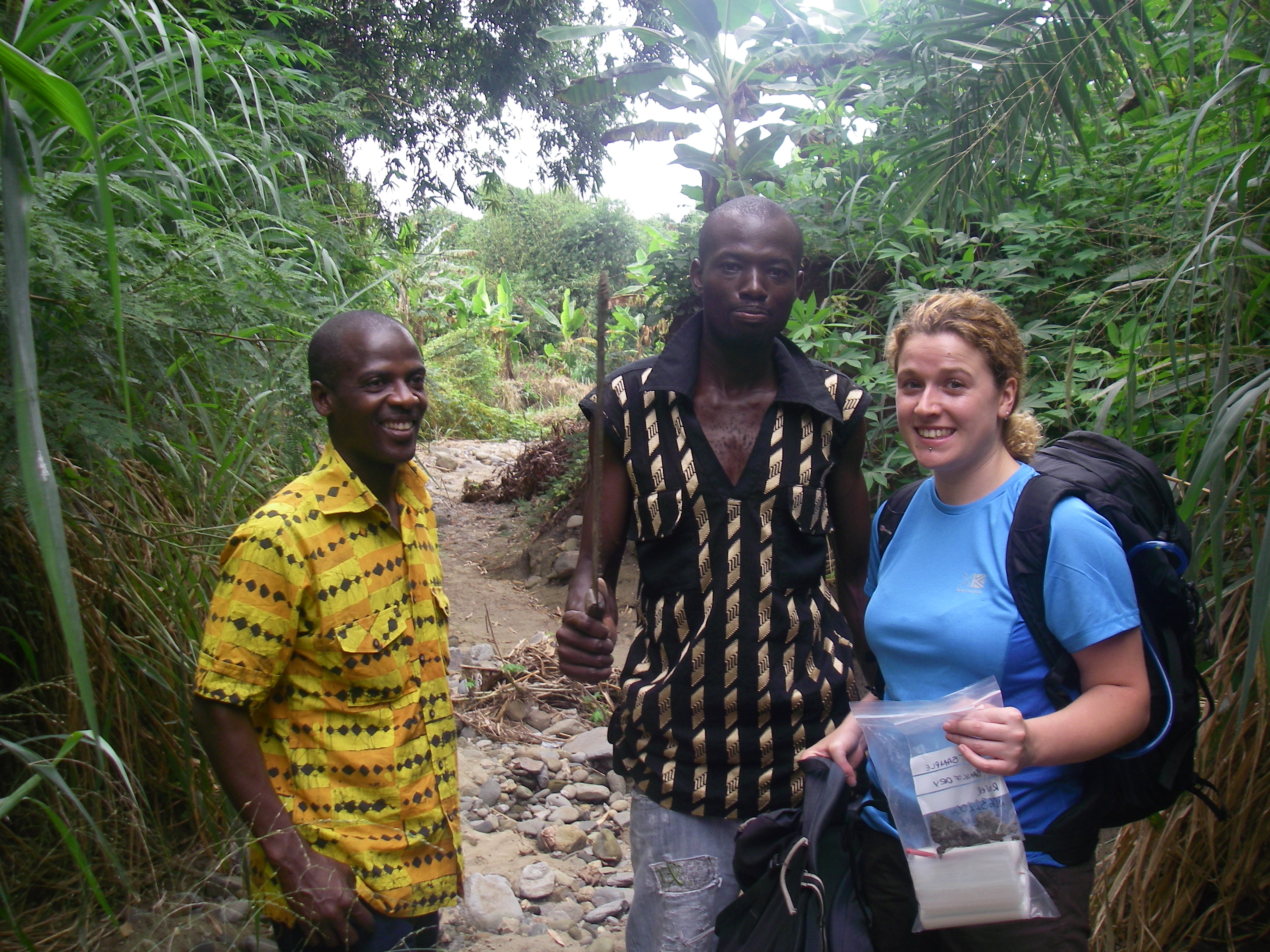
William Gosling pollen trapping in west Africa. A studentship on the new grant will investigate modern pollen-vegeation relationships
Fully funded NERC PhD studentship tied to 500,000 years of solar irradiance, climate and vegetation changes project.
To start October 2013 now avaliable with the Palaeoenvironmental Change Research Group.
Title: Tropical vegetation, environment and climate: The present is the key to the past
Supervisors:
William D. Gosling (The Open University),
Wesley Fraser (Oxford Brookes University),
Barry Lomax (University of Nottingham),
Mark Sephton (Imperial College London) &
Yadvinder Malhi (University of Oxford)
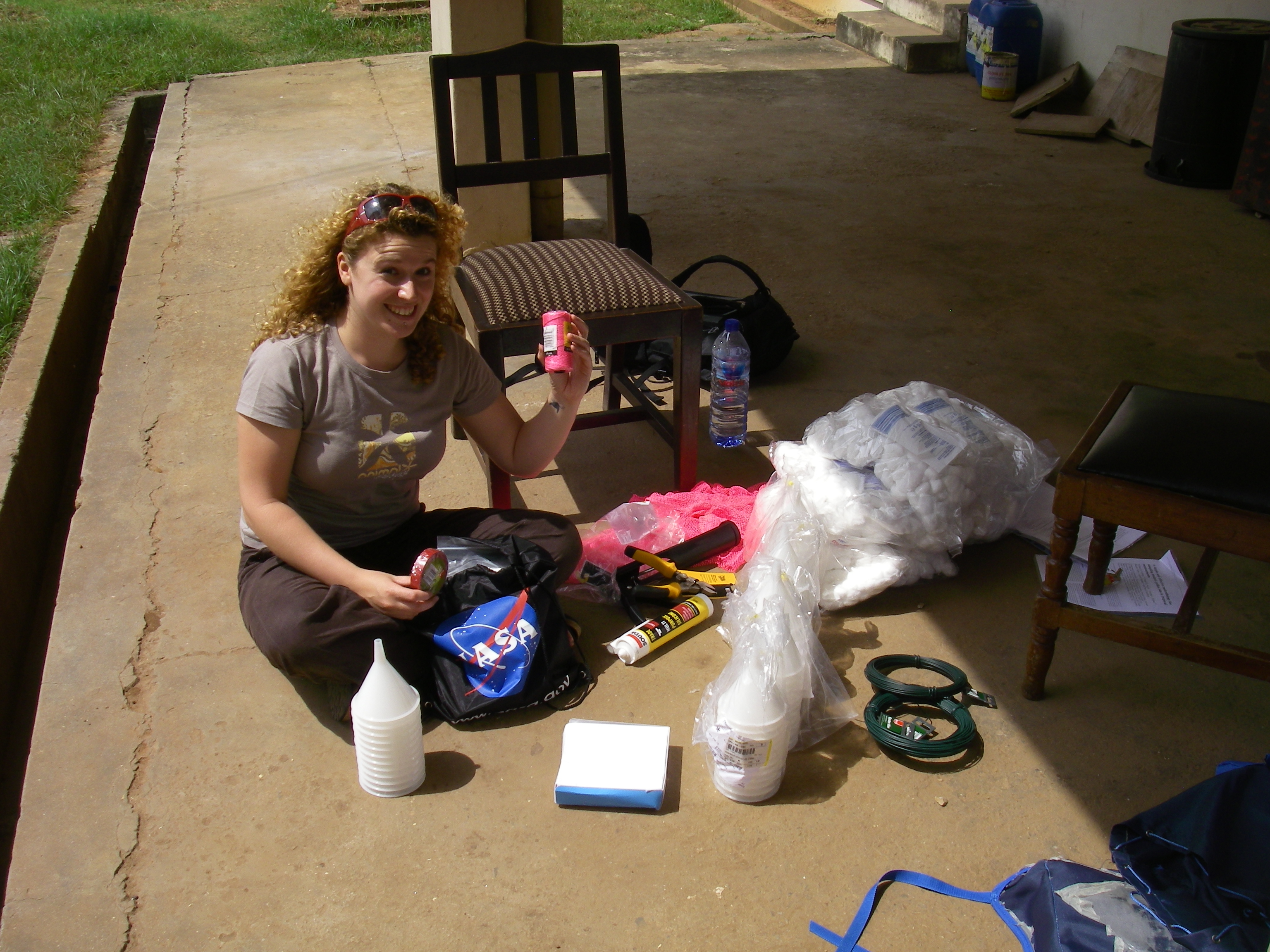
Making pollen traps on field work in Ghana
Understanding how vegetation responded to past climate change requires the development of well constrained relationships between living floras, environment and climate. This project will help constrain the great uncertainty which exists as to how tropical ecosystems are represented in the fossil record by examining the relationship between modern vegetation and the pollen it produces. The project will analyse modern pollen rain using a combination of traditional microscopic analysis [1] and cutting edge geochemical techniques [2]. We anticipate that the findings will provide new insight into past vegetation and climatic change.
For further information on the project and how to apply see the full advert: NERC PhD advert. Prior to applying please check eligibility for NERC funding by clicking here.
Closing date: 25th April, interviews will be held at The Open University during May.
To find out more about the department, research environment and student life at The Open Univerity visit the Department of Environment, Earth & Ecosystems, the Centre for Earth, Planetry, Space & Astronomical Research (CEPSAR) and OU RocSoc web pages.
Work as part of a larger research team in the UK and abroad.
References:
[1] Gosling, W.D., et al., Differentiation between Neotropical rainforest, dry forest, and savannah ecosystems by their modern pollen spectra and implications for the fossil pollen record. Review of Palaeobotany and Palynology, 2009. 153(1-2): p. 70-85.
[2] Lomax, B.H., et al., Plant spore walls as a record of long-term changes in Ultraviolet-B radiation. Nature Geoscience, 2008. 1(9): p. 592-596.
March 1, 2013

Four new workstations installed in the Past Environmental Change microscope lab
Excitement in February saw the arrival of a new research grant within the PCRG, to look at pollen and spore chemistry from Lake Bosumtwi (watch this space for new post-doc and PhD studentship positions), and (just in time) the expansion of benches in the microscope lab which will ensure that the new people will have spaces to sit in! In addition, we had a paper published with long time friends and collaborators at the University of Leeds; Roucoux et al. (2013).
Despite the disruption of the lab refit Hayley and Frazer have been cracking on with pollen and chironomid analysis. Encarni and Frazer returned from field work in Ecuador and half the samples have so far made it back to The Open University; we now wait with anticipation for customs to release the other box!

Four shiny new workstations from the other side – woo
Meanwhile I have been working on exam questions for the Geological Record of Environmental Change module (S369), interviewing prospective PhD candidates for the October 2013 start projects and have been on a training course to learn about the Vitae support for research student training.
February 22, 2013
We are now in the centenary year of the British Ecological Society (BES). To celebrate this there is a year long Festival of Ecology which includes many events across the country.
The BES is keen to share events online and these can be followed on twitter with # tags (#BES100, #BESFest) and/or by following the BES (@BESCentenary, @BritishEcolSoc).
Throughout the year we hope to get more and more video content of events and activities online. Here is a quick compiliation of existing BES online video content to give you a taste of what we are building upon!
The first Festival of Ecology video was posted by the Sex & Bugs & Rock ‘n’ Roll team and was shot at the BES annual meeting 2012:
Ecologist workshop on creative public engagement at the BES annual meeting 2012
The BES Roadies (@BESRoadies) will be taking ecology to music festivals over the summer. So far we are confirmed at Wychwood and Greenman. More video from the BES Roadies will be posted on our YouTube page.
Other BES video currently online is from:
If you are aware of any other ecology videos please add comments and links below. Thanks
February 20, 2013
William Gosling pollen trapping in west Africa. A studentship on the new grant will investigate modern pollen-vegeation relationships from tropical West Africa.
I am delighted to be able to report that the PCRG has recently obtained a NERC standard grant to investigate “500,000 years of solar irradiance, climate and vegetation changes” (NE/K005294/1).
Investigators on the project are:
Supported by project partners:
Much thanks to the many people who have supported and helped us in the development of this proposal. Now time to do some fun science…
 Ecology of the past