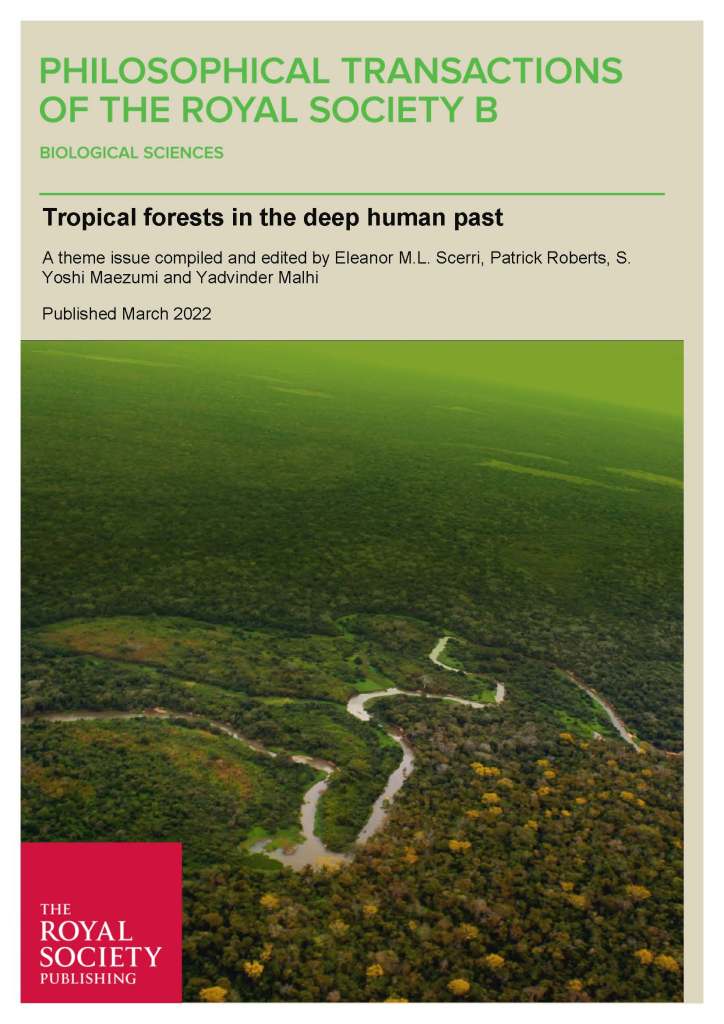
Maezumi, S.Y., Elliott, S., Robinson, M., Betancourt, C.J., Gregorio de Souza, J., Alves, D., Grosvenor, M., Hilbert, L., Urrego, D.H., Gosling, W.D. & Iriarte, J. (2022) Legacies of Indigenous land use and cultural burning in the Bolivian Amazon rainforest ecotone. Philosophical Transactions of the Royal Society B: Biological Sciences 377, 20200499. https://doi.org/10.1098/rstb.2020.0499
Nascimento, M.N., Heijink, B.M., Bush, M.B., Gosling, W.D. & McMichael, C.N.H. (2022) Early to mid-Holocene human activity exerted gradual influences on Amazonian forest vegetation. Philosophical Transactions of the Royal Society B: Biological Sciences 377, 20200498. https://doi.org/10.1098/rstb.2020.0498
Bush, M.B., Rozas-Davila, A., Raczka, M., Nascimento, M., Valencia, B., Sales, R.K., McMichael, C.N.H. & Gosling, W.D. (2022) A palaeoecological perspective on the transformation of the tropical Andes by early human activity. Philosophical Transactions of the Royal Society B: Biological Sciences 377, 20200497. https://doi.org/10.1098/rstb.2020.0497
Gosling, W.D., Scerri, E.M.L. & Kaboth-Bahr, S. (2022) The climate and vegetation backdrop to hominin evolution in Africa. Philosophical Transactions of the Royal Society B: Biological Sciences 377, 20200483. https://doi.org/10.1098/rstb.2020.0483
The festive period blog post related to the recent volume of Palaeoecology of Africa (published entirely open access online) picks out the four Perspective articles. We included Perspective articles within the volume to place the volume in context and showcase some topical ideas, with the overall objective of stimulating further debate on past environmental change in Africa.
The opening two papers of the volume are both Perspectives. Louis Scott opens the volume with a short history of the Palaeoecology of Africa series. He sketches out the rich and varied history of the publication which, commenced in 1966 as a collection of eight reports (van Zinerden Bakker 1966), includes seven conference proceedings, and has been edited at various times by Eduard Meine van Zinerden Bakker, Joey Coetzee, Klaus Heine and currently Jürgen Runge. The second article, Lézine et al., tracks the rise and revival of the “African Pollen Database” (APD) from its formation in 1996, through to its decline in 2007, and up to its re-initiation in 2019 from which this volume of PoA has sprung. Personally, I think the huge enthusiasm shown to participate in this volume and to contributing to collaborative initiatives like the APD, demonstrate the strength of the field and can only bode well for future research.
The other two Perspective papers showcase nicely some of the motivation behind the enthusiasm for palaeoecological research. Lynne Quick focuses in on the hyper-diverse Cape Floristic Region of southern Africa and what records of past vegetation and climate change can tell us to reveal these origins and assist in the conservation and management of this ecological wonder today. The final perspective, by Lindsey Gillson, rounds off the volume by thinking more broadly about how palaeoecological research can be utilised in the development of conservation policy in Africa. She focuses particularly on how these records can provide insights into drivers of change in the past (climate, fire, and herbivory) and how this can then be used to guide conservation and enrich our understanding how the landscape we see in Africa today came to be.
To find out more download all the articles for free:
Gosling WD, Maezumi SY, Heijink BM, Nascimento MN, Raczka MF, van der Sande MT, Bush MB, McMichael CNH. 2021. Scarce fire activity in north and north-western Amazonian forests during the last 10,000 years. Plant Ecology & Diversity. DOI: 10.1080/17550874.2021.2008040
The second in my series highlighting papers in the recent volume of Palaeoecology of Africa (published entirely open access online) focuses on the research articles. The research articles make up the ‘guts’ of the volume, comprising 10 of the 24 papers. Three of these are from western Africa (Dinies et al.; Gosling et al.; Lemonnier & Lézine), two from eastern Africa (Githumbi et al.; Kinyanjui et al.), two from central Africa (Richards; Gaillard et al.), and three from southern Africa (Chevalier et al.; Hill & Finch, Hill et al.). These research articles present new data and key insights into past environmental change in Africa, which fall into two broad categories, providing information on: (i) how we can extract information from pollen data sets, and (ii) the processes operating to drive vegetation.
The recently published volume of the Palaeoecology of Africa series contains a number of different types of papers: research articles, reviews, perspectives and data papers. One of the key reasons I was motivated to become involved in the project was to help mobilise palaeoecological data from Africa towards open access datasets (African Pollen Database, Neotoma). To hopefully get greater recognition to the great work done over the years and to help facilitate synthetic work that will provide a greater understanding of spatial variance in past climate change. Ultimately, four short data papers were included in the volume: an enhanced c. 16,000 year pollen record from the Bale Mountains in Ethiopia (Gil-Romera et al. 2021), two pollen and charcoal record from the southern Cape Coast in South Africa, c. 3200 and 650 years long respectively (du Plessis et al. 2021a; du Plessis et al. 2021b), and a c. 700 year long record from Madagascar (Razanatsoa et al. 2021). The records provide new insights in to landscape scale environmental change driven by both humans and climate. To find out more check out the open access articles and the data at:
Maezumi SY, Gosling WD, Kirschner J, Chevalier M, Cornelissen HL, Heinecke T, McMichael CNH. 2021. A modern analogue matching approach to characterize fire temperatures and plant species from charcoal. Palaeogeography, Palaeoclimatology, Palaeoecology 578:110580. https://doi.org/10.1016/j.palaeo.2021.110580

 Ecology of the past