Phil and Adele have survived field work in Ghana collecting pollen traps, looking at the vegetation, visiting Lake Bosumtwi and riding horses (!?) – hooray.
Earlier this month Rachel Gwynn (Geography, UCL) visited the PCRG to use our core splitter to reveal what was contained within two cores collected from the Carribean. She has also been kind enough to provide photos of the sediments and an insight into the story so far:
Sediments from Fresh Water Pond Barbuda (Photograph Rachel Gwynn)
Lake sediment cores covering the past few hundred to thousand years have been taken from two lakes, Wallywash Great Pond in Jamaica and Freshwater Pond in Barbuda. The sediments form part of the NERC-funded project Neotropics1k (PI Prof. Jonathan Holmes), which is concerned with climate variability in the northern Neotropics over the past millennium. The sediment cores show marked changes in composition and colour, from pale marl to dark organic mud. These colour changes, which are clearly visible in the photographs, represent changes in sediment composition that are in turn related to lake-level variations caused by long-term climate shifts. Deeper, open-water conditions under wetter climate are represented by the marls, whereas lowered lake levels, caused by direr climate, are associated with organic-rich sediments.
Wallywash Great Pond– core section W2
Thirteen separate units have been identified through the 1 m core length, varying between light coloured marl, dark organic and shelly sediments.
The abundance of preserved Ostracod valves increases throughout the marl and shell rich layers but drops significantly in the organic rich material.
Barbuda Freshwater Pond- core section FWP
This core has four distinct units. 0-23 cm is a calcareous mud with a diffused lower boundary into a shelly calcareous mud at 25-35.5 cm. 35.5-38 cm and 38-52 cm is two variations of calcareous mud.
These units, as with the W2 core, have been defined using a Munsel Soil Chart.
The Ostracod valves are thought to be abundant throughout the core due to the high marl content.
Wallywash Great Pond Jamaica (photograph Rachel Gwynn)
I am glad to say that after almost two months out of the office running around with 8 bags of equipment, Frazer and I have finished our tour of the Americas. As the work has been so diverse, we would like to split our comments and impressions into two different posts, we hope you enjoy them!
One of the key goals of the fieldtrip to Ecuador (August-September) was to sample organic and volcanic (tephra) layers from sedimentary exposures with the aim of obtaining new information about past envrionmental change in the region. Our Ecuadorian collaborator, Dr Patricia Mothes (Instituto Geofisico), had identified four of sites she thought might be useful too us: El Fatima Dique, Mera “2” Dique, El Rosol and Vinillos.
At the Fatima site, near Puyo, a thin organic bed was sampled sandwiched between volcanic ash deposits. Wood macrofossils from this deposit have been dated to the last glacial period.
For further descriptions of what we found and field photos read on…
The second part of our Ecuadorian expedition took in lakes and sections close to the towns of Papallacta and Cosanga. The variation in climatic conditions was marked as we experienced first hand the transition from freezing fog and driving rain to burning sun and heat within a few tens of kilometers as we travelled from >4000 m down to around 1000 m elevation.
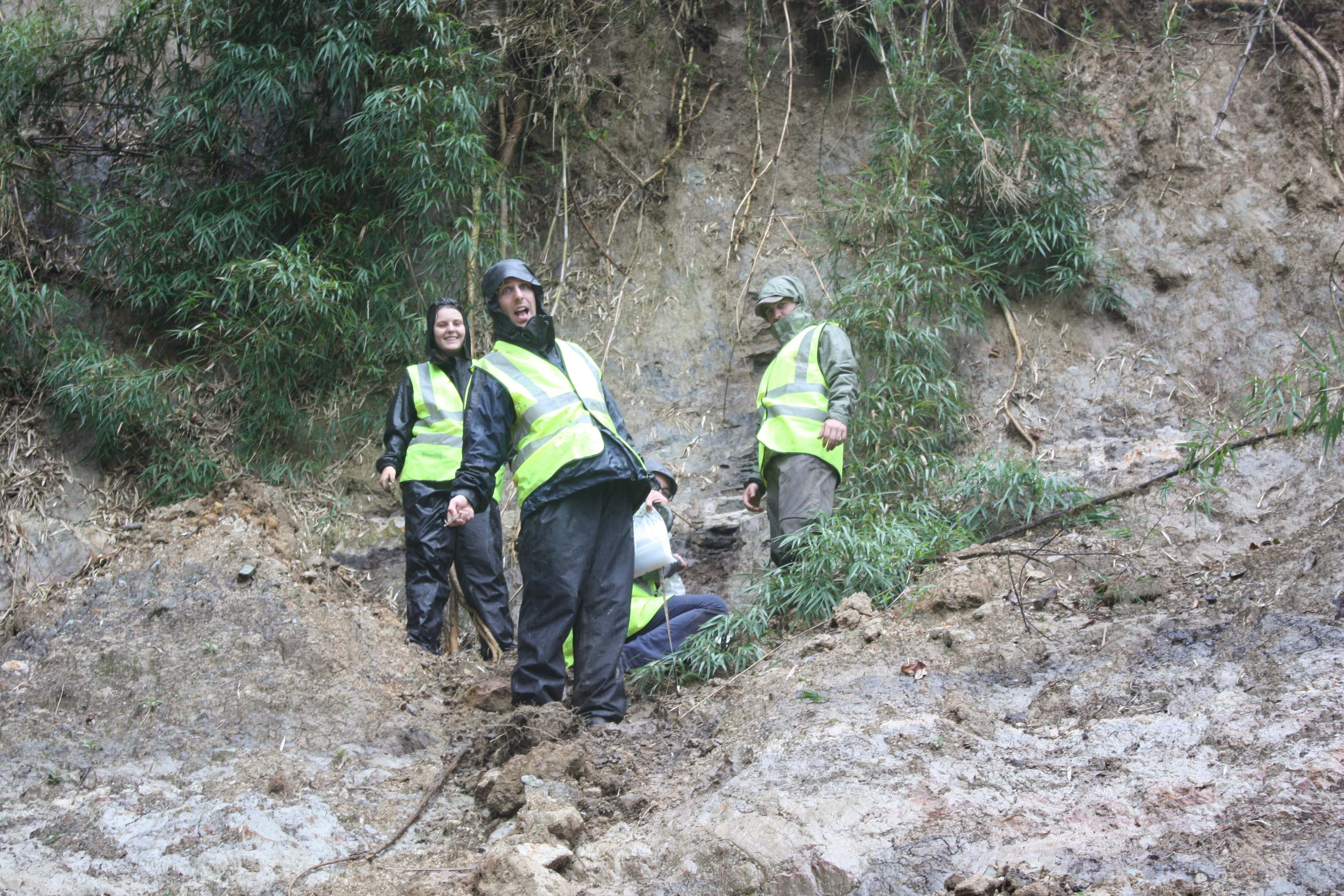
Sampling the sedimentary section at Vinillos was hampered by a tropical downpour. Sediments recovered from here include volcanic ash, mud slide deposits including large wood macrofossils and fine grained organic sediments probably deposited in still water environments.
Preparing to recover a short core from a pond near the antenas at Cujuca. Short cores will be used for Chironomid analysis.
Tomorrow we will attempt to recover short cores from two more lakes. Then our final few days here in Ecuador will be spent visiting partners and packing up.
The first half of our field work expedition to Ecuador has now been completed. We had a very successful visit to Mera collecting samples from three new sections and recovered short cores from four lakes.
The sediment sections have yielded many wood macrofossils and samples for pollen analysis. It is anticipated that these will shed light on the nature of tropical vegetation during the last glacial period and before. Some of these samples will be analyzed by Hayley as part of her PhD research.
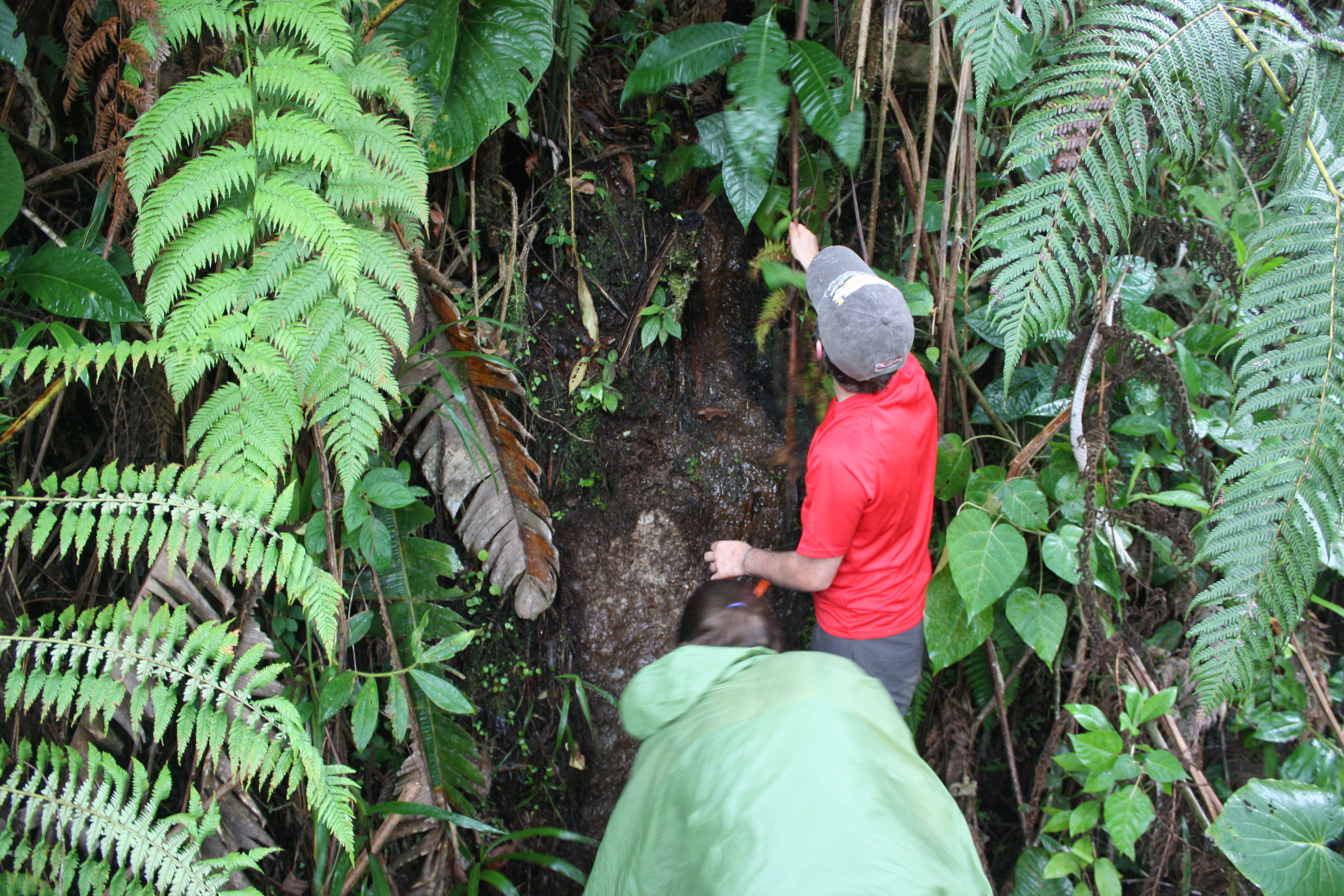
The sedimentary section found near Mera contained layers of crushed forest beneath volcanic ash. These “forest beds” provide a snapshot of vegetation in the landscape at the time of eruption. Part of plants growing on the landscape thousands of years ago are clearly preserved in the sediment.
We have now spent two days in sampling sedimentary sections near the Rio Tigre close to Mera in Ecuador. The sections are peat deposits interspersed with volcanic ash and contain many wood macrofossils. It seems likely that the depositional environment was a shallow water swamp or bog. Although we will have to wait for the analysis of the fossil record to know the composition of the vegetation at the site.
I whish I could start with “ Once upon a time…” because that would be the easiest way to begin this paragraph (or a paper). Besides, to some extend, “Once upon a time” can be appropriate because this is a story related to the OLD friends of the Paddington Bear. By that, I mean a story about the mega fauna in South America.
Macrauchenia drawn by Kobrina Olga (Photo credit: Wikipedia)






 Ecology of the past