Mapping Ancient Africa: INQUA Rome – session 2

August 24, 2023
WDG

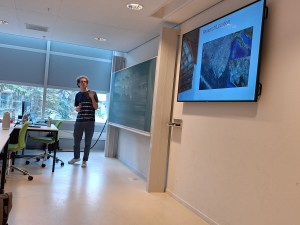
The second part of the Mapping Ancient Africa session at the INQUA Rome congress contained eight talks. Busisiwe Hlophe (University of the Witwatersrand) kicked us off by showing us the power of looking at wood anatomy preserved in charcoal microfossils to determine the nature of past vegetation and climate. Rahab Kinyanjui (National Museums of Kenya) presented phytolith work from archaeological sites revealing a mixed woody and grassy vegetation associated with archaic Homo sapiens in Kenya.

Three talks from the Cape Region in South Africa then followed with Saul Manzano (University of Leon), Stella Moscher (University of Utah), and Asithandile Ntsondwa (Nelson Mandela University) using various palaeo ecological approaches to explore climate, vegetation and fire regime shifts during the Holocene. Adele Julier (University of Portsmouth) then took us a little further north to Namibia to think about the challenges of parameterising modern pollen-vegetation relationships in arid regions. The final southern African talk was given by Gemma Poretti (University of Cape Town) explored a new approache to tracking change in past rainfall patterns using charcoal material.

Continue Reading

Uncovering Ecuador’s landscapes and cultures: A student adventure

August 16, 2023
Bianca Tacoronte Gomes

By: Lina Cabrera Sáenz and Bianca Gomes

We invite you to join us on an incredible journey through the heart of Ecuador, where a group of adventurous students from Florida Institute of Technology embarked on a life-changing experience as part of the Neotropical Archaeoecology summer field course. Buckle up as we delve into the marvels of nature, indigenous cultures, and unforgettable experiences. Let’s dive right in!

Unveiling the Andes

Our adventure began with a breath-taking visit to the Paramo at Cayambe-Coca National Park. Paramos are high altitude (3000-4000 metres) wet grasslands above the tree line and below the snow line within the equatorial Andes. Our tour guides Patricio and Byron gave us information about the local vegetation, focusing on the Polylepis tree (locally known as “paper tree”), which is unique to this sort of habitat. They also told us about some of the fascinating wildlife that can be seen here, such as the Andean Bear (Tremarctos ornatus) and the Andean Puma (Puma concolor).

We then descended through the cloud forest (3,600–3,400 meters) and lower montane rainforest (3,400–2,500 meters). Across these various habitats, we documented changes in hummingbird abundance and recorded their behaviour at four different feeder points: Guango Lodge, La Brisa, San Isidro Lodge, and Cascada el Hollin. The sheer diversity of hummingbird species left us in awe, and we marvelled at their iridescent feathers and incredible agility. 

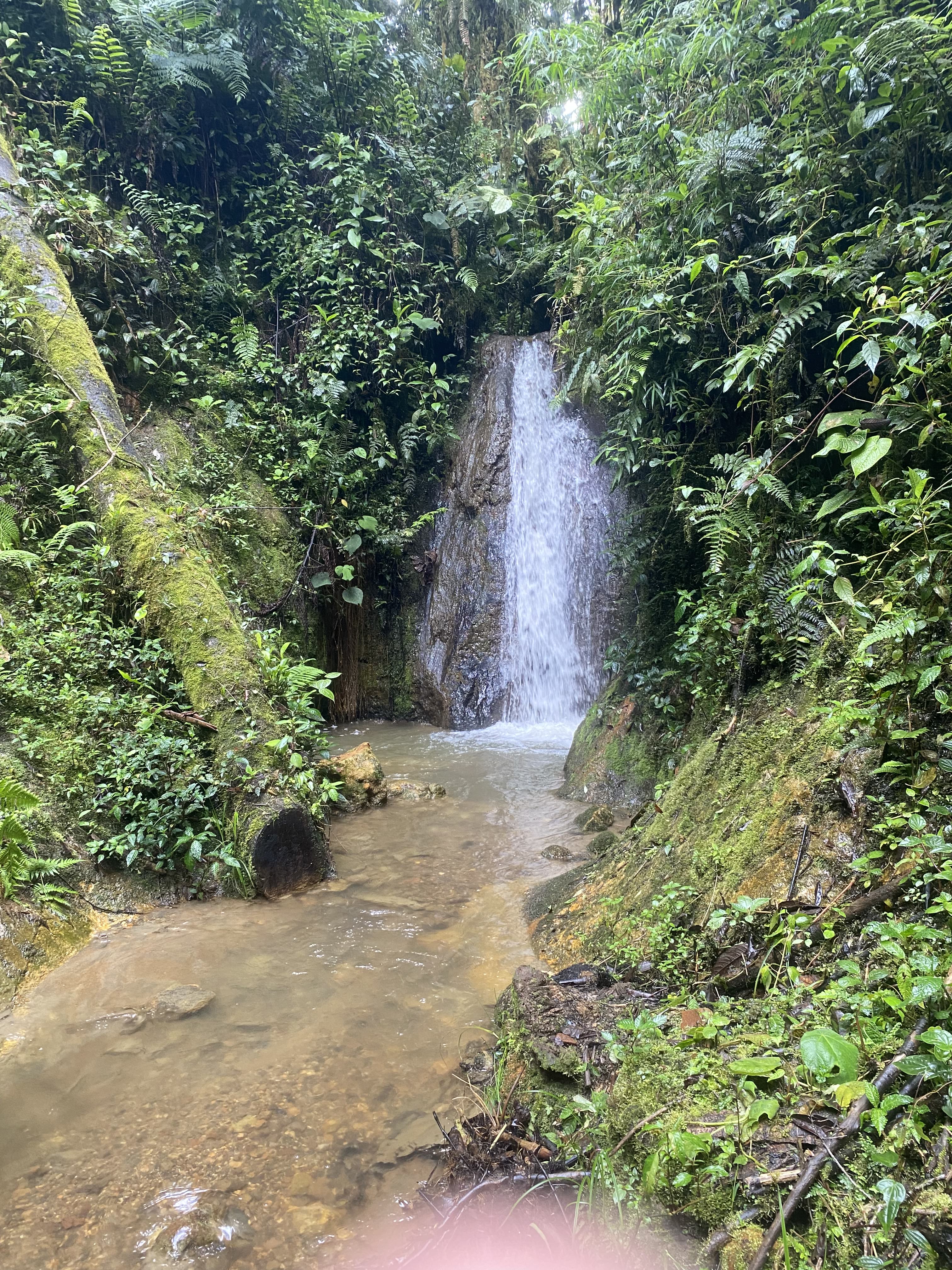
We explored a waterfall near San Isidro Lodge (https://cabanasanisidro.com), and we were able to observe pre-Inca pottery. At the lodge we also saw a diverse array of bird species, which was delightful! The forest’s nightlife brought us close encounters with a group of nocturnal monkeys, and to our surprise, we stumbled upon a very rare mountain tapir. The following morning we saw a small agouti (a small rodent) prowling around the lodge, and ended our adventures in the cloud forest on a high note. 

San Isidro waterfall and some of the animal diversity we observed

Continue Reading

Mapping Ancient Africa: Scientists – Alfred Houngnon

August 15, 2023
WDG

My name’s Alfred Houngnon, native of Benin Republic in West Africa. I hold an agricultural engineering degree in “Rangeland Management and Conservation” (Abomey-Calavi University). After gaining relevant field experience, I obtained a French Government Bursary to pursue an MSc degree in “Tropical Plant Biodiversity” at Montpellier (France). There, I learned about how to use indicators of past environmental and climatic change to give insights into projected future change.

It was a great scientific experience to participate in-person at the XXI INQUA Congress 2023 in Rome (Italy). This opportunity came under the supervision of William Gosling, and with the support of the Mapping Ancient Africa (MAA) project funded by INQUA’s Palaeoclimate commission (PALCOM). I have been working with Will for a number of years and published a first paper related to this work in 2021; a checklist of vascular plants from a ‘relict’ forest in Benin (Houngnon et al., 2021). A second manuscript is under development and was accepted for poster and oral presentation at INQUA 2023 congress that brought together around 4000 abstracts.

Interview 1: Alfred Houngnon (AGIR)

The bursary from the MAA project allowed me to also attend the MAA Rome workshops held at the Royal Netherlands Institute in Rome (12-13 July 2023). During the workshops, I was trained in two novel approaches to palaeoclimate modeling. The first based on interfacing paleoclimate models through the “pastclim” R package (Michela Leonardi), and the second on reconstructing palaeoclimates on the basis of ancient pollen data using the “CREST” program (Manu Chevalier). The workshops helped me to sharpen the communication of my ideas and in so doing strengthened the manuscript in preparation for submission to an international journal for publication.

Continue Reading

Lost forests of the Netherlands

June 13, 2023
WDG

The June 2023 meeting of the Dutch palynological society (Palynologische Kring) took place at the offices of the Dutch National Cultural Heritage Agency (Rijksdienst Cultureel Erfgoed) in Amersfoort. The focus of this meeting was the past forest landscape of the Netherlands. The meeting included the annual report of the society, three scientific talks, and a prize giving for the best MSc thesis.

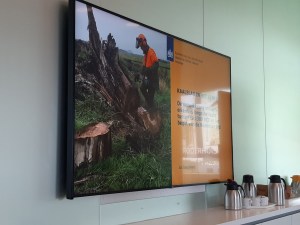
Presentation of Jos Bazelmans showed the huge amount of woody material extracted from Dutch peat bogs.

The annual report of the society showed a healthy finances and membership (>100 members). Two key events from last year were the award of the societies highest award, the Jongmanspenning, to Margaret Collinson for her massive contribution to the field, and the annual excursion; in 2022 this was to Leiden and included visits to Roman archaeological sites.

Kelly van Leeuwen winner of the 2023 Florschütz Award

The scientific part of the meeting was kicked off my Roy van Beek who presented results from his ongoing project on the peatlands of the Netherlands which suggest peatland expansion occurred between 5500 and 3500 years ago (van Beek et al., 2023). The second talk was by our host, Otto Brinkkemper, and traced the history of woodlands across the Netherlands on the basis of macrofossil finds; including huge tree stumps remarkably preserved in peatlands (Bazelmans et al., 2021; Kooistra et al., 2006). The final talk was given by Jos Bazelmans who showed the remarkably high volume of tree stumps that have been recovered from the Netherlands, and how tree rings from these 100s of record are being used to reconstruct forest histories and past climate change. It was interesting to hear that the average age of the tree stumps found was around 250 years, and that some of the trees had lived to around 400 years in exceptional cases.

Kelly with her proud supervisors Stefan Uitdehaag (right), and I (left)

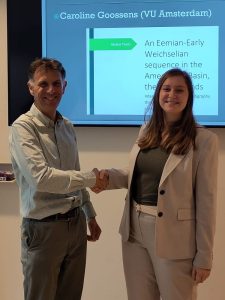
The final section of the meeting was the prize giving. Corrie Barkels, on behalf of the independent judging panel, announced Kelly van Leeuwen as the winner for her thesis entitled “Using soils samples and footwear to improve forensic palynology”. Her thesis was conducted at the University of Amsterdam as part of her MSc Earth Sciences degree and was conducted in collaboration with the Netherlands Forensic Institute. Congratulations Kelly!

Continue Reading

Bison of the Maashorst (Netherlands)

May 17, 2023
WDG

On Tuesday 16 May 2023 a small team of researchers from the Institute for Biodiversity & Ecosystem Dynamics (University of Amsterdam) visited the Maashorst (Netherlands) to visited an area “re-wilded” with European Bison (Bison bonasus). In addition to the bison the area is also now home to Tauros and Exmoor Ponies The purpose of the trip was to collect soil surface samples to examine for dung fungal spores. Certain fungi grow only on the dung of herbivores and the spores of these fungi can be preserved in the sedimentary record (for more information see Lee et al., 2022). Analysis of dung fungal spore diversity through the sedimentary record can therefore provide insights into the changes in the amount of dung (animals) in the landscape in the past. The purpose of this sampling effort was to see if we can quantify how many, and what type, of spores are representative of this group of bison. This information will help us to be able to interpret ancient records of fungal spores in more detail.

Special thanks to Maurice van Doorn (Gemeente Maashorst) for showing us around.

#Train2EGU and back

April 27, 2023
WDG

The European Geophysical Union General Assembly is taking place in Vienna this week (23-28 April 2023). Thousands of scientists from around the world have come together at the Austria Centre to discuss the latest discoveries related to our understanding of how the Earth system functions. This year I choose to travel to EGU by train from Amsterdam. It was not until later that I discovered that #Train2EGU was a “thing” (see photos below). I was not able to stay in Vienna for the whole congress so I am now back in Amsterdam. However, my time at the congress was excellent:

  • Listening to a wide range of talks (including sessions on past environmental change in Africa, the role of fire in shaping ecosystems and landscapes, and how we can develop new methods to extract information from sedimentary records),
  • Holding in-person scientific meetings with colleagues to try and figure out what the datasets mean on various projects (mainly focused on wiggly lines generated from long lake records), and
  • Meeting up with friends and colleagues who I had not seen for many years…

I hope all those still at EGU are having fun. While I see the necessity of scientists to get together in the same physical space to advance our field I also see the tension with the environmental impacts of travel. Getting together at big congresses such as this maybe the most travel efficient way to solve this conundrum? Anyway, I hope at least people think about their travel plans and I for one enjoyed by #Train2EGU experience; all connections met and – apart from 1 hour of very crowded conditions after leaving Frankfurt – a very pleasant experience in which I could easily work / sleep / eat.

My route out: Bussum – Amsterdam – Frankfurt – Vienna. My route back: Vienna – Frankfurt – Utrecht – Hilversum – Bussum.

Landscape Dynamics in an era of change

March 15, 2023
WDG

The course “Landscape Dynamics in an era of change: Learning from the past to face the future” took place in the Drakensberg Mountains of South Africa between 5 and 15 March 2023. The course was run by the Graduate School for Production Ecology and Resource Conservation (PERC) and participants were drawn from universities in the Netherlands and South Africa. The main goal of the course was to investigate the past and current dynamics of the region and predict possible futures in an inter- / trans-disciplinary context. Consequently the content of the course was incredibly diverse including: geology, geomorphology, palaeoecology, cultural history, vegetation studies, soil science, farming systems and forestry. These topics were integrated into four group projects centered on invasive species, rewilding, commercial farming and small scale farming.

MSc track Environmental Management

February 27, 2023
WDG

The “Environmental Management” track of the University of Amsterdam MSc Earth Sciences program is the more applied sister to the Earth System Science track. The Environmental Science track is focused on the solutions to societal challenges that can be gained from the Earth sciences. Drawing on linkages with social sciences you will gain a broad interdisciplinary training covering topics including: urban-ecological development, human-wildlife conflicts, and the climate crisis. During the degree you will work with researcher within the interdisciplinary Institute for Biodiversity & Ecosystem Dynamics (IBED), carry out an independent research project, and an internship at a societal facing organisation.

  • Energy and Climate Change: Investigate the relationship between climate change and energy systems, and confront the challenges of creating a decarbonised world.
  • GIS and Remote Sensing in Ecosystem Dynamics: Learn how to use large remotely sensed datasets to gain insights into geological, geomorphological and soil systems.
  • Integrated Coastal Dune Management: Explore the concept of “Resilience Thinking” in tacking the complex management task of protecting the Dutch coastline and its ecosystems.
  • Metropol Ecology: Focused on the part of the Earth system where people are, investigate biodiversity and ecosystems in urban systems and mega cities.
  • Science Based Geo-ecological Management: How can science guide environmental management, address key challenges of supporting society, includes field visit to Oostvardersplassen.
  • System Innovation and Transition Management: Climate, energy and agricultural systems are all changing discover how understanding their dynamics is important for governance and sustainability.
  • Click here for further details and a full list of courses.
Environmental management of high Andean ecosystems. During the field school in Peru MSc Earth Science students work with locals and NGOs to improve practices (click here to find out more)

The Environmental Management track can be taken in conjunction with the “Science for Sustainability” minor offered by the Faculty of Science, or other free elective courses to broaden your program.

During the course you will do an internship to get direct experience of working outside academia. Organisations hosting internships in recent years have included:

MSc track Earth System Science

February 17, 2023
WDG

At the University of Amsterdam the MSc Earth Science is split into two tracks, one of these is entitled: “Earth System Science”. Earth System Science is a research intensive track focused on understanding the fundamentals of abiotic and biotic interactions across the globe and through time. During this degree you will spend around 6 months studying to pick up specialist knowledge and skills, and around 18 months actively developing yourself – in your key areas of interest – through project work.

The taught part of the Earth System Science track includes courses such as:

  • The Earth System: Learn how to analyse Earth system function across space and through time.
  • Analysis & Modelling Lab: Develop skills in data handeling, analysis and modeling relevant to Earth science.
  • Biogeochemical Cycles in the Earth System: Study how the dynamics of carbon and nitrogen link to societal challenges.
  • Climate Change: Explore the scientific basis for climate change an its implications for the environment and society.
  • Environments Through Time: Consider and analyse environmental change on timescale relevant to landscapes, societies and climates.
  • GIS and Remote Sensing in Ecosystem Dynamics: Learn how to use large remotely sensed datasets to gain insights into geological, geomorphological and soil systems.
  • Click here for further details and a full list of courses.
Clare Lee (on one leg, left) during field course in Peru successfully published her literature review which she conducted as part of her MSc in Earth Sciences at the University of Amsterdam.

In addition, free elective courses are possible from across the University of Amsterdam, or at other approved organizations or universities, i.e. it is possible to pick up skills in other specialisms (for example in languages, AI, or programming), or study a course at a university abroad, and have this included within your University of Amsterdam MSc Earth Science degree.

The project part of the Earth System Science track includes two research projects, or one research project and one internship with an external organization (such as a company or NGO). MSc research projects are often closely linked to active research within the Institute for Biodiversity & Ecosystem Dynamics. Some projects and literature reviews conducted by our MSc researchers reach a high enough level to be published in international scientific journals, either on there own or as part of a wider collaboration. Examples of recent papers including MSc researchers (highlighted in bold) are:

  • Lee, C.M., van Geel, B. & Gosling, W.D. (2022) On the use of spores of coprophilous fungi preserved in sediments to indicate past herbivore presence. Quaternary 5, 30. DOI: 10.3390/quat5030030
  • de Nijs, E.A. & Cammeraat, E.L. (2020) The stability and fate of Soil Organic Carbon during the transport phase of soil erosion. Earth-Science Reviews 201, 103067. DOI: 10.1016/j.earscirev.2019.103067

New Look MSc Earth Sciences (University of Amsterdam)

February 8, 2023
WDG

The MSc Earth Sciences at the University of Amsterdam has a new look for the start of the next academic year (starting September 2023). Drawing on the international research expertise of our staff it is now possible to tailor your studies within two complementary tracks:

  • Earth System Science: Focused on fundamental aspects of Earth science, such as biogeochemical cycles, climate dynamics, and past environmental change. Our education follows our research in exploring how abiotic and biotic elements of the Earths system interact through time and across the globe.
  • Environmental Management: Focused on the interface between Earth science and society, key topics include: management of coastal systems, ecosystem dynamics in urban environments, and the relationship between science policy and ethics. During your internship you will have the opportunity to engage with societal partners to develop skills and projects.
Judith Kirschner completed a MSc Earth Science project on past fire activity, and now is a PhD researcher in fire dynamics at the European University of Cyprus.
Mo Adam examining sediments in the high Andes during the MSc Earth Science Geo-ecosystem Dynamics field course in Peru (2022).

For both tracks education is delivered through lectures, field courses, laboratory practical’s, and data analysis. Furthermore, you will get the chance to develop your own research agenda by conducting a project with one of our scientists, or at an external partner or university. In addition to expert knowledge our graduates have transferable skills in data handeling, numerical analysis, and science communication.

To find out more about our program visit click here to visit the MSc Earth Sciences pages on the University of Amsterdam web site.

Blog at WordPress.com.