Palaeoecology at UvA and Twente 2015: Teaching and Learning

September 21, 2015
cmcmicha

By Crystal McMichael

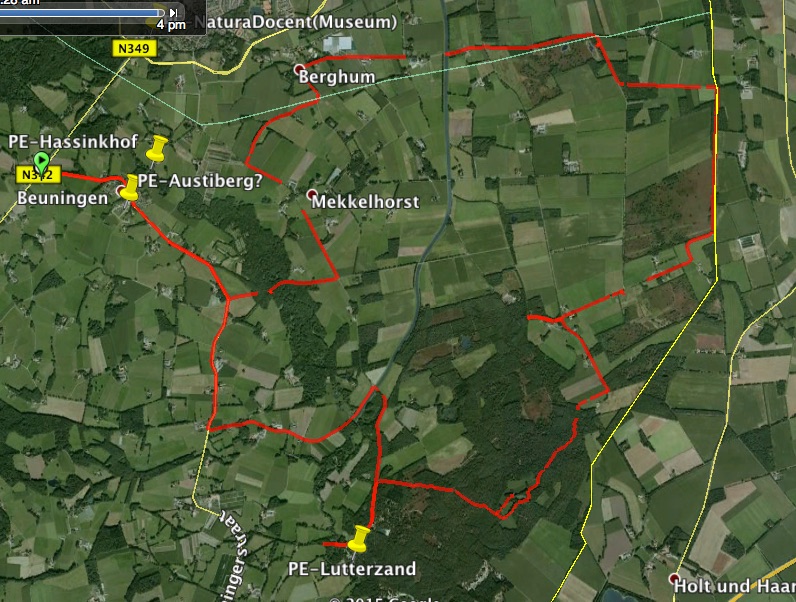
The month-long palaeoecology module at UvA is coming to an end. We have had two weeks of lectures and microscope work, an introduction to quantitative palaeoecology, and we just finished a week of fieldwork in Twente, which is in the easternmost part of the Netherlands.

Students working in the field (photo: M. Groot)

Students working in the field (photo: M. Groot)

Will Gosling and I tried something new for the field excursion this year. We split the class into eight groups, and gave each group a set of pollen and phytolith samples from an ‘unknown location’. Unknown in this context means being from one of the eight primary sites that we would visit during the field excursion. The students were required to perform vegetation surveys and characterize soils at each of the primary sites that we visited. The goal of each group was to figure out which location their set of ‘unknown’ samples came from. Basically, we had them doing forensic palynology, with idea that they could then better visualize the different vegetation assemblages seen in the palaeoecological records.
Continue Reading

Andean bear

April 30, 2015
WDG

WDG's avatarPalaeoenvironment

Bear-zoomOn our first field day three of the XPERT team (Valerie, Barry and Sarah) claim  they saw an Andean or spectacled bear (Tremarctos ornatus) in the paramo of the Cayambe-Coca National Park… Valerie did manage to provided some supporting evidence in the way photos.

An Andean bear, or a black dog? An Andean bear, or a black dog? (photo: van den Bos)

For more information on Andean bears visit: Andean bear foundation

View original post 20 more words

Sediment coring in Lake Erazo

April 14, 2015
WDG

XPERT field school is underway…

stxal8's avatarPalaeoenvironment

Lake Erazo Sediment coring on Lake Erazo. Photo by Valerie van den Bos (who spent the flight over reading a book on how to take the perfect photo)

By Alexandra Lee and Nick Primmer

To study the palaeo-environmental record of the Andean cloud forest, sediment cores were taken from the recently discovered Erazo lake. In mixed conditions of blazing sun and pouring rain, 14 researchers, one bus driver and several Ecuadorian guides hauled what felt like a ton of equipment up to the lake 2,300 m asl. In the centre of the lake, a wooden coring platform was mounted between two boats securely anchored at three positions. Using a modified Livingston corer with a drop hammer, five cores were successfully recovered from the lake up to a maximum depth of two metres. The main challenge encountered was the stability of the platform which resulted in several complications limiting the number of cores…

View original post 29 more words

Tropical Botany in Belize: Part 2 – Las Cuevas

April 1, 2015
nicholasloughlin

Tropical Botany in Belize

By Nick Loughlin

Las Cueavs Forest Reseach Station (Photograph by Anna Turbelin)

Figure 1: Las Cueavs Forest Reseach Station (Photograph by Anna Turbelin)

As mentioned in my last post I have recently returned from a 2 week field course in tropical botany run by the Royal Botanic Garden Edinburgh (RBGE) in conjunction with their MSc course on the ‘Biodiversity and Taxonomy of Plants’. The field course allowed for 10 NERC funded PhD students in relevant fields to accompany the MSc students out to Belize to learn a host of valuable skills in tropical botany and ecology.

To find out what we did read on…

Continue Reading

Netherlands Annual Ecology Meeting 2015

February 13, 2015
WDG

NERN-NWO-ELIFE-NECOV_2015Netherlands Annual Ecology Meeting
10-11 February 2015
by William Gosling

On Wednesday I attended my first Netherlands Annual Ecology Meeting (NAEM) unfortunately, due to prior commitments, I was not able to attend the whole event, but I still managed to get a nice insight into the vibrant Dutch Ecological research community. Particularly exciting for me was the “Biodiversity in Space and Time” theme. Plenary sessions by Alexandre Anotonelli (University of Gothenburg) and Hans ter Steege (Naturalis Biodiversity Center, Leiden) focused on the Amazon ecology past and present. The subsequent session on the same theme, organized by Daniel Kissling (University of Amsterdam) and Niels Raes (Naturalis Biodiversity Center), was also excellent and ranged from species richness patterns past and present in Gabon (Andre van Proosdij, Naturalis Biodiversity Center), through soil microbes (Kelly Ramirez, Netherlands Institute of Ecology) to the role of sea level change on island biodiversity (Kenneth Rijsdijk, University of Amsterdam). I am looking forward to attending more of these meetings in the future and getting involved with the NERN community.

Continue Reading

Tropical Botany in Belize: Part 1 – An Introduction

February 12, 2015
nicholasloughlin

Sunrise in Belize (Photograph by Anna Turbelin)

Sunrise in Belize (Photograph by Anna Turbelin)

Tropical Botany in Belize
by Nick Loughlin

Getting back to the UK after fieldwork is always jarring and this time is certainly no different, the change from 32°C days walking through the savanna and lowland forests of Belize to the -2°C early mornings walking through snow in Milton Keynes is an abrupt transition. I have recently returned from a 2 week field course in tropical botany run by the Royal Botanic Garden Edinburgh (RBGE) in conjunction with their MSc course on the ‘Biodiversity and Taxonomy of Plants’. The field course allowed for 10 NERC funded PhD students in relevant fields to accompany the MSc students out to Belize to learn a host of valuable skills in tropical botany and ecology. During our time in Belize we visited 2 main locations, Las Cuevas Research Station within the Chiquibul forest reserve and the Rio Bravo Conservation and Management Area (RBCMA), in my next two posts I will briefly cover the places we visited and the botany we learned.

A very small selection of the plants we sampled and identified during the course (Photographs by Anna Turbelin and Nick Loughlin)

A very small selection of the plants we sampled and identified during the course (Photographs by Anna Turbelin and Nick Loughlin)

Before I get going I would just like to thank all of the staff from the RBGE who led the field course, (David, Louis, Tiina, Becky, Chris and Helen) their ability to teach the major characteristics of 70+ tropical families to many of us who are not botanists or taxonomists in an engaging way was astounding, although I don’t believe I will ever be able to identify a Euphorbiaceae from its vegetative characteristics. Also thanks to the students from the MSc course who were great fun, if any of you move away from botany and taxonomy and want more of an idea about the world of tropical palaeoecology, give me a shout.

On our way to see the Mayan ruins at Xunantunich (Photograph by Anna Turbelin)

On our way to see the Mayan ruins at Xunantunich (Photograph by Anna Turbelin)

International Biogeography Society Conference – Bayreuth, Germany

January 28, 2015
Erik de Boer

IBS LogoInternational Biogeography Society
7th biennial conference
January 8 – 12, 2015
University of Bayreuth, Germany
Report by Erik de Boer

Two weeks ago I attended the biannual International Biogeography Society (IBS) conference in Bayreuth, together with 600+ other people from more than 50 different countries. This IBS conference, my first IBS meeting, proved to be an exciting event during which I met scientists from many different disciplines and heard talks on cutting-edge biogeographical research.

The IBS conference was held in the Bavarian city of Bayreuth, in the middle of the biodiverse landscape of Upper Franconia. This landscape provided the training ground for Alexander von Humboldt, the founder of the field of biogeography. The 4-day conference included a wide variety of symposia and many, many posters. The conference dinner in the German Steam Train Museum was highly memorable. The conference was closed by a lecture from Daniel Simberloff, once a doctorate student of Edward O. Wilson, who received the Wallace Award for his outstanding contributions to invasion ecology.

Erik_PicI had a talk in the plenary symposium of ‘Ecosystem response to past climate change’, organized by David Nogués-Bravo and Francisco Rodríguez-Sánchez. The symposium covered the dangers of climate change to biodiversity and tried to assess if the range and rate of adaptation, migration, persistence, or extirpation, that are registered in deep-time records, palaeorecords, and the recent past, are adequate responses for predicted climate change in the future. I addressed this issue from the point of view of a small remote island, where migration is obviously a limiting factor. I showed how I reconstructed climate and its effect on island biota during the last 40,000 years using long-term palaeoecological records from Mauritius (de Boer et al, 2013 & 2014). These records show that different climate regimes result in different ecosystem response to climate change in the past. Local extirpation or population collapse of larger vertebrates was a natural phenomenon in the lowlands of Mauritius due to frequent climate extremes (I will discuss this in more detail in my next blog; de Boer, 2015). Despite these population collapses, island biota have always (in the timeframe of my records) survived natural climate change. Therefore, my take home message was not to focus on the effects of (future) climate change alone. Other key components of global change, such as invasive species and habitat destruction, are more imminent threats to the biodiversity of many islands. For more information on my research, including publications, click here.

More information on the IBS read on (below) or visit the IBS website or blog. All abstracts and other details of the IBS conference in Bayreuth can be found here. The next IBS meeting will take place in Salvador, Bahia (Brazil) in March 2017.

Continue Reading

Ghana 2014 – Day 14 (29/10)

November 1, 2014
WDG

wfraser2013's avatarghana2014fieldwork

Today we were based back at FORIG getting export permits, sorting out import licenses, Lottie was running through her presentation for a final time and catching up with the Oxford group who returned from a 10-day field campaign at Kogyae. We celebrated the end of the our respective fieldwork with dinner out at the Noda hotel – always a treat!

View original post

Ghana 2014 – Day 13 (28/10)

October 31, 2014
WDG

wfraser2013's avatarghana2014fieldwork

Ghana 2014 – Day 13 (28/10)

Cascades of vivid green ferns flowing down steep-sided banks on both sides (image below), branchless tree trunks extending upwards through a dense canopy to a point beyond sight – this can mean only one thing, we are in a tropical rainforest.

image

The morning started in a typical fashion for a rainforest – visibility down to approximately 20m due to a thick mist engulfing everything (image below). We had a big day ahead of us, so a very early start was necessary; 05:30 rise for a 06:30 breakfast and in the truck and rolling by 07:00 heading for Ankasa Game Reserve less than 100km from the border with Cote d’Ivoire. Having never been to a rainforest before, I was not entirely sure what to expect other than lots of lush green vegetation and high humidity, and the vague hope of catching a glimpse of a…

View original post 451 more words

Blog at WordPress.com.