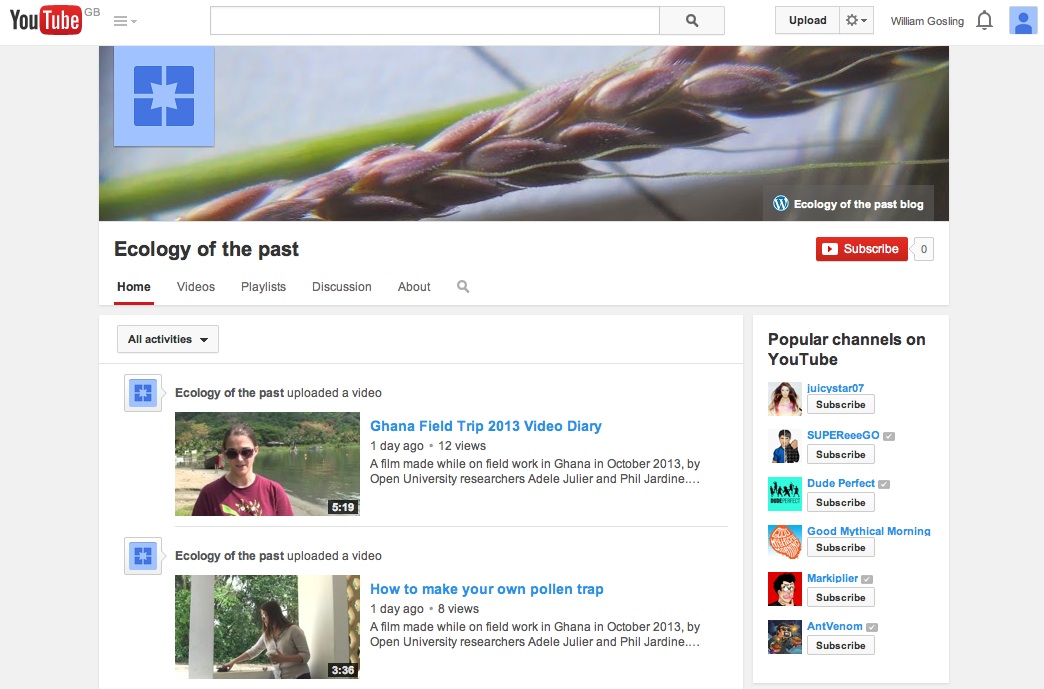
With the redesign and refocusing of the blog underway, I’m delighted to announce the launch of our very own “Ecology of the past”YouTube channel. Initially this will host videos produced as part of the Lake Bosumtwi pollen chemistry project, which includes a strong emphasis on impact and outreach activities. The videos are being targeted to a secondary school/sixth form audience, and will demonstrate both how we are doing the research and who we are as academics, highlighting the different roles and career pathways within the team. As time goes on this channel will be a platform for videos from other members of the research group, again showing who we are, what we do and how we do it.
For now, here are the first two videos: a diary of the field trip to Ghana that Adele and I went on last Autumn, and an accompanying piece showing how you too can make your own pollen trap. Enjoy!
Over the next few months the “Palaeolimnology et al.” blog will be changing. The first noticeable change will be the title of the blog to “Ecology of the past”. The idea behind changing the name is to have a title that it easily informs the reader about the broad area of our interests.
The changes have been precipitated by three key factors:
My desire to have a blog people within the Paleo and Landscape Ecology Group at the University of Amsterdam (UvA) can feel comfortable contributing to, and
The fact this blog has been running for over 3 years and it is probably time for a refresh.
Changes to the static pages and blog content will happen over the next few weeks.
I am delighted to announce that later this year I will be moving to the Institute of Biodiversity & Ecosystem Dynamics at the Universiteit van Amsterdam. I will be taking up an Associate Professor position as head of the Paleo & Landscape Ecology group. I am excited, and honoured, by this appointment and look forward to intergrating my ongoing program of research with the world class team in Amsterdam. Over the next few months I am sure further details will appear on the blog about the move as plans evolve towards my start date in September. Exciting times…
In the light of my departure, at that of Emma Sayer (bound for Lancaster), The Open University, Department of Environment, Earth & Ecosystems is now advertising two posts (details below). I have enjoyed my time at the OU and I think there are still good teaching and research opportunities for academics here. If anyone whats to contact me about the posts then I am happy to discuss.
Lectureship Environmental Science (Advert)
Lectureship / Senior Lectureship in Earth or Environmental Science (Advert)
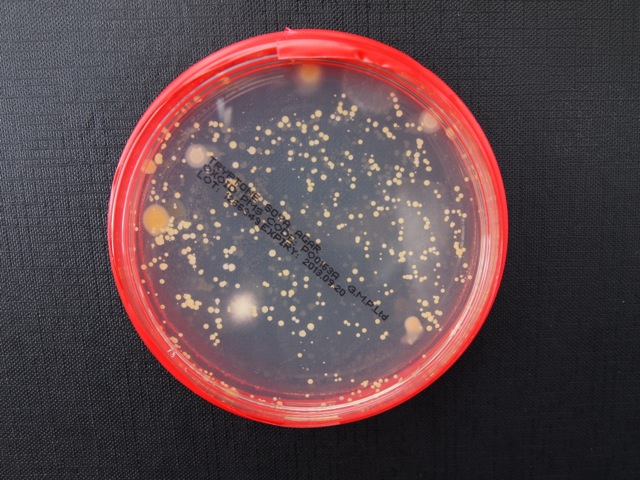
Will’s BES T-shirt logo swabbed at Greenman; for more microbes on festival kit visit the “Hall of shame” on http://www.besfest.org
August was a month for travel with PCRG members heading for Peru (Bryan, and he is still there), Greenman festival (William), INTECOL conference (William and Frazer), and the Royal Geographic Society annual meeting (William, Encarni, Frazer and Hayley). Detailed reports of the UK based travels are already on the blog, and hopefully we will get a post from Bryan on his Peruvian adventure once he is back.
Back in Milton Keynes work progressed with:
Hayley producing a revised full draft of her pollen counting methodology manuscript,
Frazer starting with the first tentative attempts to apply his chironomid training data set to fossil chironomid records,
Phil trialing inverted microscopes and training on the FTIR,
Encarni plotting field work in Ecuador (more travel for November-December),
Face-to-face teaching of practical skills in field geology is one of the most interesting and rewarding aspects of being a lecturer at The Open University. Over the last few days I have been lucky enough to participate in the running of the Sedimentary Rocks & Fossils in the Field topic within our second level Practical Science module (SXG288). This is one of two opportunities that students taking this module get to head into field, examine rocks, develop observational skills and test scientifc hypotheses; the other field based topic is Igneous & Metamorphic Rocks in theField.
Sedimentary Rocks & Fossils is based from Longridge Towers School in Northumberland (whilst the regular students are away). Longridge provides the ideal base for this topic because of its close proximity to some world class sedimentary rock and fossil exposures. Over an intensive three day field experience students examine sedimentary deposits from the Silurian and Carboniferous exposed mainly along the Northumberland coast; however, this is not a simple guide to the geology of the region. The topic is founded on the principle of problem based learning and at each field location students are expected to make observations, record them accurately and interpret the past environment. Findings are consolidated and dicussed during evening lab sessions.
On the rocks at Scremerston
This year we were delighted to welcome >40 students, some of who flew in from abroad, to study this topic over two sessions. Given the positive feeback recieved so far I think all enjoyed the topic and gained important geological field skills (for evidence of this also see photos below). I wish them all luck in their future studies and hope that they continue to be interested in Earth Science and progress towards our Natural Science degree qualification.
For further photos see below, follow #SXG288 on twitter, or visit the SXG288 Facebook page.

 Over the next few months the “Palaeolimnology et al.” blog will be changing. The first noticeable change will be the title of the blog to “Ecology of the past”. The idea behind changing the name is to have a title that it easily informs the reader about the broad area of our interests.


 Ecology of the past