The second part of our Ecuadorian expedition took in lakes and sections close to the towns of Papallacta and Cosanga. The variation in climatic conditions was marked as we experienced first hand the transition from freezing fog and driving rain to burning sun and heat within a few tens of kilometers as we travelled from >4000 m down to around 1000 m elevation.
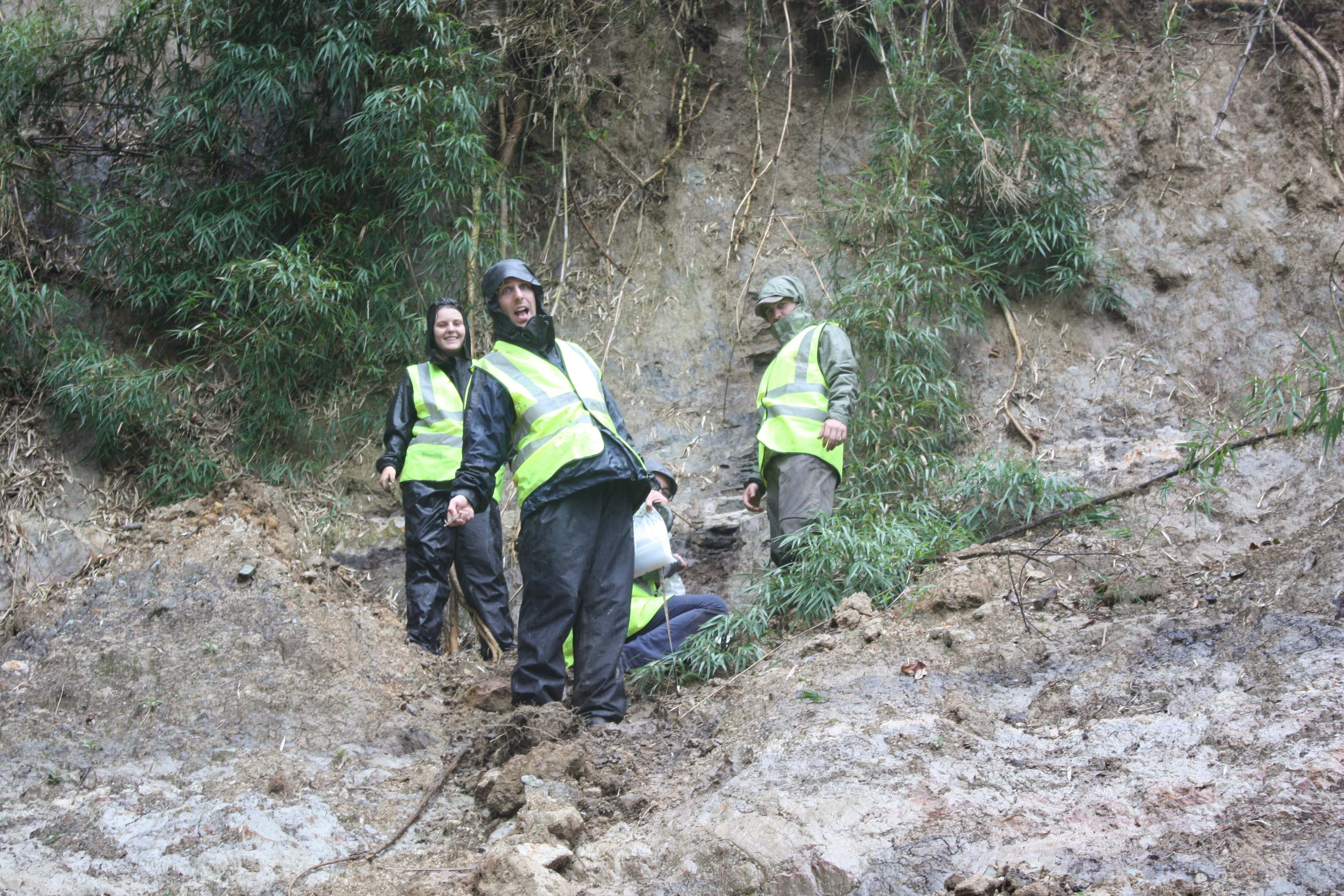
Sampling the sedimentary section at Vinillos was hampered by a tropical downpour. Sediments recovered from here include volcanic ash, mud slide deposits including large wood macrofossils and fine grained organic sediments probably deposited in still water environments.
Preparing to recover a short core from a pond near the antenas at Cujuca. Short cores will be used for Chironomid analysis.
Tomorrow we will attempt to recover short cores from two more lakes. Then our final few days here in Ecuador will be spent visiting partners and packing up.
Particpants on the Numerical Analysis course 2012: Lottie Miller, Guiomar Sanchez, Maria Rubio, John Douglass and Sonia Jaehnig (left-right). Photo courtesy of Manuela Milan.
The course provided an introduction to the methods, guidance as to when to use the techniques and then outlined the assumptions, limitations and strengths of the various methods. The need to fully understand the techniques applied before attempting to critically evaluate the results was also strongly emphasised.
The course consisted of lectures covering measures of dispersion, cluster analysis, dendrograms, regression analysis, tree models, gradient analysis, transfer functions, time series and hypothesis testing. Afternoon practical computer classes involved using R, C2 and CANOCO to implement the various techniques covered in the lectures.
Overall the course was a great introduction to statistical analysis which I would certainly recommend for anybody working with complex and noisy datasets. In the next few days I will be using my newly learnt R skills to run indirect gradient analysis such as PCA, CA, DCA and NMDSCAL to search for environmental gradients within my data.
Numerical Analysis of Biological and Environmental Data training couse is an annual event and was held at UCL, on 14-25th May 2012. For more information about the course see Gavin’s website or read his blog From the bottom of the heap.
Amazonia before Columbus – Virgin Wilderness or Domesticated Landscape? Francis Mayle (University of Edinburgh)
Tuesday 22nd May, 11.15am
The Open University, Milton Keynes
Abstract Amazonia has long been considered to be a pristine wilderness, largely untouched by human activity, supporting small, scattered indigenous tribes living in harmony with their rainforest environment.
However, recent discoveries of massive geometric earthworks, revealed by deforestation in recent decades, are challenging this ‘virgin wilderness’ paradigm and pointing to substantially greater environmental impacts by pre-Columbian societies than previously supposed.
In my talk I review these archaeological discoveries and discuss how a combined palaeoecological-archaeological approach has the potential to resolve the scale of environmental land use and disturbance associated with these ancient cultures. I also consider the implications of these findings for understanding rainforest ecology and biodiversity, as well as conservation policy.
If you are external to The Open University and wish to attend this lecture please contact William Gosling in advance.
JUST PUBLISHED
Bush, M.B. & Gosling, W.D. (2012) Environmental change in the humid tropics and monsoonal regions. The SAGE handbook of environmental change: Volume 2. Human Impacts and Response (ed. by J.A. Matthews, P.J. Bartlein, K.R. Briffa, A.G. Dawson, A. De Vernal, T. Denham, S.C. Fritz and F. Oldfield), pp. 113-140. SAGE, London. ISBN: 978-0-857-02360-5
This small (about 30 attendees) workshop brought together academic researchers mainly working in the field of past environmental change to discuss the use, and potential use, of data sets in understanding the key environmental challenges facing society. The bulk of the discussion took place with reference to ‘ecosystem services’. Three types of ecosystem service were mentioned early on for which it was thought that the fossil record can provide a unique long term perspective (beyond historical records): 1) provisioning services (e.g. food, timber, biofuels), 2) regulating services (e.g. carbon), and 3) cultural services (e.g. national parks, tourism).
Below I will summarize some of the issues discussed. Please note that this does not cover the full range of discussion or all of the many high quality contributions. For further information click here to visit the workshop web page.



 Ecology of the past